When Photojournalists Forget the Words

Reading Time: 4 minutes

Over the years, I’ve noticed something interesting when photojournalists present their work at conferences or workshops.

Many of them rely heavily on writers to tell the story.

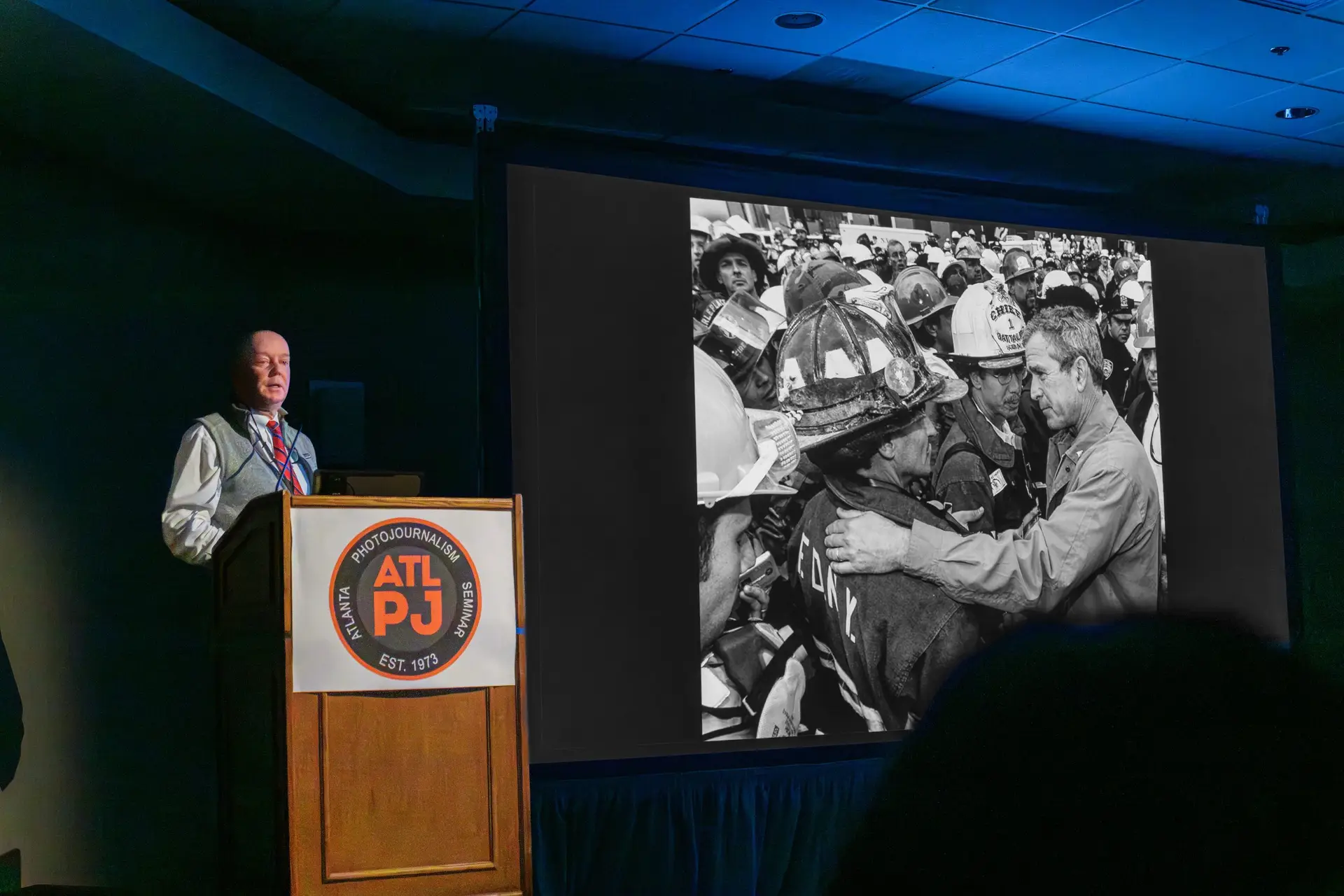
For this story, I selected photos from two of today’s top photojournalists, Doug Mills and Carol Guzy, who consistently put the subjects first. When they present, they don’t just show images—they tell the story of the people in their photos and then add the context that brings the work fully to life.

That’s not unusual in newsrooms. In newspapers and magazines, the partnership between a reporter and a photographer can be incredibly powerful. The writer provides depth, context, and explanation. The photographer provides the emotional entry point—the moment that pulls the reader into the story.

When it works well, the two are married together beautifully.

But something often gets lost when photographers present their work on their own.

They show powerful images on the screen, but the audience only hears fragments of the story. Instead of hearing about the people in the photos, the presentation becomes more about the photographer’s experience—how they got access, how hard the assignment was, or what challenges they faced making the picture.

Meanwhile, the audience is left trying to figure out what is actually happening in the story.

The problem is simple: the audience never saw the original package.

They didn’t see the full article that the writer produced. They didn’t read the background reporting. They didn’t get the captions in context with the larger narrative.

All they see is the photo.

And if the photographer doesn’t fill in the story, no one else will.

The Photographer Still Carries the Story

Even when a writer originally tells the story in print, the photographer still bears responsibility for it.

Why?

Because the images exist because of the people in them.

Photojournalists aren’t just creating interesting pictures. They are documenting someone else’s life, struggle, celebration, or moment in history. The photos only matter because of the human story behind them.

If we fail to tell that story when we have the microphone, we miss the very reason the photograph exists.

Don’t Let the Photos Become Window Dressing

Sometimes presentations unintentionally turn photographs into visual decoration.

The images serve as slides in the background while the photographer mostly talks about themselves.

But photojournalism was never meant to be about the photographer.

It’s about the subject.

The person whose life intersected with the camera.

When we show our work publicly, we are being trusted again with that person’s story. The least we can do is make sure the audience understands who they are and why their story matters.

Tell the Story First

One simple shift can make presentations far more powerful:

Tell the story first. Then share the backstory.

Introduce the people in the photographs.

Explain what is happening in their lives.

Help the audience understand the stakes, the emotions, and the context.

Once the audience understands the story, then it becomes meaningful to hear how the photographer found it, gained access, or overcame obstacles to document it.

But the story must come first.

Otherwise, the audience is just looking at pictures without understanding why they matter.

Carol Guzy speaks at the Atlanta Photojournalism Conference 2025, sharing the stories behind her photographs and reminding the audience that the power of photojournalism begins with the lives of the people in front of the lens.

Why Journalists Must Seize Every Opportunity to Tell the Story

Every time journalists speak publicly, they have an opportunity—and a responsibility—to tell the subject’s story.

There are several reasons why this matters.

First, many people will never encounter the original journalism.
Most stories today have a short life in print or online. A presentation may reach people who have never seen the article or publication where the work first appeared.

Second, storytelling preserves the dignity of the subject.
When we tell the full story, we help the audience see the person behind the photograph—not just the moment that was captured.

Third, it keeps journalism focused on its purpose.
Journalism exists to inform the public and help people understand the world around them. If the focus shifts entirely to the journalist, we’ve lost sight of that mission.

Finally, it honors the trust people gave us.
The people we photograph often allow us into vulnerable moments of their lives. When we share those images publicly, we owe it to them to make sure their story is told clearly and truthfully.

The Photograph Is the Doorway

A great photograph is often the doorway into a story.

It grabs attention. It creates curiosity. It invites people to ask questions.

But the photograph alone is rarely the whole story.

That’s where the journalist comes in.

When photographers stand in front of an audience, they are no longer just showing pictures. They are serving as the storyteller who helps the audience understand what they are seeing.

And when we do that well, the photographs become far more than images on a screen.

They become a window into someone else’s life.

Tagged : / /

Celebrating Visual Storytelling at UTC’s 10th Annual Photo Night

Reading Time: 4 minutes

Yesterday I had the privilege of being part of something special at the University of Tennessee at Chattanooga. The Communication Department hosted the 10th annual Photo Night, a celebration of visual storytelling that brought together professional photographers, filmmakers, students, and the Chattanooga community.

The day started with workshops where professionals shared their experiences and insights with students who are just beginning their journeys into visual storytelling. Events like this matter because they create space where working professionals can pass along both the craft and the heart behind the work.

The evening program, held in the Roland Hayes Concert Hall at UTC’s Fine Arts Center, felt a bit like a visual storytelling version of a late-night talk show. Each presenter shared stories from their work, giving the audience a glimpse into the moments behind the images.

The lineup of speakers reflected just how strong the storytelling community is:

  • Kathleen Greeson, a Chattanooga documentarian and photographer whose work has explored important social issues, including her current long-form documentary project examining rural health and hospital closures in Tennessee.
  • Brynn Anderson of Associated Press, who regularly covers major sporting events around the world, including the Super Bowl, World Series, Olympics, and NCAA Final Four.
  • Chris Shaw, founder of Final Flash Productions.
  • Blake Davis, founder of Bloom Video Production.
Billy Weeks interviews Chattanooga photojournalist and documentarian Kathleen Greeson during the 10th Annual Photo Night at the University of Tennessee at Chattanooga. Greeson shared insights from her career in visual storytelling and previewed her current long-form documentary project exploring rural health care and hospital closures across Tennessee.

The event was hosted by photojournalist and UTC lecturer Billy Weeks, who founded Photo Night and continues to lead the program. Billy often describes the evening as more of a storytelling show than a lecture, and that description fits perfectly.

But what makes Photo Night unique is that the students are truly the stars.

Billy Weeks interviews Blake Davis, founder of Bloom Video Production, during the 10th Annual Photo Night at the University of Tennessee at Chattanooga. Davis shared stories from his journey building a production company and discussed the creative and technical challenges of producing compelling video content for clients.

Throughout the evening, the audience saw students in UTC’s Rising Rock program produce their work. These stories are powerful examples of what happens when young storytellers are given mentorship, real-world experience, and the opportunity to pursue meaningful stories.

Chris Shaw, founder of Final Flash Productions, shares stories from his work during the 10th Annual Photo Night at the University of Tennessee at Chattanooga, giving the audience a behind-the-scenes look at the creative process and challenges of producing compelling visual stories.

More than 500 people attended the event, filling the hall with photographers, journalists, students, and members of the community. There were moments of laughter, moments of reflection, and stories that clearly moved the audience.

The tables were turned on Billy Weeks and Delaney Holman, head editor for Rising Rock, who interviews him, and here he is talking about a photo he took last summer in Kenya.

Billy summed it up best in a note he sent to the speakers afterward. He wrote that students were still talking the next day about what they saw—but more importantly about what they felt. For those of us who believe in the power of visual storytelling, that’s the real goal.

Mark Gilliland discusses his long-term documentary project on the rodeo in the Chattanooga, Tennessee, area over the past 25 years.

For me, it was a joy to share some of my own work and to spend time encouraging students preparing to enter the profession. After more than four decades working as a visual storyteller, I still believe one of the most important things we can do is invest in the next generation.

Alison Gerber, the editor of the Chattanooga Times Free Press, talks about where the industry is now in journalism, the emergence of “News Deserts,” and the many ways the industry is exploring to fund journalism going forward.

Photo Night has now celebrated ten years, and if last night was any indication, the future of visual storytelling is in very good hands.

I was the first speaker at 9 am, presenting on Business and Marketing Skills for the Photographer.

Here is a link to the PDF of the presentation I made if you care to see it. https://stanleyleary.com/marketing/

Tagged : / /

What You Should Be Working on to Become a Photojournalist

Reading Time: 4 minutes

If you want to become a photojournalist, you need to understand something up front: this isn’t about taking pretty pictures. It’s about telling stories that make people feel something.

And that requires two things working together all the time—technical mastery and emotional intelligence.

Let’s start with the foundation.


Master the Technical First

Before anyone trusts you with their story, you have to prove you can handle the tools.

You should be completely comfortable with:

  • Shooting in manual mode
  • Working in changing light
  • Using on-camera flash
  • Using off-camera flash
  • Balancing ambient and strobe
  • Freezing action and working with motion blur
  • Exposing for skin tones in difficult environments

Flash, especially, is something many new photographers avoid. Don’t. Learn it. Master it. Understand how to shape light, control direction, and create depth. If you can walk into a dimly lit room and confidently light a scene without overpowering it, you’re already ahead of most beginners.

Technical skill builds confidence. But it doesn’t build a connection.

That’s the next step.


Don’t Just Practice Photography — Create a Photo Story

One of the best things you can do is produce a photo story about something you genuinely care about.

Not because it will go viral.
Not because it will win awards.
But because you care.

People will not hire you to cover their passions until they see that you can cover a story with emotional depth. They don’t want a collection of well-exposed images. They want to see that you understand how to engage a viewer.

And here’s the key:

A photo story is not just a checklist.

It’s not simply an assignment where you gather a few wide shots, a couple of details, and a portrait.

It’s about emotion.

Memorial Day @ Georgia National Cemetery

The Difference Between a Shot List and a Story

Now, let’s be clear—shot lists matter.

A strong photojournalist understands narrative structure and plans accordingly. A solid shot list for a story typically includes:

  • Establishing Shot (Wide Shot): Sets the scene and gives context.
  • Medium Shots: Connects the viewer to the subject and shows activity.
  • Tight/Detail Shots: Adds emotional depth and meaningful context.
  • Portrait(s): Captures the key individual(s), often in their environment.
  • Action/Interaction Shot: Shows movement, behavior, and purpose.
  • Conclusion Shot: Brings closure to the narrative arc.

You also want variety—high angles, low angles, eye level. You research beforehand. You anticipate moments.

That’s good journalism.

But here’s where many beginners stop: they check off the list and think they’ve told a story.

They haven’t.

They’ve gathered parts.

A story emerges when those parts work together emotionally.


Susan Fonseca, who was helping with translations and organization for the President of Honduras, Juan Orlando Hernández, takes a selfie with the CEO of Delta Air Lines, Ed Bastian.

Why Emotion Matters (And What Simon Sinek Teaches Us)

I often think about this through the lens of Simon Sinek and his “Golden Circle” concept—Why, How, What.

He connects this idea to how our brains work:

  • The Neocortex handles rational thought and language. That’s the “What.”
  • The Limbic System drives feelings, trust, loyalty, and decision-making. That’s the “Why” and the “How.”

Here’s the fascinating part: the limbic system has no capacity for language. That’s why we say, “It just feels right,” but struggle to explain why.

When you communicate from the outside in, what do you first appeal to? Logic.

When you communicate from the inside out, why first—you appeal to emotion.

Great photojournalism works the same way.

If your images only communicate the “What,” viewers may understand the information.

But if your images communicate the “Why,” they feel it.

And feeling drives action.

Publications, nonprofits, brands—they all need images that move people emotionally. That’s what influences decisions, donations, loyalty, and trust.


Jesus & Gloria say goodbye to their son before the funeral service for Jesus Fonseca, Jr.

Treat Every Assignment Like a Story

Whether you’re covering a football game, a city council meeting, a nonprofit event, or a portrait session—approach it like an essay.

An assignment is often defined by the client’s needs:

  • “We need a headshot.”
  • “We need event coverage.”
  • “We need photos for the website.”

A story asks deeper questions:

  • What’s at stake?
  • Who is affected?
  • What emotion defines this moment?
  • Why should anyone care?

When I shoot, I absolutely work through the shot list in my head. I want my wide, medium, tight, action, portrait, and closing frames.

But I’m not just checking boxes.

I’m watching faces.
I’m listening to the tone.
I’m paying attention to body language.
I’m waiting for the moment when the story reveals itself.

That’s when journalism happens.


Start Narrow. Then Expand.

Photojournalists are asked to cover everything—politics, sports, features, breaking news, and human interest.

That can feel overwhelming.

Start with one area. Master it. Build depth. Learn how to tell that type of story well.

Then expand.

Over time, your portfolio should show range—but each section should still demonstrate emotional depth, not just technical competence.


The Biggest Thing Missing in Most Beginner Portfolios

If I had to name the number one thing lacking in most new photojournalists’ portfolios, it’s this:

Emotional connection.

The images are sharp.
The exposure is solid.
The composition is fine.

But I don’t feel anything.

The photographer never stepped into the story. They never allowed themselves to feel it first.

You cannot photograph emotion you refuse to experience.

The craft of photojournalism is learning to recognize those emotional beats in real time—and then having the technical skill to capture them when they happen.

That’s the intersection.

Feel the story.
Recognize the moment.
Use your technical mastery to preserve it.

When you can do that consistently, you’re not just taking pictures.

You’re telling stories people can’t ignore.

Tagged : /

Finding Your Own Path in Photography

Reading Time: < 1 minute

James Nachtwey speaking at the Atlanta Photojournalism Seminar, 2024.
Hearing him share his life’s work reminded me why I chose this profession. His courage, empathy, and relentless pursuit of truth have shaped generations of visual storytellers — myself included. But what James did can’t be repeated. His path was uniquely his — forged by moments, conflicts, and convictions that only he could have lived. The best way we can honor that is not by trying to walk his road, but by finding our own stories to tell with the same integrity and compassion.

I’ve sat through countless presentations by incredible photographers — people whose work makes you want to grab your camera and run out the door to create something just as powerful. But I’ve learned over the years: those speakers aren’t giving you a map to follow. They’re showing you what’s possible.

Their stories are meant to inspire you, not to be copied by you.

Each has walked a road filled with unique experiences, challenges, and opportunities that shaped who they are as visual storytellers. You can learn from their techniques, admire their vision, and even borrow bits of their wisdom — but you can’t (and shouldn’t) try to live their story.

Photography is deeply personal. What you bring to a frame — your perspective, values, and curiosity— makes your work different from everyone else’s.

So as you sit in on talks or workshops, listen closely. Take notes. Let their stories spark something inside you. But when you pick up your camera again, make work that’s true to you.

“Don’t be a second-rate version of someone else; be a first-rate version of yourself.” — Judy Garland

Let their stories light your fire, not draw your outline. Your path will look different — and that’s precisely the point.

Tagged : / /