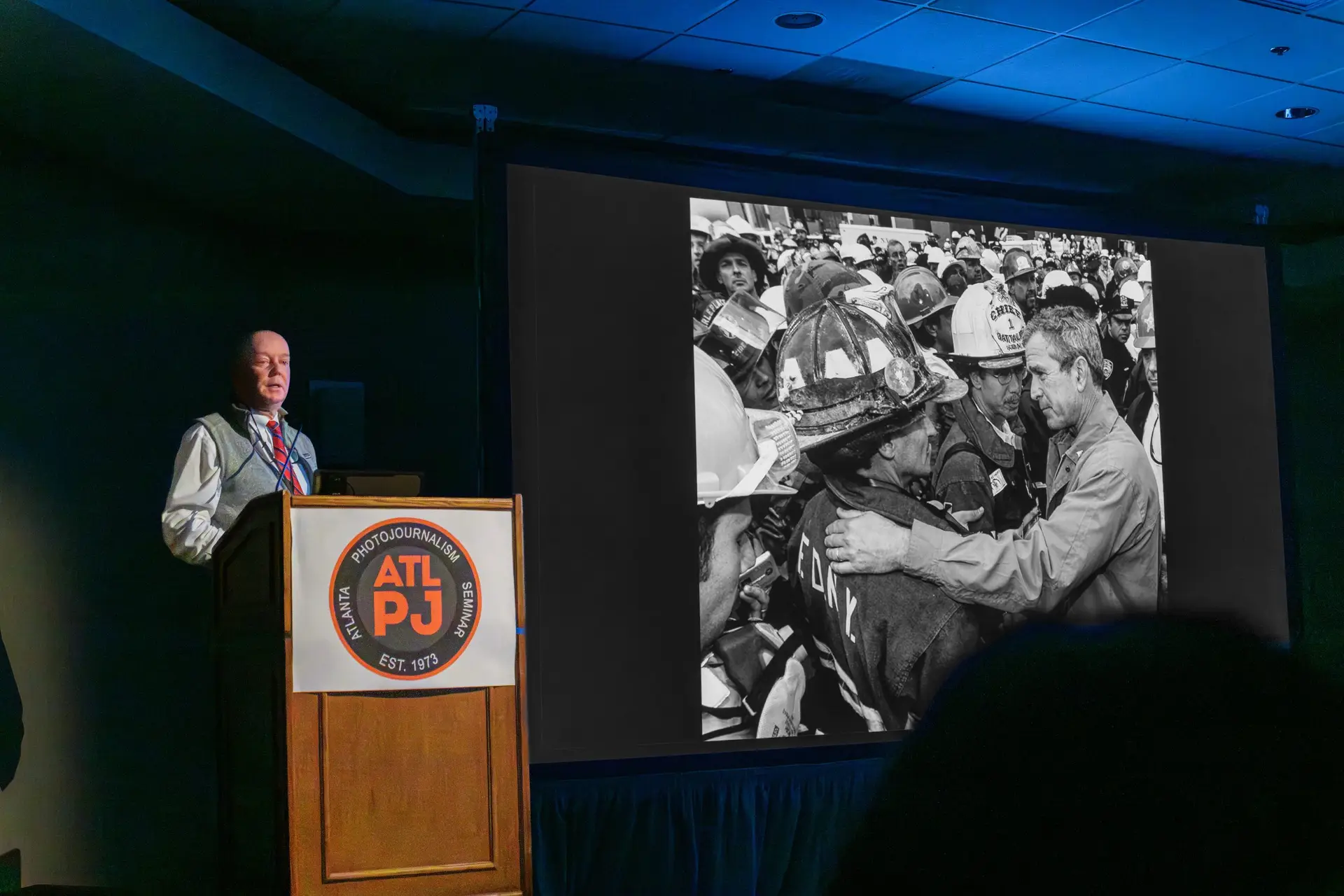
Doug Mills shares the story behind a historic black-and-white photograph from Ground Zero, capturing President George W. Bush embracing a firefighter amid the rubble and rescue workers following the September 11 attacks.
Over the years, I’ve noticed something interesting when photojournalists present their work at conferences or workshops.
Many of them rely heavily on writers to tell the story.
For this story, I selected photos from two of today’s top photojournalists, Doug Mills and Carol Guzy, who consistently put the subjects first. When they present, they don’t just show images—they tell the story of the people in their photos and then add the context that brings the work fully to life.
That’s not unusual in newsrooms. In newspapers and magazines, the partnership between a reporter and a photographer can be incredibly powerful. The writer provides depth, context, and explanation. The photographer provides the emotional entry point—the moment that pulls the reader into the story.
When it works well, the two are married together beautifully.
But something often gets lost when photographers present their work on their own.
They show powerful images on the screen, but the audience only hears fragments of the story. Instead of hearing about the people in the photos, the presentation becomes more about the photographer’s experience—how they got access, how hard the assignment was, or what challenges they faced making the picture.
Meanwhile, the audience is left trying to figure out what is actually happening in the story.
The problem is simple: the audience never saw the original package.
They didn’t see the full article that the writer produced. They didn’t read the background reporting. They didn’t get the captions in context with the larger narrative.
All they see is the photo.
And if the photographer doesn’t fill in the story, no one else will.
The Photographer Still Carries the Story
Even when a writer originally tells the story in print, the photographer still bears responsibility for it.
Why?
Because the images exist because of the people in them.
Photojournalists aren’t just creating interesting pictures. They are documenting someone else’s life, struggle, celebration, or moment in history. The photos only matter because of the human story behind them.
If we fail to tell that story when we have the microphone, we miss the very reason the photograph exists.
Don’t Let the Photos Become Window Dressing
Sometimes presentations unintentionally turn photographs into visual decoration.
The images serve as slides in the background while the photographer mostly talks about themselves.
But photojournalism was never meant to be about the photographer.
It’s about the subject.
The person whose life intersected with the camera.
When we show our work publicly, we are being trusted again with that person’s story. The least we can do is make sure the audience understands who they are and why their story matters.
Tell the Story First
One simple shift can make presentations far more powerful:
Tell the story first. Then share the backstory.
Introduce the people in the photographs.
Explain what is happening in their lives.
Help the audience understand the stakes, the emotions, and the context.
Once the audience understands the story, then it becomes meaningful to hear how the photographer found it, gained access, or overcame obstacles to document it.
But the story must come first.
Otherwise, the audience is just looking at pictures without understanding why they matter.

Why Journalists Must Seize Every Opportunity to Tell the Story
Every time journalists speak publicly, they have an opportunity—and a responsibility—to tell the subject’s story.
There are several reasons why this matters.
First, many people will never encounter the original journalism.
Most stories today have a short life in print or online. A presentation may reach people who have never seen the article or publication where the work first appeared.
Second, storytelling preserves the dignity of the subject.
When we tell the full story, we help the audience see the person behind the photograph—not just the moment that was captured.
Third, it keeps journalism focused on its purpose.
Journalism exists to inform the public and help people understand the world around them. If the focus shifts entirely to the journalist, we’ve lost sight of that mission.
Finally, it honors the trust people gave us.
The people we photograph often allow us into vulnerable moments of their lives. When we share those images publicly, we owe it to them to make sure their story is told clearly and truthfully.
The Photograph Is the Doorway
A great photograph is often the doorway into a story.
It grabs attention. It creates curiosity. It invites people to ask questions.
But the photograph alone is rarely the whole story.
That’s where the journalist comes in.
When photographers stand in front of an audience, they are no longer just showing pictures. They are serving as the storyteller who helps the audience understand what they are seeing.
And when we do that well, the photographs become far more than images on a screen.
They become a window into someone else’s life.

