Speaking to a Camera Club: Insights from a Professional Photographer

Reading Time: 2 minutes

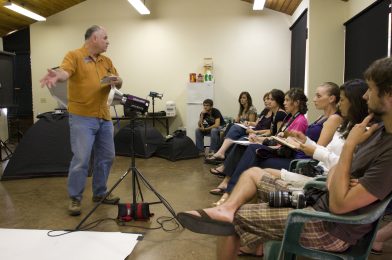
When asked to speak to a camera club composed mainly of amateurs, many thoughts run through the mind of a professional photographer. These invitations are both an honor and a responsibility. It’s a chance to share knowledge, inspire others, and give back to the photography community. Here’s a peek into the thought process of preparing for such a talk.

Tailoring the Presentation

One of the first steps is understanding the audience. I always start by asking the organizer:

Which topics do you think your camera club is most interested in hearing from me about? Once you pick, I can send you a synopsis.

Some of the topics I suggest include:

  • The Power of Storytelling in Photography: This is a central theme in impactful photography and resonates universally.
  • Lighting Techniques for Impactful Photography: Mastering lighting is crucial, making this a valuable topic for all photographers.
  • Creating Emotional Connections Through Portrait Photography: Improving portrait skills and capturing genuine emotions is always in demand.
  • Brand Building Through Visual Storytelling: Essential for those looking to commercialize their photography skills.
  • Travel Photography: Capturing Stories from Around the World: An exciting topic that appeals to hobbyists and professionals.
  • The Business of Photography: Practical advice for turning a hobby into a business.
  • Videography for Photographers: Expanding Your Skills: As videography gains importance, this topic can help photographers broaden their skill set.
  • Faith and Photography: Using Your Talents for a Greater Purpose: This is particularly meaningful for those interested in faith-based or nonprofit work.

Knowing the Audience

To deliver a meaningful talk, it’s crucial to understand the club’s dynamics:

  • What do the members like to shoot? This helps tailor examples and anecdotes to their interests.
  • How often do they shoot? Understanding their commitment level can guide the depth of technical details.
  • Is the camera club a social group or focused on growth? This insight shapes the tone and content of the presentation.

Crafting the Message

I strive to avoid talking down to the audience. Instead, I share my experiences and the stories behind my epiphanies. Here are additional considerations for a successful presentation:

  • Engage with Stories: Personal stories and real-life examples make the content relatable and memorable.
  • Provide Practical Tips: Offer actionable advice that attendees can immediately apply to their photography.
  • Encourage Interaction: Foster a dialogue rather than a monologue. Q&A sessions and interactive segments can be highly effective.
  • Showcase a Variety of Work: Diverse examples can inspire and appeal to a broader audience.
  • Highlight Mistakes and Learnings: Sharing mistakes and lessons learned can encourage and educate amateurs.

Inspiring Improvement

Finally, I aim to inspire and motivate the club members to improve their photography. Here are some tips to achieve this:

  • Emphasize Practice: Encourage regular practice and experimentation.
  • Advocate for Feedback: Suggest seeking constructive criticism to grow and improve.
  • Highlight Learning Resources: Point them to workshops, online courses, and photography books.
  • Promote Community: Encourage them to engage with each other, share work, and learn collaboratively.

Conclusion

Speaking to a camera club of amateurs is a rewarding experience that requires thoughtful preparation and a genuine desire to share knowledge. A professional photographer can make a lasting impact by understanding the audience, crafting a tailored message, and inspiring improvement. Whether discussing storytelling, lighting, or the business of photography, the ultimate aim is to ignite passion and foster growth among fellow photographers.
Tagged : /

The Journey of the Red-Shouldered Hawks: A Personal Photo Project

Reading Time: 6 minutes

Since the onset of COVID-19, many of us have spent more time at home, discovering new hobbies and appreciating the nature surrounding us for me, this period of increased home time turned into a unique opportunity to connect with and document the lives of the red-shouldered hawks that nest in our backyard.

Red-Shouldered Hawk

A New Beginning

It all started during the early days of the pandemic when I noticed a pair of red-shouldered hawks beginning their courtship in late January. With a newfound abundance of time, I embarked on a personal photo project, capturing their journey from mating to independence. Little did I know this project would become a profound and rewarding experience.

Heartbreak and Hope

Last year, the hawks’ nesting attempt ended, but the nest didn’t go well. All their eggs were lost, a reminder of the fragile balance of nature. I was determined to follow their story more closely this year, hoping for a different outcome. Equipped with my camera, I started documenting their progress, visiting the next day after day, eager to fill in the story’s gaps that I had missed the previous year.

The Stages of Growth

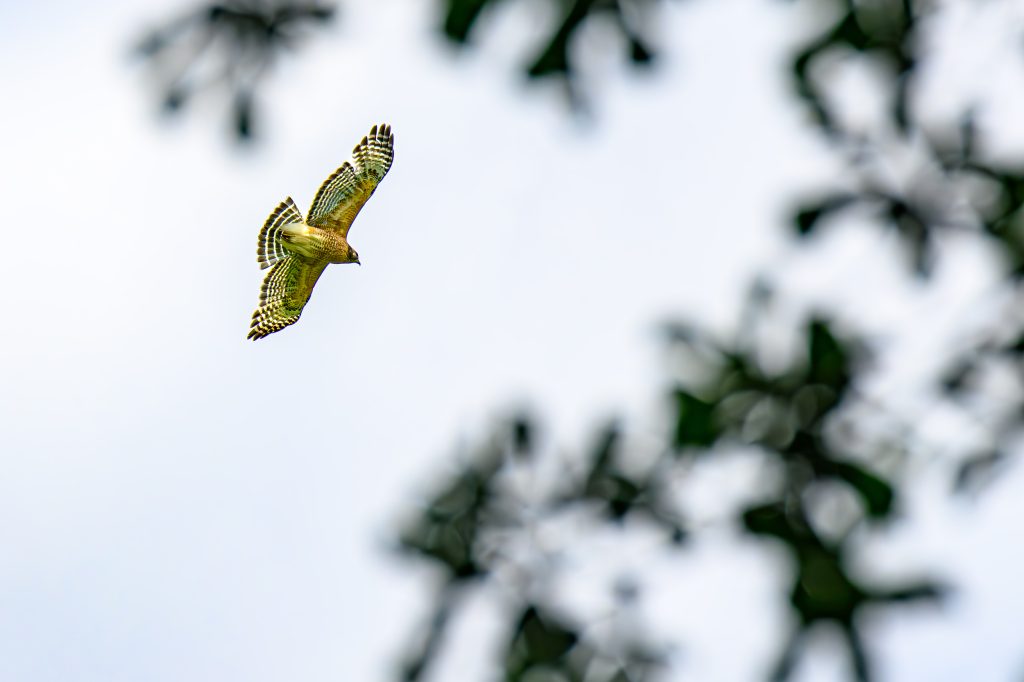
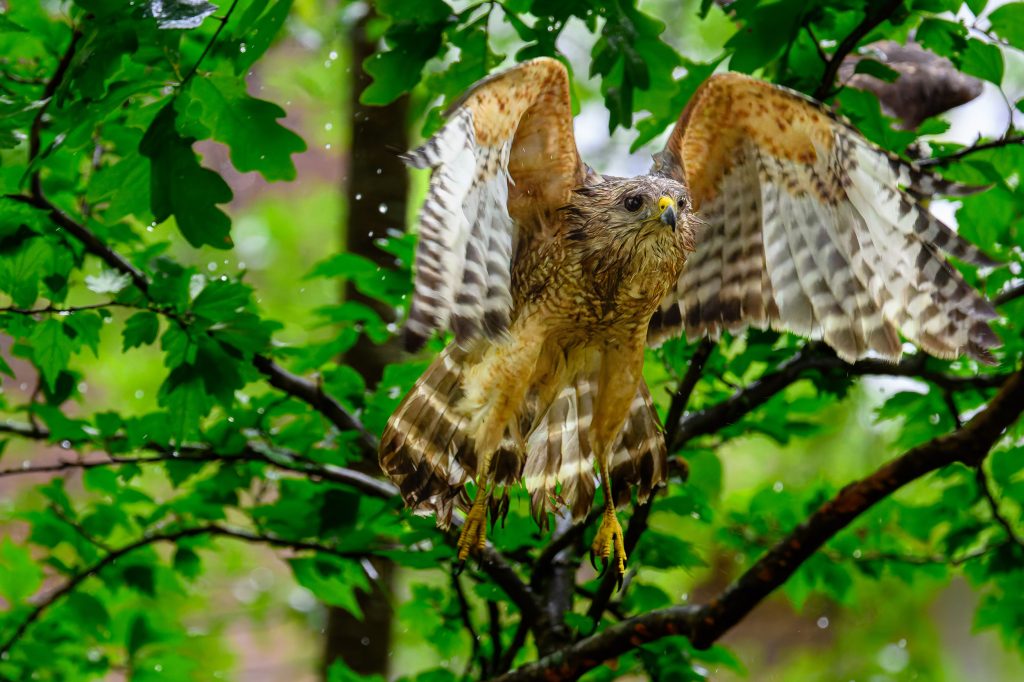
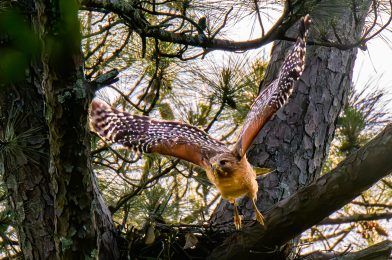
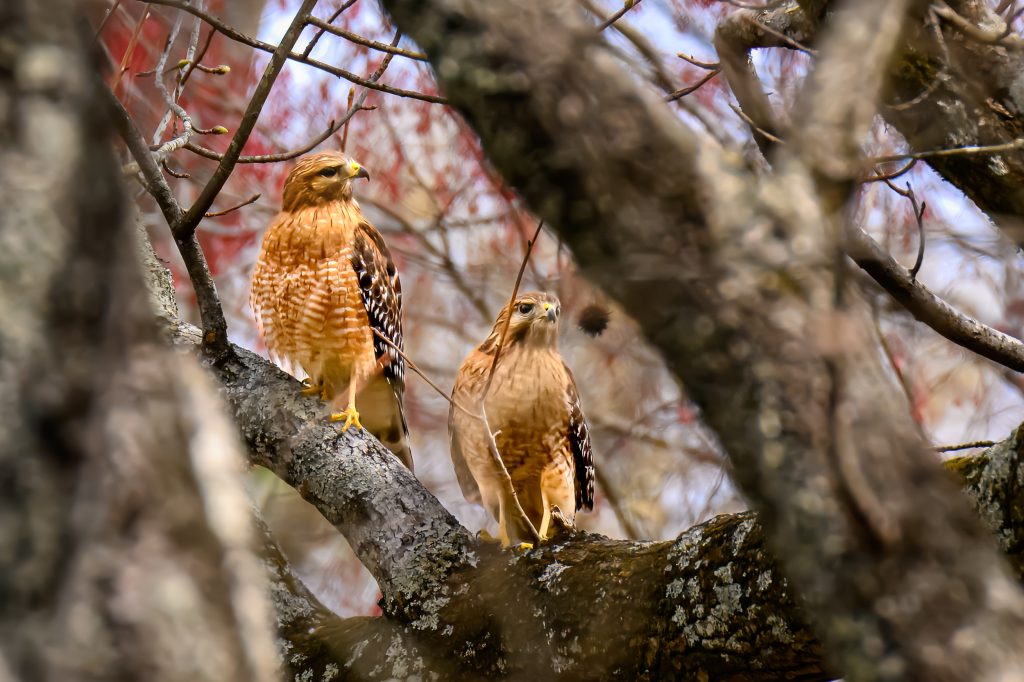
Whether wheeling over a swamp forest or whistling plaintively from a riverine park, a Red-shouldered Hawk is typically a sign of tall woods and water. It’s one of our most distinctively marked common hawks, with barred reddish-peachy underparts and a strongly banded tail. In flight, translucent crescents near the wingtips help to identify the species at a distance. These forest hawks hunt prey ranging from mice to frogs and snakes.

Mating (January – March)

In late winter, the hawks began their courtship. Their aerial displays and vocalizations signaled the beginning of a new cycle. This initial stage, filled with excitement and hope, was a perfect start to my photo series.

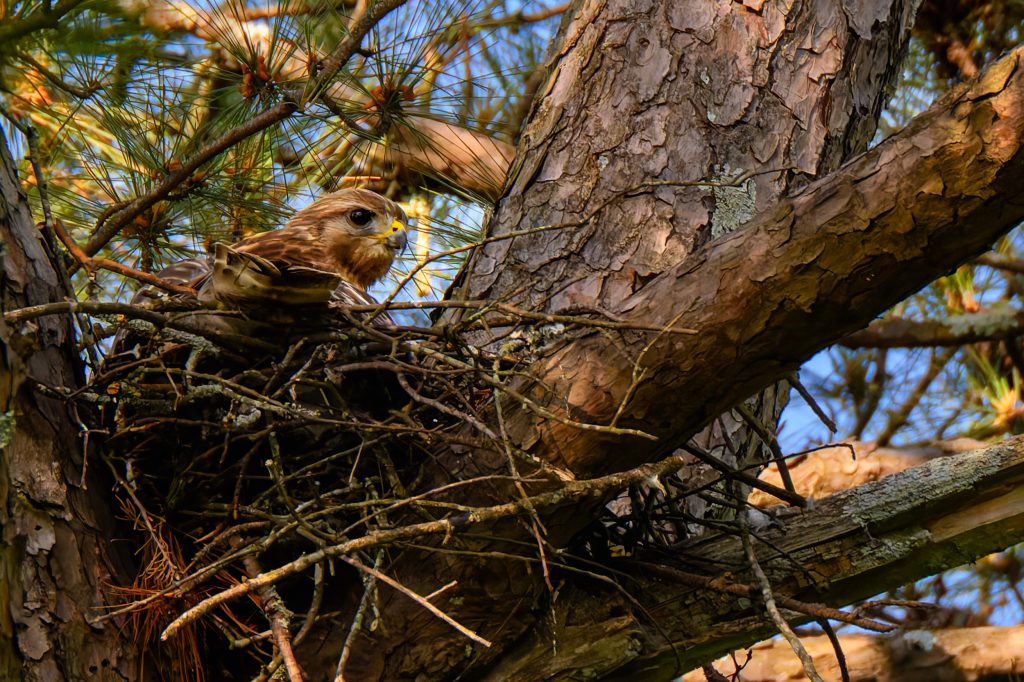
Hidden from view, moments like these remind us of the red-shouldered hawk’s tender care and nurturing instinct. Witnessing the circle of life unfold in the cozy confines of their nest is a testament to the beauty of nature’s delicate balance.

Nesting (February – April)

By February, the pair had chosen their nest site high in a sturdy tree. They diligently constructed their nest, a labor of love and precision. Capturing these moments highlighted their dedication and teamwork.

Egg Laying (March – April)

In early spring, the female laid her eggs. Over several days, 2-5 eggs appeared in the nest, each promising new life. I documented the serene beauty of the eggs nestled safely in their home.

Incubation (March-May)

Incubation required patience and vigilance. Both parents took turns warming the eggs, a task primarily shouldered by the female. I captured intimate moments of this nurturing phase.

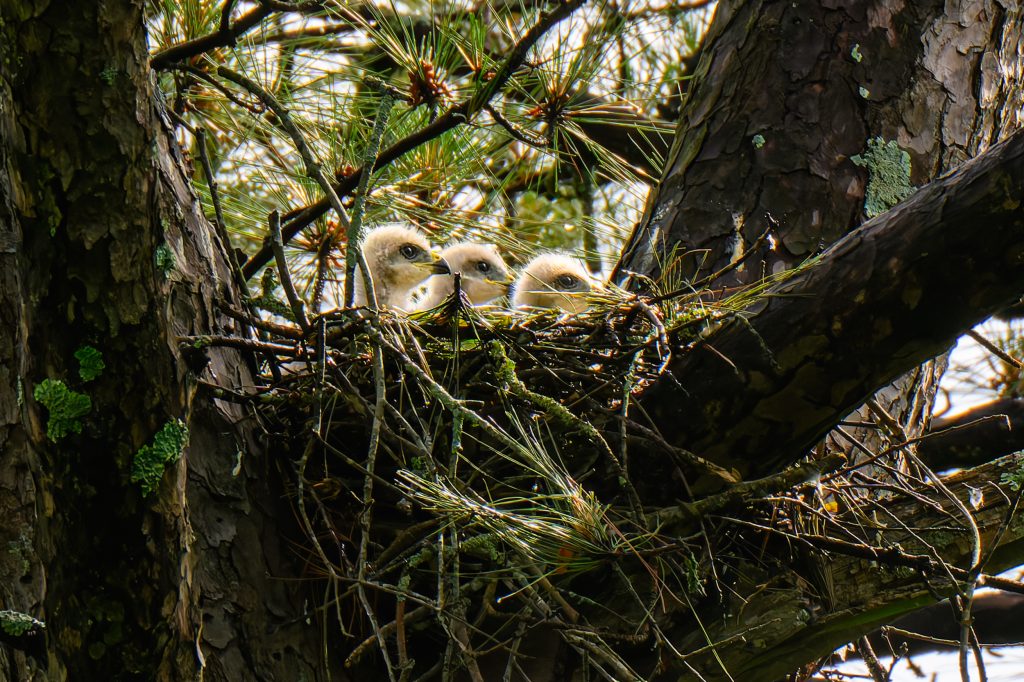
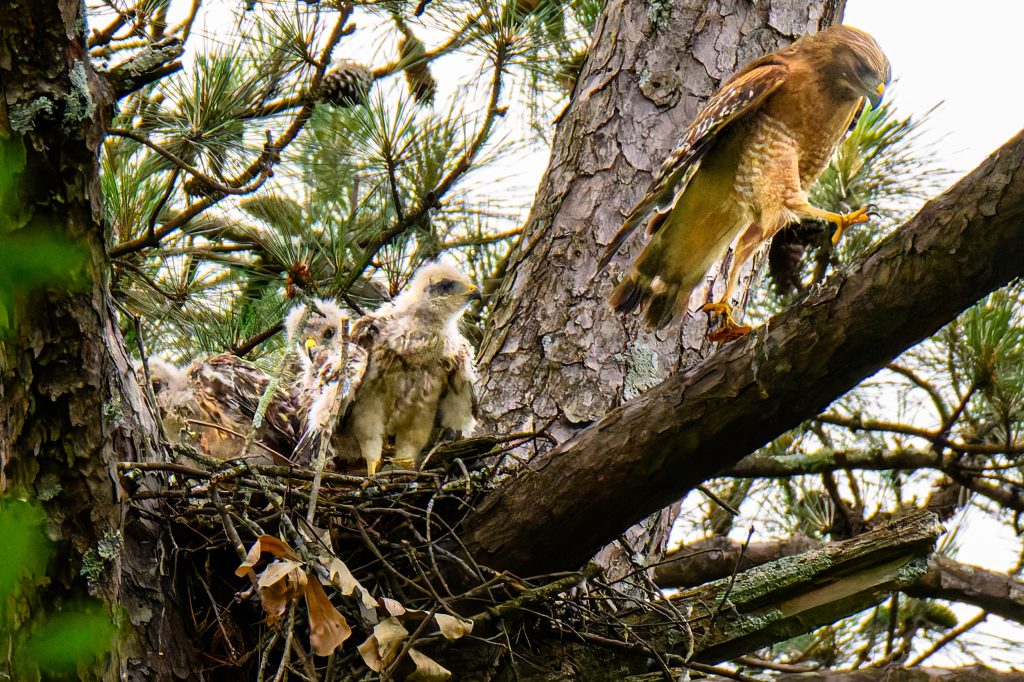
I was thrilled to capture a momentous occasion today as I finally snapped a photo of all three baby Red-Shouldered Hawks! These adorable bundles of fluff are still sporting their pristine white feathers, eagerly awaiting their next meal from their doting parents. Did you know that baby hawks, known as eyasses, rely entirely on their parents for food and protection during this stage? It’s a testament to the remarkable bond between these magnificent birds and the dedication of their caregivers.

Hatching (April – May)

Late April brought the long-awaited hatching of the chicks. They emerged, fragile and downy, eyes still closed to the world. Witnessing and photographing this tender stage was incredibly moving.

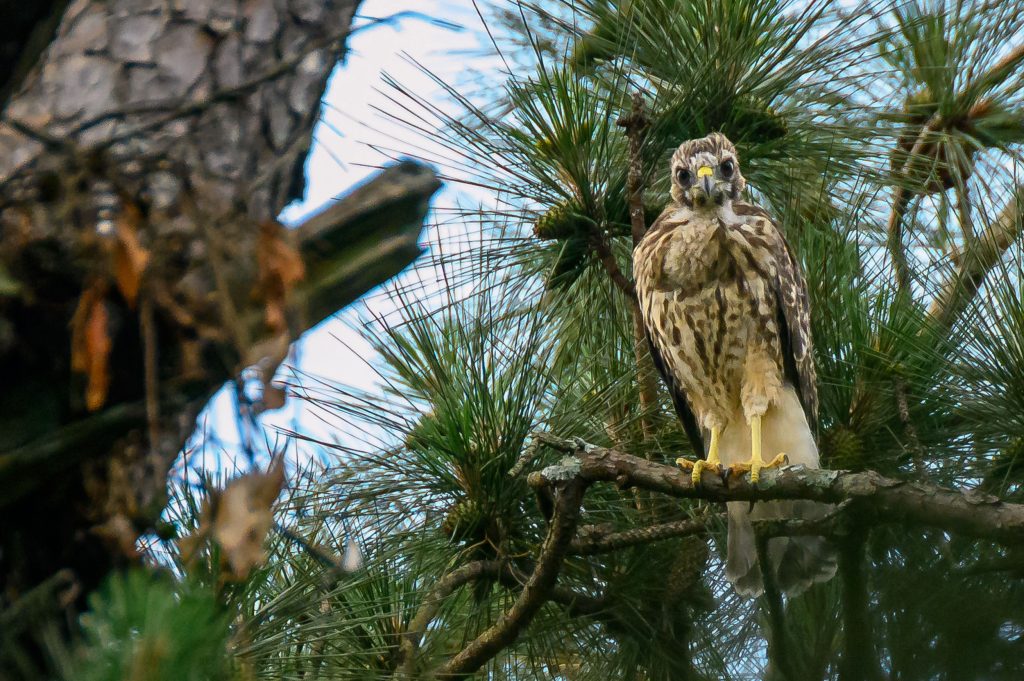
Red-shouldered Hawk juvenile out of the Nest and exploring our backyard

Brooding and Feeding (April – June)

The female brooded the chicks for the first few weeks while the male provided food. As the chicks grew, both parents hunted tirelessly to feed their hungry young. This period was a flurry of activity, a testament to the parents’ unwavering care.

Groparents’Development (May – June)

The chicks grew rapidly in May. Their eyes opened, and they began to develop juvenile feathers. I captured their clumsy movements and curious explorations, each day revealing new milestones.

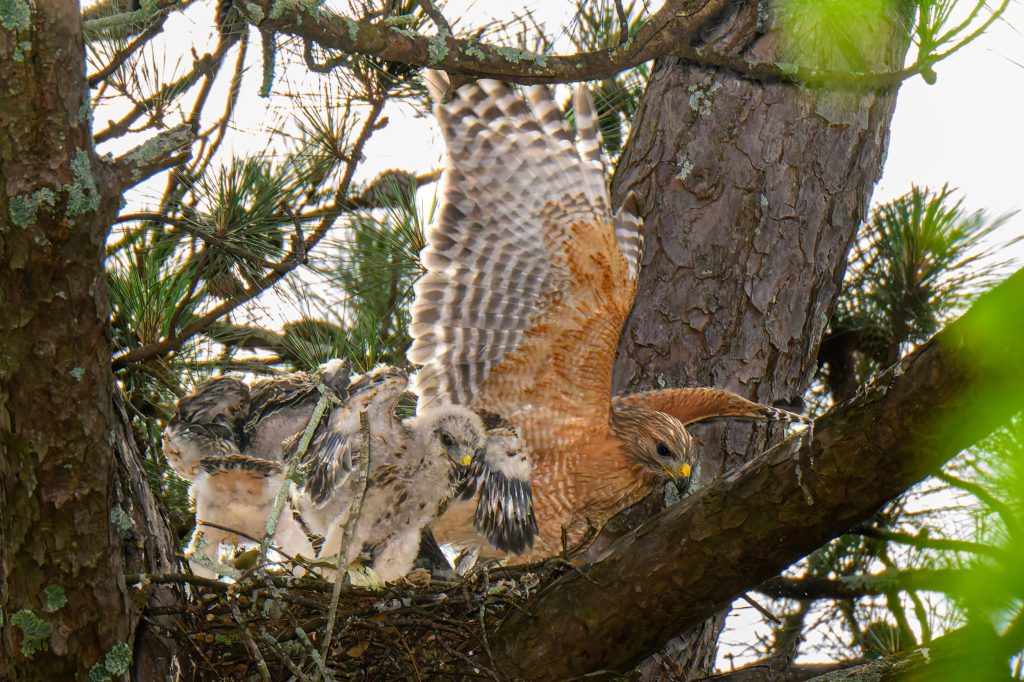
Red-shouldered hawk nestlings eagerly anticipate their next meal from their devoted parents. These adorable fluff balls are likely around three weeks old, displaying behaviors like enthusiastic feeding, wing stretching for strength, and tentative exploration of their surroundings. Their downy feathers transform into juvenile plumage as they grow, mirroring their majestic adult counterparts. Sibling squabbles and vocal calls fill the air, signaling their rapid development towards fledging.

Fledging (June – July)

By late June, the chicks were ready to leave the nest. Their tentative flapping and short flights were a thrilling sight. Photographing their fledging was both exhilarating and bittersweet.

Red-shouldered hawk nestlings eagerly anticipate their next meal from their devoted parents. These adorable fluff balls are likely around three weeks old, displaying behaviors like enthusiastic feeding, wing stretching for strength, and tentative exploration of their surroundings. Their downy feathers transform into juvenile plumage as they grow, mirroring their majestic adult counterparts. Sibling squabbles and vocal calls fill the air, signaling their rapid development towards fledging.

Post-Fledging Dependency (July – September)

The young hawks stayed close even after leaving the nest, learning to hunt under their parents’ watchful eyes. I documented their growth into skilled flyers and hunters, and their confidence soared.

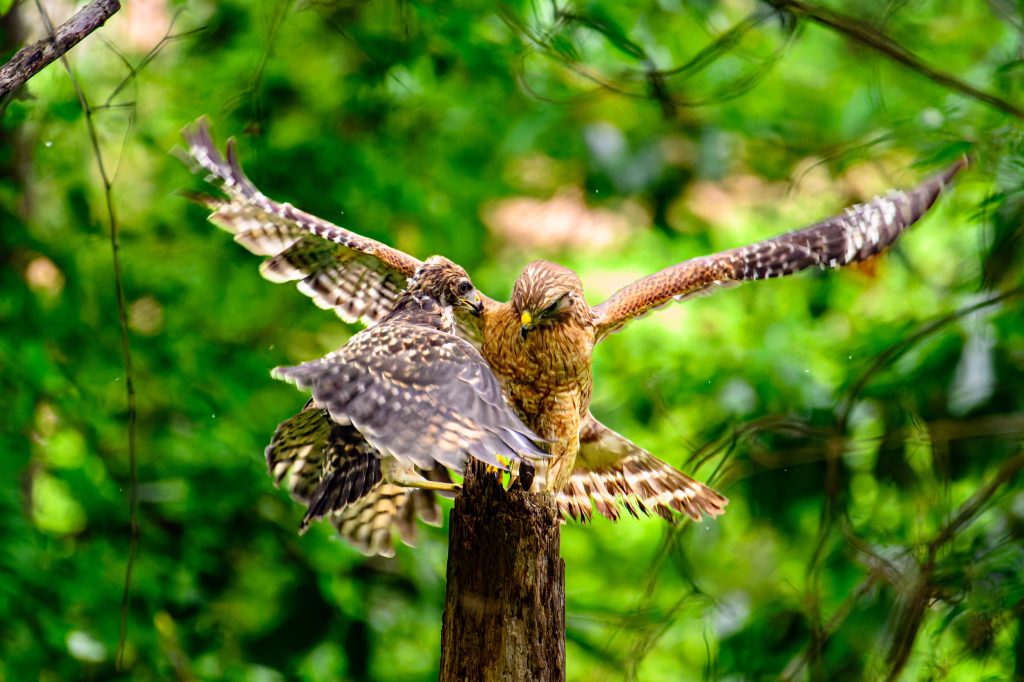
The juvenile red-shouldered hawks are out hunting today. I saw the parents show up and try to feed the juvenile in our backyard. If you were at our house, all you would hear is the constant screeching of the hawks.

Independence (September – October)

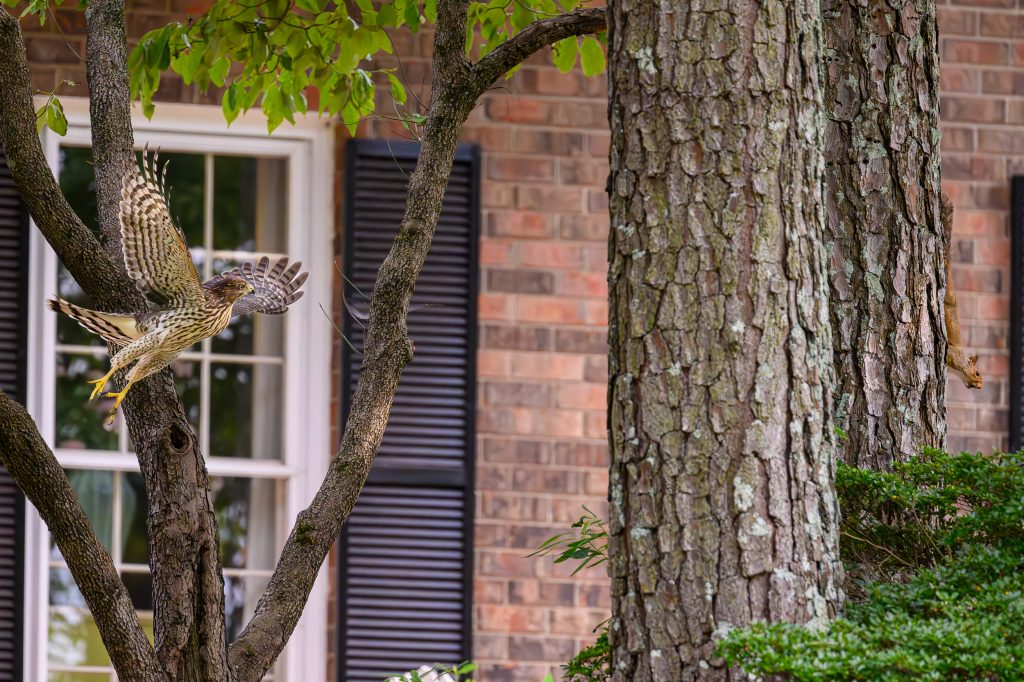
Red-shouldered hawk in pursuit of a squirrel in our neighbor’s yard.

Finally, by late summer, the young hawks became independent. They dispersed to find their territories, marking the end of this year’s chapter. Capturing the year’s journey to independence was a fitting conclusion to my project.

Reflections on a Personal Photo Project

Like any personal endeavor, this photo project required time, patience, and persistence. Returning to the nest day after day allowed me to document each stage thoroughly, creating a comprehensive visual story. This project has been a reminder of the value of long-term commitment to photography and the joy of witnessing nature’s cycles up close.

Conclusion

Through my camera lens, I have come to appreciate the resilience and beauty of red-shouldered hawks. Their journey from courtship to independence mirrors the dedication required in any creative project. I hope these images inspire you to start your photo project, find stories in your backyard, and embrace the process of documenting them over time.

Stay tuned for more updates and stories from Stanley Leary, Storyteller and Brand Builder. Until then, enjoy these glimpses into the lives of our backyard hawks.

The juvenile red-shouldered hawks are out hunting today. I saw the parents show up and try to feed the juvenile in our backyard. If you were at our house, all you would hear is the constant screeching of the hawks.

I hope this blog post inspires you to look closely at the nature around you and to consider starting your project. There’s a whole world of stories to be told outside your door.

The Power of Listening: A Photographer’s Guide to Persuasion in 2024

Reading Time: 2 minutes

In the bustling world of photography freelancing, the art of persuasion often takes center stage. Yet, what if I told you that the most potent tool in your arsenal isn’t your eloquence or sales pitch but your ability to listen deeply?

A fascinating insight unfolds in the book The Persuaders by Anand Giridharadas: the path to genuine persuasion doesn’t lie in replacing beliefs but in displacing them. Giridharadas interviewed Loretta Ross, and her wisdom resonates profoundly as she highlights the art of unsettling ideas rather than forcefully replacing them. It’s about fostering curiosity, raising questions, and reducing certainties rather than imposing new convictions.

So, how does this translate to the world of freelance photography? The key lies in engaging in conversations with your clients and potential clients on a deeper level. Here’s a quick tip list on how to truly listen and understand your client’s struggles in the coming year:

  1. Start with Genuine Interest: Initiate conversations by asking open-ended questions about their experiences and opinions. Create a space for personal stories to unfold.
  2. Share Your Own Stories: Foster a sense of camaraderie by sharing your experiences and opinions. This builds a connection and encourages reciprocal sharing.
  3. Seek Universal Connections: Explore how their struggles resonate with broader human experiences. It’s about normalizing their issues and making them relatable on a universal scale.
  4. Invest Time: Understand that genuine understanding takes time. Aim for at least 30 minutes of deep conversation to grasp their challenges and perspectives.

As we enter 2024, let’s kickstart the year by initiating meaningful conversations with our clients. Here’s a quick list of ways to extend a conversation beyond a brief exchange:

  1. Ask Thought-Provoking Questions: Encourage discussion by posing questions that prompt introspection rather than simple yes/no answers.
  2. Be Authentic and Vulnerable: Share your thoughts and vulnerabilities. It builds trust and encourages them to open up.
  3. Listen Actively: Focus on what they’re saying without forming your response. Show genuine interest and understanding.
  4. Create a Safe Space: Ensure they feel comfortable expressing themselves without judgment or pressure.

Remember, persuasion isn’t about pushing an agenda; it’s about fostering genuine connections and understanding. So, here’s to a year of listening deeply, understanding profoundly, and creating stronger bonds with our clients—one meaningful conversation at a time.

Tagged :

Capturing the Thrilling Moments: My Experience Shooting the Atlanta Thrashers for the Associated Press

Reading Time: 4 minutes

Introduction

As a photographer for the Associated Press, I’ve had the privilege of covering many events. Still, one of my most memorable experiences was getting the opportunity to photograph the Atlanta Thrashers in action. Surprisingly, when I first stepped onto the ice rink, I had only photographed hockey a few times. However, little did I know that my childhood experiences playing street and ice hockey in New Jersey would prove invaluable. It was a journey that rekindled my love for shooting sports and reinforced the idea that sports photography has much in common with capturing life’s moments.

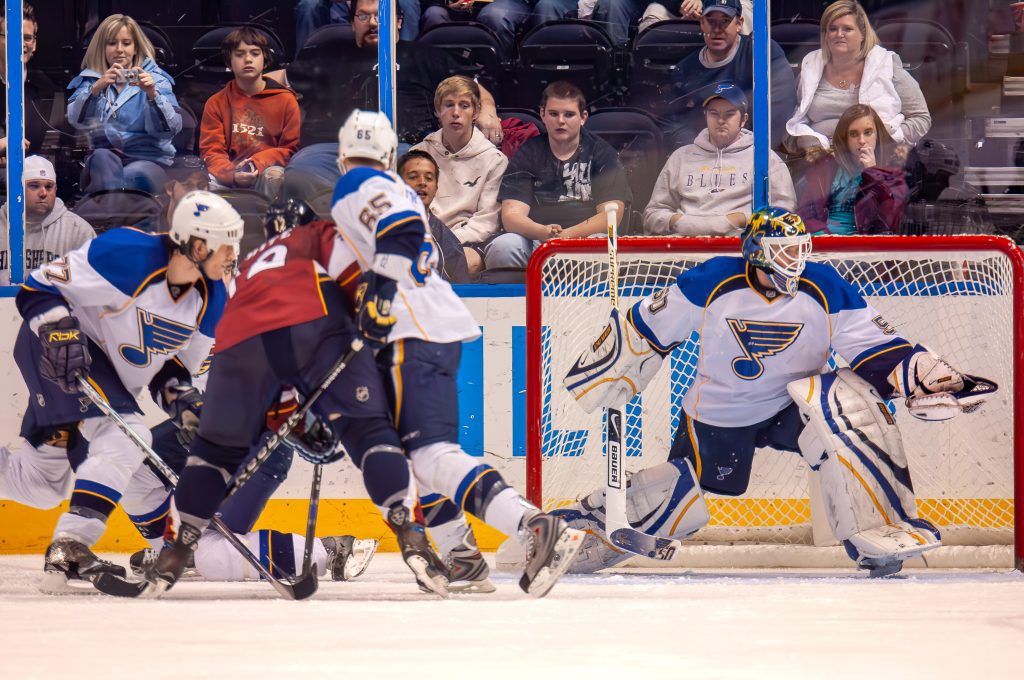
St. Louis Blues goalie Chris Mason (50) makes a save against the Atlanta Thrashers during the second period in an NHL hockey game in Atlanta, Sunday, Nov. 30, 2008. (AP Photo/Stanley Leary) [NIKON D2Xs, 122.0-300.0 mm f/2.8, Mode = Aperture Priority, ISO 400, 1/640, ƒ/2.8, (35mm = 450)]

Hockey: A Beautiful Challenge

  1. Peak Moments and Scoring: In sports, whether it’s hockey, football, or basketball, there’s a palpable sense of anticipation leading up to a peak moment that can change the game – a goal, a touchdown, a slam dunk. Similarly, in life, some moments can define our experiences. Whether it’s a graduation, a wedding kiss, or a child’s first steps, these peak moments are the equivalent of scoring goals in our personal stories.
  2. Anticipation Over Reaction: One of the critical lessons I learned while photographing the Thrashers was the importance of anticipating moments versus reacting to moments. A photographer must expect the critical moments like a seasoned goalie who anticipates where the puck will go. In life, too, predicting significant events and being prepared can make all the difference.
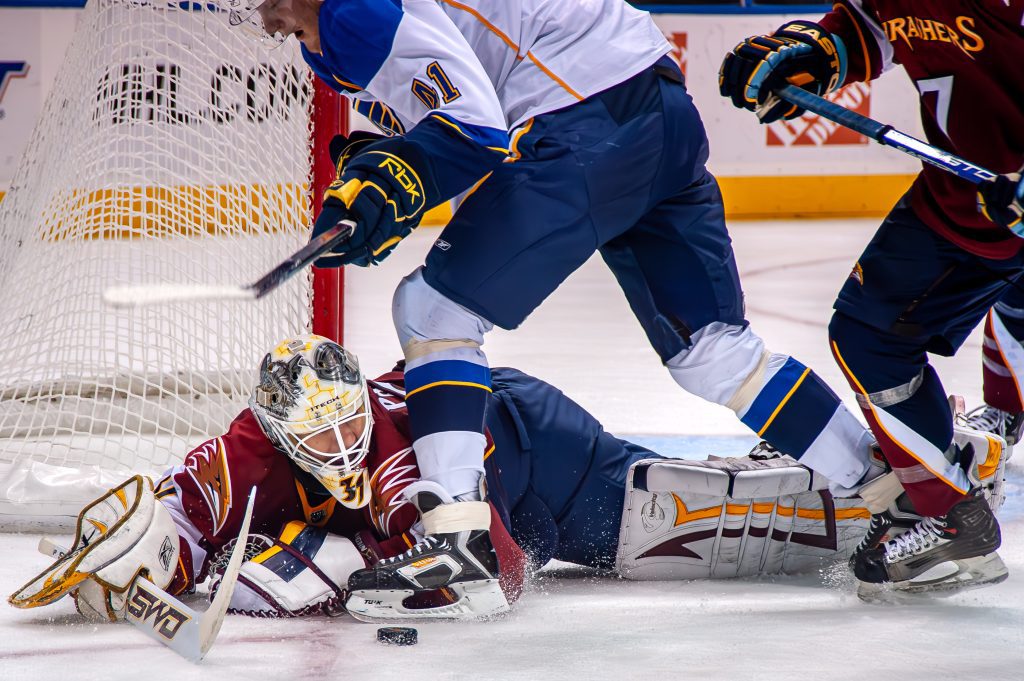
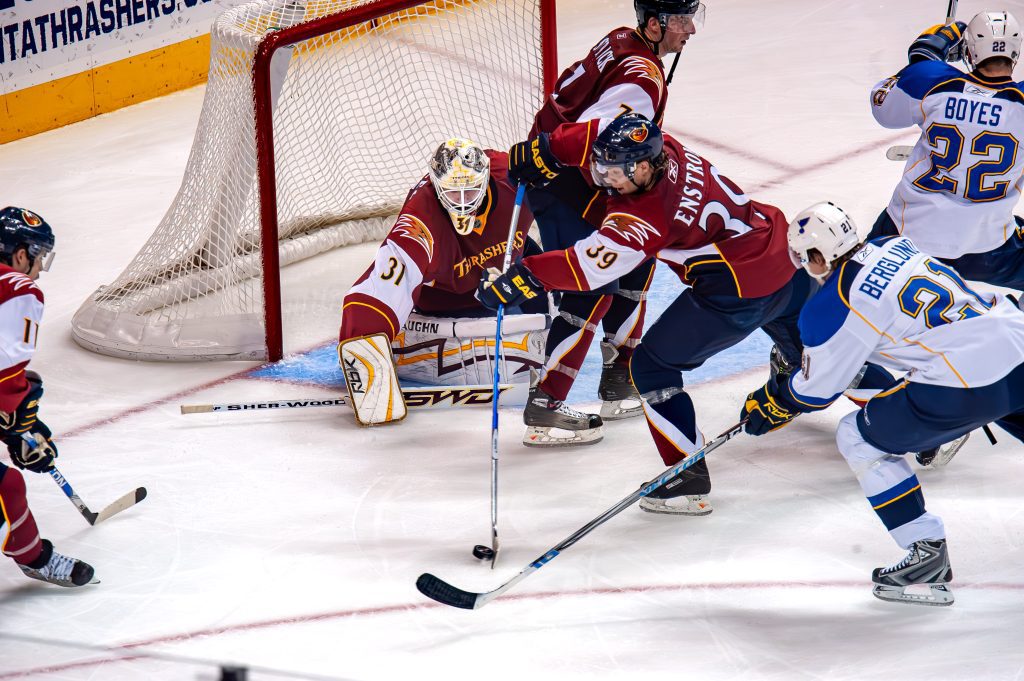
Atlanta Thrashers goalie Ondrej Pavelec (31) makes a save while St. Louis Blues left wing Steve Regier (41) pursues during the second period in an NHL hockey game in Atlanta, Sunday, Nov. 30, 2008. (AP Photo/Stanley Leary) [NIKON D3, 24.0-120.0 mm f/3.5-5.6, Mode = Aperture Priority, ISO 5000, 1/1000, ƒ/5.6, (35mm = 110)]

The Common Thread: Sports and Life

I discovered that sports photography has much in common with capturing moments in everyday life. It’s not just about fast-paced action and freezing moments in time; it’s about telling a story, conveying emotion, and connecting with the viewers. Here are some tips that I found essential not only for sports photographers but for anyone looking to capture the essence of any moment:

Atlanta Thrashers defenseman Tobias Enstrom (39) of Sweden pushes the puck out from St. Louis Blues center Patrik Berglund (21) of Sweden. At the same time, Atlanta Thrashers goalie Ondrej Pavelec (31) protects the goal during the third period in an NHL hockey game in Atlanta, Sunday, Nov. 30, 2008. St. Louis Blues won 4-2. (AP Photo/Stanley Leary) [NIKON D3, 122.0-300.0 mm f/2.8, Mode = Aperture Priority, ISO 6400, 1/1250, ƒ/5.6, (35mm = 380)]

Tips for Photographers (and Everyone Else)

  • Know Your Subject: It is crucial to understand your subject and its dynamics, whether it’s a hockey game or a family gathering. Study the game, the players, or the people you photograph to anticipate where the action will unfold.
  • Patience is Key: Not every moment is action-packed in sports and life. Sometimes, the most potent images are captured during the quieter, more contemplative moments. Patience allows you to be ready when those moments occur.
  • Use the Right Equipment: Just as a hockey player needs the right gear, a photographer needs the right camera and lenses. Choose equipment that suits the conditions and allows you to capture sharp, clear images.
  • Master Your Settings: Understanding your camera settings is essential. Whether adjusting exposure for a well-lit shot or using a fast shutter speed to freeze action, knowing your camera inside out ensures you’re always prepared.
  • Anticipate, Don’t React: The golden rule of sports photography also applies to life. Anticipate the moments you want to capture, whether a winning goal or a loving embrace. Please don’t wait; make it happen by being ready. If you wait to see a moment, the time it takes you to react it is already over.
  • Embrace Emotion: In both sports and life, emotions run high. Capture the raw emotions – the joy, the frustration, the love – because they make the images relatable and powerful.
  • Tell a Story: Every photo should tell a story. Consider the narrative you want to convey through your images, whether a game-winning shot or a candid family moment.
An ice crew at a Thrashers game on November 30 at the Omni Center in Atlanta. At least nine times every game, the crew must clear the ice of shavings within a two-minute time limit. (AP Photo/Stanley Leary) [NIKON D3, 122.0-300.0 mm f/2.8, Mode = Aperture Priority, ISO 5600, 1/1000, ƒ/5.6, (35mm = 420)]

Conclusion

My time covering the Atlanta Thrashers reminded me that photography, much like life, is about capturing and precisely anticipating peak moments. It reinforced my passion for shooting sports and reminded me that sports and life photography have more in common than meets the eye. Whether you’re behind the lens or living in the moment, these tips can help you capture the essence of any experience and tell a compelling story through your images. So, get out there, whether on the ice rink or in everyday life and seize those peak moments with your camera or simply with open arms.

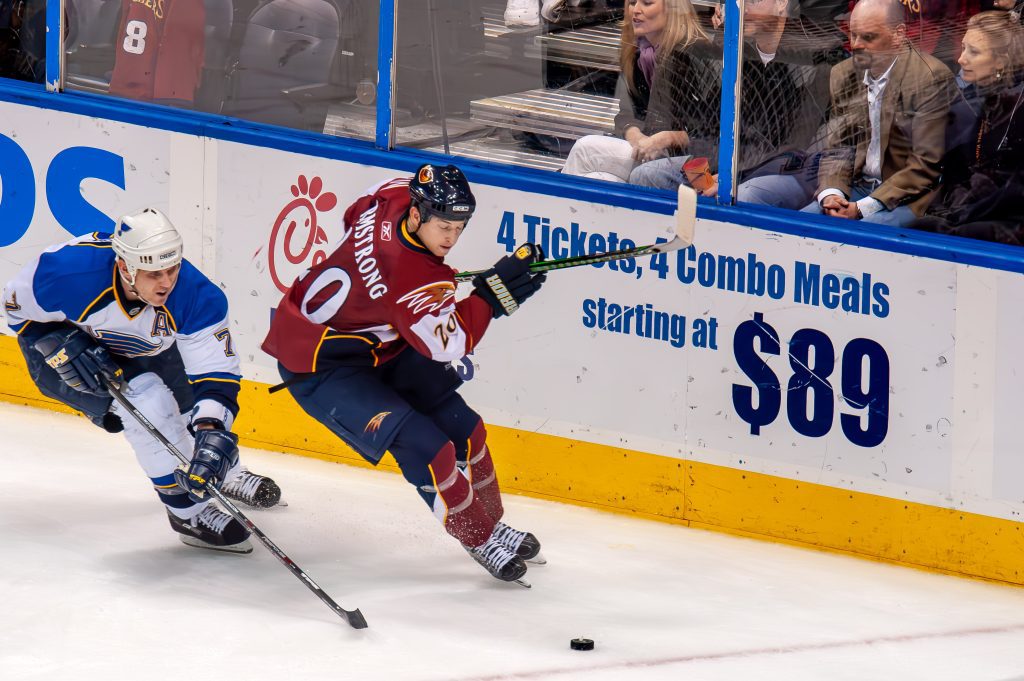
Atlanta Thrashers right wing Colby Armstrong (20) of Saskatchewan and St. Louis Blues center Keith Tkachuk (7) pursue the puck during the third period in an NHL hockey game in Atlanta, Sunday, Nov. 30, 2008. Blues won 4-2. (AP Photo/Stanley Leary) [NIKON D3, 122.0-300.0 mm f/2.8, Mode = Aperture Priority, ISO 6400, 1/1000, ƒ/5.6, (35mm = 390)]

Stories That Move US

Reading Time: 4 minutes

Pink Floyd’s song “Another Brick in the Wall” is a theme about where significant events in life cause us and many other people to detach themselves mentally from the outside world.

Depression occurs in situations where you are so overwhelmed by your thoughts that you can’t relax to process these events.

Some events like a death of a loved one can get us stuck in grief. Grief is personal and individual, and every person experiences its nuances differently. While most of us learn how to live with this grief, I don’t think it has an expiration date.

The past couple of years has been hard on many of my friends. Some have prospered these past couple of years. However, most of my friends have been experiencing untold amounts of grieving.

The first Brick in the Wall in Pink Floyd’s lyrics is about the father leaving his son to go and fight the war. The father dies and leaves him alone.

The second Brick is one where school teachers don’t get to know him and are more about the boy conforming to their rules rather than trying to understand him and help nurture him.

“All in all it’s just another brick in the wall. All in all, you’re just another brick in the wall.”

– Pink Floyd

Pink Floyd’s twist in the lyrics is when those bricks are not just what is happening to you, but you become them.

The power of the song is in the art of storytelling. The listener resonates with the feelings of the storyline. They develop empathy for the story’s hero because the tension of the problem they are dealing with echoes their struggle. They, too, have a brick.

Yesterday I went with a group of photographers to see Minamata. The movie is about photographer W. Eugene Smith who travels to Minamata, Japan, a coastal city ravaged by mercury poisoning in 1971. Ushered by a passionate translator and encouraged by local villagers, Smith’s powerful images expose decades of gross negligence.

“I’ve never made any picture, good or bad, without paying for it in emotional turmoil.”

– W. Eugene Smith

His wife, Aileen Mioko Smith, said, “This kind of communication is essential; rather than just hammering facts, you get to know people, your heart is moved—and that’s what creates core change.”

Aileen Mioko Smith said, “We went there at a time when already lots of media had been there, and if anything, patients were burned by people coming in, intruding and shooting for 30 minutes and then leaving, just using them as an assignment.”

Now the most exciting thing about Eugene Smith that is different from most photojournalists today is his commitment to the subject with his time. He would live with his issues for periods.

National Geographic has always understood this was the key to powerful images and storytelling through the years. It takes time.

Bricks are so helpful in a building. In the story of the three little pigs, we realize the house made of bricks is the one the wolf could not blow down.

I see many of these Brick Events in my life as what brought on depression. In some ways, depression enhances your life and improves your functionality. For example, I find depression to give me insights that help deepen relationships.

Most everyone will have Life Events or, as Pink Floyd describes, Bricks. Those who can help us see these events in perspective are the storytellers. They are the mortar that allows us to construct those events into a foundation, for which more bricks can be added.

Every story has a brick, or as Joseph Campbell, author of the Hero’s Journey, put it, a crisis/tension that people cannot solve alone. The hero departs on a journey that, when completed, will be different.

The best storytellers are the ones that do the best job of introducing the character and the problem that they are dealing with in the story. In the movie I saw of Eugene Smith, he realized he had to spend the time to get to know the people of Minamata. At the turning point in the film, Smith becomes the mentor to the people of Minamata. He does this by asking them to let him photograph very intimate moments in their lives so that the world will understand their plight with mercury poisoning.

Ah Ha Moment!

Not long ago, I realized that my degree in Social Work and my work as a Photojournalist were similar. As a counselor, you spend a lot of time getting to know someone. You use the technique of mirroring.

The skill and art of this seemingly simple strategy of mirroring lies in being fully present to hear what has been said and in being able to take on the perspective of the other so that you can pull out the underlying theme from what is sometimes a long, rambling, almost incoherent speech where fleeting, free-floating ideas are being put into words.

I found that the mirroring process in counseling was me hearing their story and then repeating it, but in a more concise way than they had delivered it to see if I truly understood their plight.

As a journalist, I was doing the same thing and listening to and clarifying their story. The power of the photograph and video I use today is their ability to pull an audience into the story powerfully and authentically.

My joy comes from being able to do like Eugene Smith and help a person or an organization to tell their story more effectively using my visual storytelling skills.

Eugene Smith knew that the audience needed to see the hero of a story dealing with their conflict.

I resonate with Eugene Smith’s words, “The first word I would strike from the annals of journalism is the word objective. I think you need to understand the subjects, not worry about losing your objectivity, and side with them if you get close. It was about understanding their reality and what they were really like.”

I think Eugene Smith was an advocate of using the principles in photojournalism.

“The journalistic photographer can have no other than a personal approach, and he can’t be completely objective. Honest—yes. Objective—no.”

– W. Eugene Smith

Photojournalists covering disaster need to know their role

Reading Time: 3 minutes

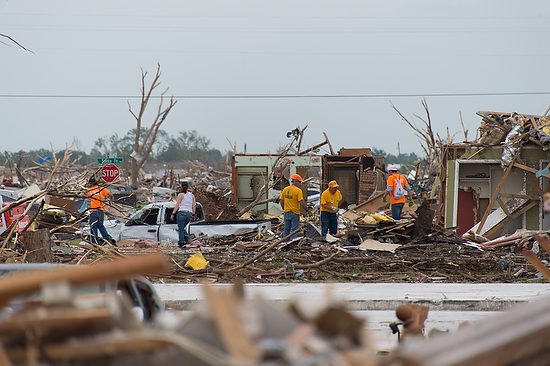
Moore Oklahoma Disaster Relief Coverage

I find many people who have trouble covering disasters or helping with them due to being overwhelmed emotionally. While seeing horrific tragedy can affect you if it consumes you it isn’t healthy. It is healthy to have a heart and be moved by the situation, but when it imobilizes you is when it is a problem.

When you are unsure of your role is when you are more prone to being an emotional wreck and not very useful.

The people of Moore Oklahoma are some of the most resilient people I have ever met. One of the reasons for this is their understanding of their roles in disasters.

You can ask any resident their plan in case of a tornado and they can tell you their A, B or even a C plan they have in place. Most of them will first tell you if they have a place to go for shelter below ground or in a safe room above ground.

The next plan beside seeking shelter is to get out of the way. Most of them with this plan will just get in cars and drive away from the area.

Once the tornado has hit everyone jumps into recovery mode. What is interesting here is many people realize they are better off doing what they do best rather than doing just anything.

After digging out of their own homes, many will go back to work, because what they do as a job is helpful. Many who worked in the restaurants would go back helping feed those who are the first responders and the victims of the tornado.

You see most of these residents understand how they are most helpful for recovery efforts.


The Photojournalist’s role

While I could have gone to Moore, Oklahoma with a team to help clean up, I am much more useful telling the story. You see when I do my job well as a photojournalist I am helping get the word out.

There are three basic things I see as my role as a visual storyteller.

First, I need to help people know what happened. Now besides taking pictures showing the damage, I need to help tell the personal stories of the victims of the tornado. This first piece of the puzzle will help engage my audience.

When I capture the emotional impact the tornado is having on the community, it is time to move onto step two.

Second, I want to show what is happening right now. This is where I am showing the immediate first responders helping the community. This could be in the moments right after the damage while they are digging through the rubble to find survivors or it can be even days to weeks later where I am showing teams helping clean up.

I enjoyed showing all the teams helping clean up. I was there to show Chick-fil-A going around helping those home owners and clean up teams by giving them a hot sandwich.

Many of the local Chick-fil-A franchise guys all realized they served their community best by doing what they do best–making chicken sandwiches.

As a photojournalist I have to remember what I do best. Visual storytelling by me is helping the subjects connect with the audience who can potentially help. This is where I move on to the last part.

Third, I need to help my audience know how they can get involved. You can here the lady sharing how it is helpful for teams to come and help them put their community back together and for those who cannot come even prayer can make a difference.

Without giving people a way to respond can often cause problems. Most news media outlets coverage will tell their audience they can give to the Red Cross for example. I encourage you to consider going with a team as well and for everyone to pray for the people.