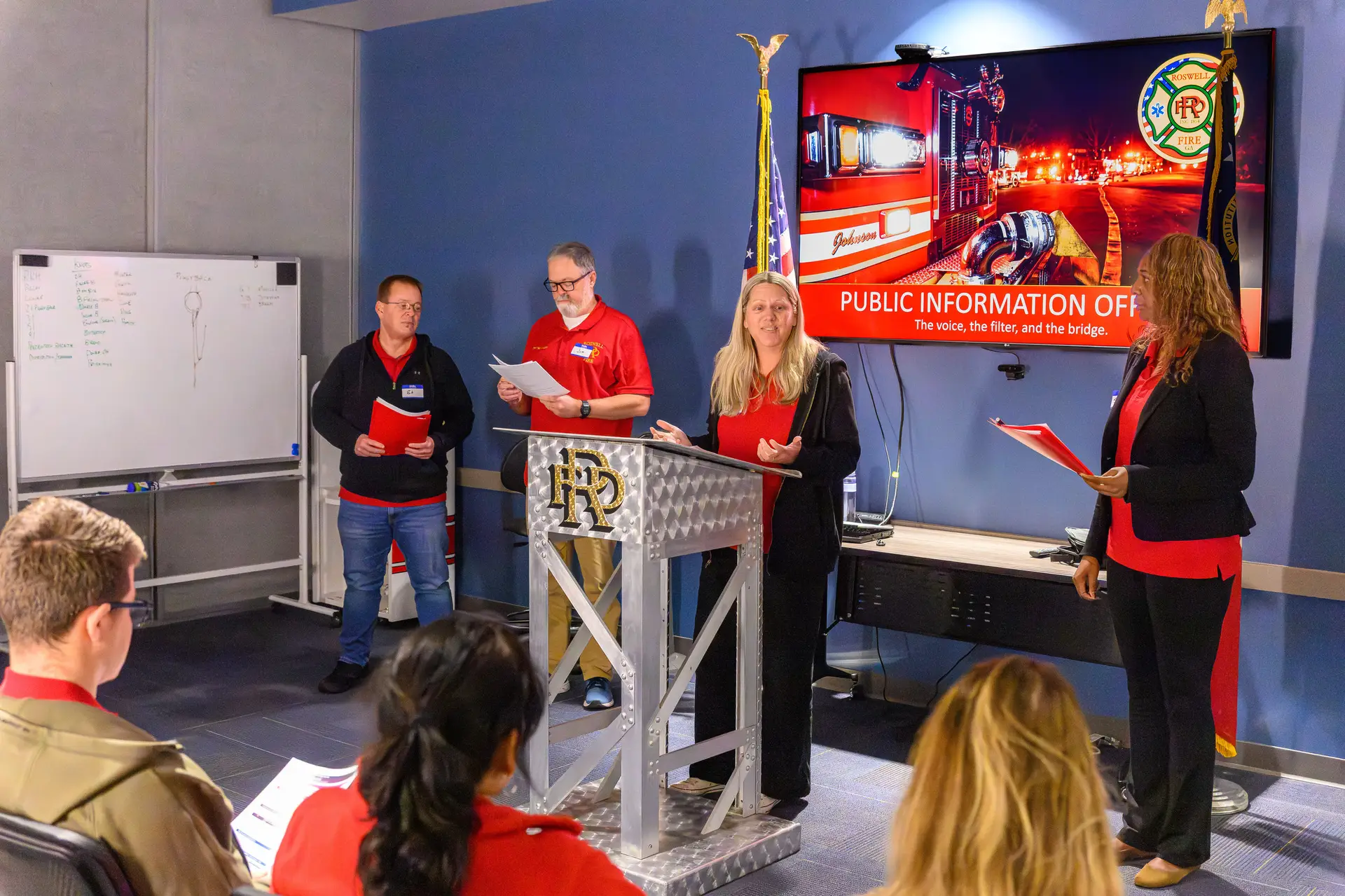
During week five of the Roswell Fire Citizens’ Academy, we focused on the role of the Public Information Officer. On the surface, it’s about communicating clearly during emergencies. But what struck me most is how the lessons apply far beyond crisis communication—they speak directly to how we all communicate every day.
We started with a simple exercise. We were told a story about five people and asked to rank their characters from best to worst. Everyone made their decisions pretty confidently. Then we were given more information.
And just like that, the rankings changed.
Same people. Same story. More context.
That’s when it hits you—how quickly we form opinions with incomplete information.

Later, Chad Miller, the Roswell Fire PIO, walked us through the classic illustration of blindfolded individuals describing an elephant. One person feels the trunk and says it’s like a snake. Another feels the leg and says it’s like a tree. Someone else touches the ear and describes a fan.
They’re all right… and all wrong at the same time.
Each person is confident in their conclusion because of what they experienced. But none of them has the full picture.
Sound familiar?
We don’t just see this in the media or during major news events. We see it in conversations with our spouses, our kids, our coworkers, and our clients. We hear part of a story, interpret it through our own experiences, and then respond as if we know the whole truth.
And that’s where communication starts to break down.
In the academy, we also looked at how misinformation spreads—often unintentionally. A partial truth gets shared, someone adds their interpretation, and before long, it takes on a life of its own.
Then we stepped into the pressure of it ourselves.

We were divided into groups and given crisis scenarios. Each team had to organize a mock press conference, with participants playing roles such as Public Information Officer, Fire Chief, Police Chief, Transportation Director, and Mayor. The rest of the class acted as the media, asking questions.
The biggest takeaway from everyone?
It’s incredibly hard to communicate clearly when:
- You don’t have all the information
- The situation is evolving
- People are demanding answers right now
And yet—that’s exactly where many of us live in our day-to-day communication.
We feel pressure to respond quickly.
We assume we understand what’s going on.
We fill in gaps without even realizing it.
But good communicators—whether in a crisis or in a conversation—do something different.
They slow down.
They ask better questions.
They recognize what they don’t know.
One of the most valuable tools shared in the class was a list of 77 questions journalists commonly ask during a crisis, along with 64 “bridging statements” to help guide responses. The purpose isn’t to dodge questions—it’s to stay grounded in what is known and avoid speculating beyond that.
That’s a powerful principle for all of us.
Because most communication problems don’t come from bad intentions—they come from incomplete understanding.
After years of working as a photojournalist, in public relations, and now teaching storytelling, I’ve seen this play out again and again. The strongest storytellers aren’t the ones who rush to conclusions. They’re the ones who take the time to see the whole picture—or at least acknowledge when they can’t.
So what does this look like in real life?
It might sound like:
- “I may not have the full story—can you help me understand?”
- “Here’s what I know so far…”
- “Before I respond, I want to make sure I’m seeing this clearly.”
Those small shifts can change everything.
Because when we recognize that our perspective is only part of the story, we become better listeners, clearer communicators, and ultimately, more trustworthy voices.
Whether you’re standing in front of a room during a crisis press conference or having a conversation across the dinner table, the principle is the same:
You probably don’t have the whole story.
And that’s not a weakness.
It’s the starting point for better communication.

