Best moments of 2013 for me

Reading Time: 5 minutes

What a year it has been. I have had a great year of moments and feel incredibly blessed.

Lili’uokalani Park, Hilo, Hawaii. [Nikon D4, 28-300mm, ISO 250, ƒ/7.1, 1/60]

Each year starts with me in the Georgia Dome covering the Chick-fil-A Bowl. This year will be no different. In addition, my wife, Dorie, will be celebrating her 20th year working in the press box.

Tom Butler, Kona Coffee Grower [Nikon D4, 28-300mm, ISO 2000, ƒ/10, 1/200]

I am returning to Kona, Hawaii, to teach lighting and business practices to Youth With A Mission Photography School 1. I love meeting these students from all over the world every year. I learn from them, if not more than I probably teach them. 

Anacleto Rapping is on the far left, and Joanna Pinneo is on the far right, reviewing a student’s portfolio at the Southwestern Photojournalism Conference. [Nikon Coolpix P7000, ISO 1600, ƒ2.8, 1/30]

This year, I am also working with the Southwestern Photojournalism Conference in Fort Worth, TX. The Southwestern Photojournalism Conference takes place the first weekend in March.

Bill Bangham, Eugene Richards, and Stanley Leary at the SWPJC. [Nikon Coolpix P7000, ISO 1600, ƒ2.8, 1/60]
Dave Black looks at a person’s portfolio at the SWPJC.  [Nikon Coolpix P7000, ISO 1600, ƒ2.8, 1/50]

We took our daughter, Chelle, to Los Angeles for her first visit during spring break. We visited all of her uncle’s friends. 

Pam Goldsmith is a world-renowned violist who was Richard Zvonar’s partner for more than 20 years. Richard is our daughter’s uncle. Pam took time to help Chelle, who had also taken up the viola. [Nikon D4, 14-24mm, ISO 1600, ƒ/9, 1/60]
Chelle visits Richard Bugg, who works with Meyer Sound. Their sound system was used at the Beijing Olympics and in other major productions worldwide. Richard Bug is another one of Richard Zvonar’s business associates. Together, they built this sound design system.  [Nikon Coolpix P7000, ISO 400, ƒ2.8, 1/6]
Dorie and Chelle stand before Chick-fil-A in Hollywood, CA. We stopped here for lunch while sightseeing in Hollywood one day. [Nikon D4, 28-300mm, ISO 100, ƒ/3.5, 1/800]
Dorie, Stanley, and Chelle Paradise Cove in Malibu, California. [Nikon D4, 28-300mm, ISO 100, ƒ/8, 1/200]
Paradise Cove in MalibuaAnother friend of Richard Zvonar is Ronan Chris Murphy, who has a recording studio in Santa Monica; we visited him there. [Nikon D4, 14-24mm, ISO 12800, ƒ/6.3, 1/25]
Chelle and Dorie stand before the Hollywood sign. [Nikon D4, 28-300mm, ISO 280, ƒ/29, 1/60]

Now you don’t have to go to Hollywood to meet the stars. Many live near us in Roswell, GA. 

Chelle met Pip, an American singer who competed in season 2 of The Voice on Team Adam Levine, while Chelle was a model on the show with Pure Fashion. [Nikon D4, 28-300mm, ISO 1600, ƒ/5.6, 1/125]

I get to live out much of my life through my kids. So her school had Mark Wood come and lead a workshop with the orchestra. Wood was a violinist and an original member of the symphonic rock group Trans-Siberian Orchestra, which he left in 2009. He has also played with Celine Dion, Billy Joel, Steve Vai, Westworld, and Lenny Kravitz. As a solo performer, he has released seven CDs featuring his versions of popular rock songs. On these CDs, he is accompanied by “The Mark Wood Band,” consisting of one member of the Trans-Siberian Orchestra, several other musicians, and his wife, Laura Kaye. Chelle even got to sing with him on stage. 

Mark Wood is leading the workshop. [Nikon D4, 28-300mm, ISO 10000, ƒ/5.6, 1/100]
Chelle is performing on her Viola with Mark Wood. [Nikon D4, 120-300mm ƒ/2.8 Sigma, ISO 12800, ƒ/4, 1/320]
Chelle is singing with Mark Wood. [Nikon D4, 120-300mm ƒ/2.8 Sigma, ISO 12800, ƒ/4, 1/320]

As you can see, photography is helping me remember and share my moments with you and the world. 

1st Lt. Nelson Lalli returned this past summer after serving our country in Afghanistan for nine months. We were so thankful he returned home. [Nikon D4, 14-24mm, ISO 10000, ƒ/8, 1/60]

While many other moments were unique, I will close out this past year with my coverage in Mexico. I was thrilled to cover a coffee cooperative that is turning not just farmers’ lives around but also their communities. 

David Cifuentes Velazquez, the coffee grower and member of the Just Coffee Cooperative, enjoys sharing with a visiting group how coffee has grown. The joy on his face and that of his family captured the restoration of their family brought about by the coffee cooperative. [Nikon D4, 14-24mm, ISO 12800, ƒ/5, 1/80]

Remember, everyone has a story, and I would love to help tell your account. So give me a call if you need any help.

Check out my latest package, translated into English from my coverage of a coffee cooperative in Mexico, below.

Fuji X E-2 16M is it enough megapixels?

Reading Time: 2 minutes

Fuji X E-2, ISO 6400, ƒ/3.2, 1/50 handheld

Can the Fuji X E-2 16M sensor do the job for a working pro?

As you can see in the photo above, the quality is there for available light shooting full frame, but when people ask if the 16M sensor is good enough, they want to see the photo at 100%.

100% view of the image above

Here is a low light situation: how many street photographers and photojournalists would capture their images? Of course, if you are shooting a commercial job, you would likely be shooting with a low ISO.

Fuji X E-2, ISO 200, ƒ/18, 1/180

Here is a portrait of my daughter shot with the Fuji X E-2. Again the question is, what about at 100%?

100% view of the photo above.

From my perspective, it would be a rare moment that any of my clients would ever need anything with more megapixels than this camera gives me.

Now, my lab is telling me that if your camera is a 6M size sensor and they can make any size print from this file size, then it would appear that 16M is more than sufficient.

PPRPix Tips

So I wasn’t surprised to hear that Hiroshi Kawahara, Fujifilm’s Operations Manager, also said that 16M was enough.

[youtube https://www.youtube.com/watch?v=_gGsoBUIFrM]
If the other camera manufacturers do not learn from what Fuji is doing, Fuji will crush them. What is essential to listen to in the interview is how even while they think 16M is enough, they still listen to the customer and are researching to improve the megapixels.

One coolest thing about Fujifilm is its firmware upgrades for all its cameras. They continue to upgrade their cameras because they are listening to the customer. The firmware upgrades for the cameras make them even better. For the most part, if you want the latest camera design from other manufacturers, you must buy the latest one. While you might think this could hurt sales, it is doing just the opposite for Fuji.

Conclusion: The Fuji X E-2 exceeds the needs of my clients right now. It is a camera I am shooting now for corporate jobs.

Custom White Balance vs Presets

Reading Time: 3 minutes

Custom White Balance using ExpoDisc

Today I shot the Wreaths Across America Day event at Roswell Presbyterian Cemetery.

While shooting this, I realized many folks assume those presets for white balance will give good enough results. Well, sometimes they do. They will put you in the ballpark for each type of situation.

Auto White Balance

Now you may be satisfied with Auto White Balance. The point here is that it is different from the custom white balance above.

It was raining, and they didn’t have a rainy preset.

Cloudy Preset

While the cloudy preset is closer, I think it is slightly too orange.

Daylight Preset

Even the Daylight preset is different.

Shade Preset

I think the Shade Preset is the closest, but still some minor differences.

The latest version of ExpoDisc 2.0 comes with warming filters. They are slightly a cyan color of different densities to let you pick how much you want to warm up your image. So without them, you get a pure 18% grey; by adding these, you warm up the photo.

You just put the warming gel in the front of the ExpoDisc and then take your reading. This way, you can keep consistent warming to all your photos.

So what should you do? I would advise always doing custom. You can always change it later using Adobe Lightroom if you shot it RAW.

To the left, here is the pull-down menu available to you in Adobe Lightroom if you shot it RAW. Again, these are very similar to the presets on your camera.

Sometimes the perfect custom white balance maybe not be your preference in the end.

Click on the link below to see more photos from Wreaths Across America Day at Roswell Presbyterian Cemetery.

Wreaths Across America Day – Images | Stanley Leary
stanleyleary.photoshelter.com

Learning Curves and Personal Projects

Reading Time: 5 minutes

Learning Curves

A few things impact our success as photographers and creatives in general. First, no matter the subject, two things affect our understanding of that subject. First is our book knowledge of the subject, and the second is our experience with the subject matter.

One thing is to understand the inverse square law, and another is to put it into practice. Even seeing a picture of the Inverse Square Law will not make it usable knowledge without some training.

In Malcolm Gladwell’s book Outliers, he addresses this concept of experience. He talks about how the Beatles were playing twice as long sets in nightclubs as most in the industry. He then points out this is how they were able to crunch their 10,000 hours of experience which usually takes about ten years to accomplish, playing 3 hours a day for the average work week, and cut that time in half by playing 6 hours a night at clubs.

There are a few places in my career where I was able to crunch some knowledge. For example, when I ran one-hour labs for a few years, I was processing and printing around 40 to 80 rolls of film each day. As a result, I became pretty good at looking at a negative and knowing when something looked magenta, it would print green, and when something looked cyan, it would turn out red. So the years of printing color negatives helped me understand my colors.

Now, if I had stayed in my first job at a newspaper where I shot 8 to 10 rolls of film a day, it would have taken me 5 to 10 times longer to learn what I did while processing film at a one-hour lab.

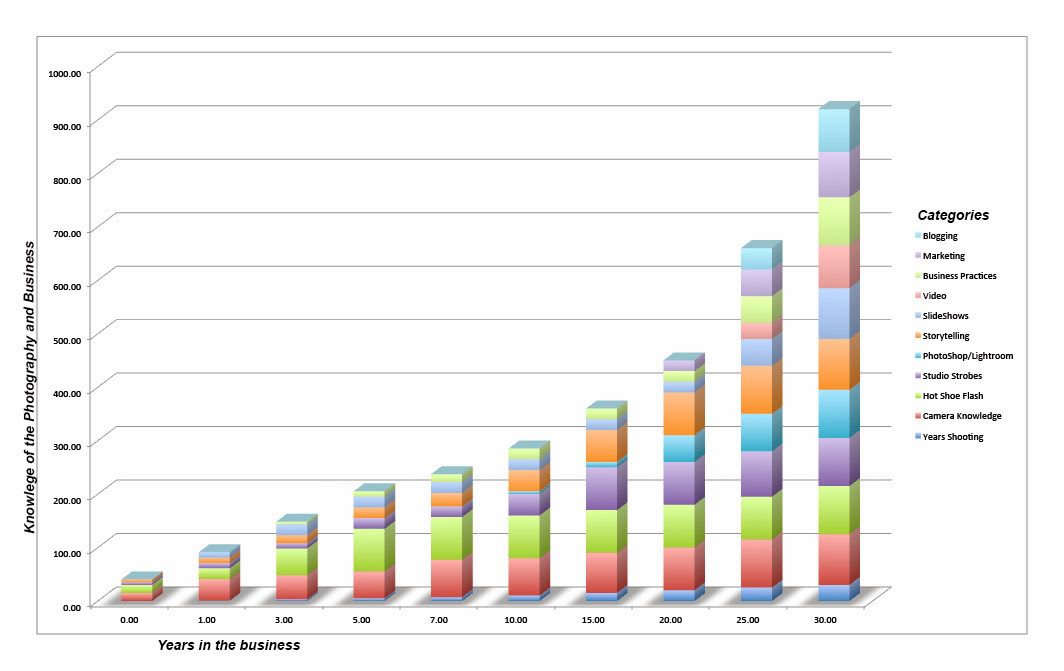
If you look at that top chart, you will see that I knew almost nothing about photography in my first year. While I started to grow, it wasn’t even in all business areas. Each room had its learning curve.

As assignments and responsibilities came my way, those learning curves were growing in new areas. Working at a newspaper, photo studio, photo lab, magazine, college public relations department, and now as an independent photographer, all were very different from each other and had their learning curves.

I believe the more learning curves you have in your life, the more success you will have. When you stop learning, you stop growing. When you stop learning is when you start to die.

Personal Projects

While you learn because you get new responsibilities, you don’t get these responsibilities given to you without a good reason. People hire you to do what they know you can do, not because of what they don’t know you can do. The best way to get a job shooting jobs overseas is to shoot one to show them.

People hire me to shoot projects that are dear to their hearts or at least unique to their paychecks. But, they need someone to help them be successful and do their job better.

There are two reasons people hire me. First, they know what they need, and I fit the bill. They need a headshot and see if I can do what they need and hire me. The second reason I get hired is people see what I am doing and want it.

Needs vs. Wants

I believe needs-based hires are based on what they have seen work for themselves or others and know that this will give them the desired result. Steve Jobs is one of the best to come along in years and created a want for many people. The introduction of the iPhone was a smartphone that made it cool to do certain functions we do every day. Later, when he introduced the iPad, it was introduced to solve problems I didn’t even know I had until I saw how it worked.

For the most part, most Apple products are much more expensive than their competition. How can they do this? They continue to deliver. Many competitors with lower prices don’t provide the quality experience that Apple has consistently. The quality experience is why now when Apple introduces a new product, there is a line at their stores to buy what no one has used before. They know, based on experience this is worth the risk, and the rewards are sure to come.

The best way for creatives to duplicate what Steve Jobs did with Apple products is to create something where you are speaking as passionately about it as Steve did when he introduced a new product. For example, just listen to his presentation on the iPad launch here on YouTube.

[youtube https://www.youtube.com/watch?v=Ndnmtz8-S5I]
The key is to find your passion. What gives you the most joy and happiness? What disturbs you the most and makes you so mad you want to do something about it? Whatever you pick must be emotionally essential, or you will not be able to stay on that subject long enough to capture another person’s interest.

Social Justice is a topic that motivates my heart more than just about anything. I wouldn’t say mistreating or unjustly Is what I like. I want to tell their story. My packages help to communicate total despair or victory.

Many nonprofits are trying to help people just like me. They see my passion for a topic and now want me to help them tell their story and hopefully move their audience as much as I moved them.

One of my passions is immigration. Migrants, for the most part, just follow where the work is, and having work available where they live was my concern. So providing multimedia and still photography coverage for the Just Coffee group based in Agua Prieta, Mexico, was a good fit for my passion.

As corporations and nonprofits saw my coverage, more and more of them wanted similar coverage. I created a want. They were not seeing this type of storytelling coverage to help brand a company.

I was using emotion-packed photos and emotion in the voices of the videos to help communicate despair and triumph.

I think my project graph would look like the above. While I am doing more personal projects than before, I am now seeing a direct correlation between showing what I am passionate about and job growth in the number of clients and projects I am doing today.

When your projects are a way of giving back to your community, as mine has, you also benefit. For example, the movie Pay It Forward helped to start a movement. At first, many thought it was just a fad. Years later, we are seeing people pay it forward in the drive-thru lines, and this string of gestures often goes all day long.

We see TV ads today showing that paying it forward and being contagious.

Why not do a personal project that has the potential to pay it forward in many ways? If you do, then others will want to work with you. They want what you got, which is a heart for others.

Summary: Find your passion and create a package that shows what you can do when you do something to your best ability. Share this with everyone you can. Significant learning curves may be associated with your project as you discover that doing what you need to do to show your passion in the best possible way may require some new skills. The good thing is because you are so passionate about the topic, your ability to learn these further skills increases. After all, your desire is much stronger than when it is just a job. If your project pays it forward, you may even start something that goes viral.