The fear is real. So is the reward of crossing the line anyway.
Almost everyone who has ever had to approach a stranger — to interview them, sell to them, photograph them, or simply love them as a neighbor — has felt the same tightening in the chest right before they do it. That feeling isn’t weakness. It’s one of the oldest instincts we carry, and understanding where it comes from changes how we lead people through it.
Where the Fear Actually Comes From
For most of human history, people outside your group weren’t a networking opportunity — they were a genuine risk. Psychologists call our deep preference for the familiar “in-group favoritism,” and it’s not a personality trait some people have and others don’t. It shows up in children as young as six, operates mostly below conscious awareness, and was, for thousands of years, a survival strategy rather than a flaw. Staying close to your own and staying wary of outsiders kept people alive.
That instinct didn’t disappear just because modern life got safer. It still fires the moment a photography student has to approach someone they’ve never met, the moment a salesperson has to make a cold call, the moment a churchgoer has to talk to someone outside their usual circle. The body doesn’t know the difference between “unfamiliar person at a coffee shop” and “stranger from a rival tribe.” It just knows: proceed with caution — or don’t proceed at all.
Once you understand that, the goal shifts. You’re not trying to make the fear disappear. You’re helping people act alongside it.
For Leaders Teaching Journalism and Photography
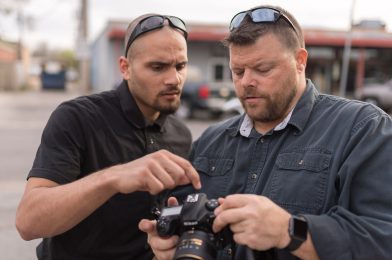
If you teach storytelling for a living, you already know this fear by name — it’s the assignment that brings strong students to tears, not because the camera confused them, but because walking up to a stranger and asking “Can I tell your story?” feels like crossing a real boundary. It is one. The instinct to stay with people who feel familiar is ancient; the craft you’re teaching asks students to override it on purpose, every time.
The most useful thing you can do isn’t push harder — it’s name the mechanism. Tell students plainly that the fear they’re feeling isn’t a sign they’re unsuited for this work; it’s a sign the work is doing exactly what it’s supposed to do. Then build in low-stakes reps — small, low-pressure approaches to strangers in non-photography settings — before the real assignment, so the nervous system gets practice before the deadline matters. Students who understand why they’re afraid stop waiting to feel confident before acting, and start acting their way into confidence instead.
For Business People
In business, this same fear shows up as the email sent instead of the call made, the LinkedIn message instead of the conversation, the lead researched for an hour instead of approached. It looks like procrastination. It’s actually the same ancient wiring — and it’s worth naming, not just pushing past.
What makes the difference is reframing the approach itself. “Can I get five minutes of your time?” feels like an extraction. “I’d genuinely like to understand your situation” feels like an invitation. The words matter less than the posture behind them: are you taking from this stranger, or inviting them in? Most people aren’t waiting to say no to you — they’re waiting to be noticed. The discomfort almost always lives entirely on your side of the conversation, not theirs.
And the stakes are higher than they look. Every new client, every referral, every person who eventually trusts you with their business started as a stranger. The ability to walk toward that discomfort instead of away from it isn’t a soft skill. It’s the foundation the rest of the business sits on.
For the Church
Here’s where the pattern gets most personal, and most convicting. Jesus’ last instruction to His followers wasn’t vague — He told them to be witnesses “in Jerusalem, and in all Judea and Samaria, and to the ends of the earth,” moving in expanding circles from the familiar toward the unfamiliar.
And here’s what often gets skipped over: the first believers obeyed the “Jerusalem” part almost immediately. Ten days after the ascension, Peter stood up and preached to a crowd in the city he already knew. But the harder part of the command — Judea, Samaria, the people genuinely unlike them — didn’t happen for years. The believers stayed clustered together in Jerusalem until persecution scattered them by force into Samaria, a region they’d been taught to treat with open hostility.
In other words: even people who had walked with Jesus Himself, who had a direct command from Him, defaulted to staying with their own. It took real pressure to finally move them across that line.
That should be both humbling and freeing for believers today. If you find it easier to stay inside your church bubble — surrounded by people who think, vote, and worship like you — you’re not uniquely failing. You’re feeling the same pull every human community feels, the same pull the apostles felt before persecution forced their hand. The difference is, we don’t have to wait for persecution to do what obedience could do on its own. We can choose, on purpose, to cross the line Jesus actually drew — toward the Samaritan, the stranger, the person outside the comfortable circle — instead of waiting for circumstances to push us there.
The Reward on the Other Side
Whatever room you’re standing in — a classroom, a sales floor, a church lobby — the instinct to stay with your own is ancient, automatic, and shared by everyone in it. That’s not the bad news. It means no one in front of you is uniquely broken or uniquely behind. The fear is universal.
What isn’t universal is the willingness to walk toward the stranger anyway. That’s the part that’s learned, practiced, and chosen — and it’s the part that produces every great story, every real client relationship, and every act of obedience that actually costs something. The reward was never on the comfortable side of that line. It’s always been on the other side of it.