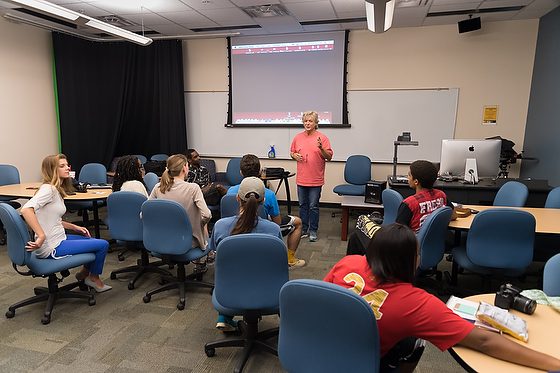
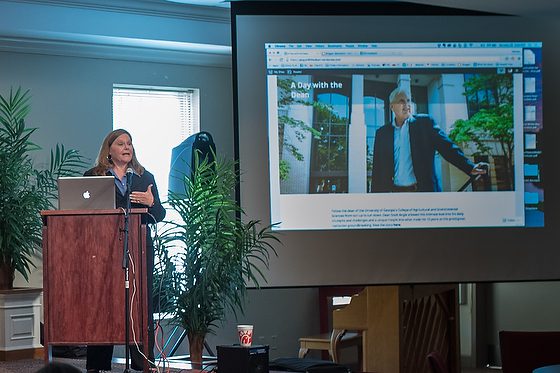
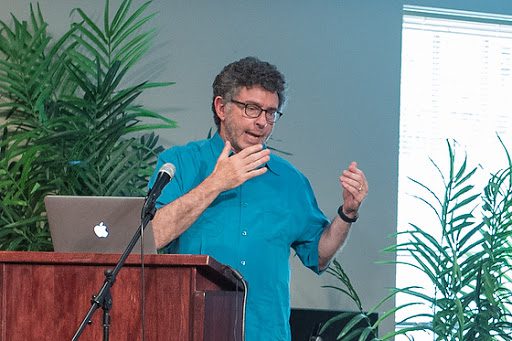
Robin Nelson speaks to the photojournalism class at Kennesaw State University on Thursday, June 16, 2016. [Nikon D5, Sigma 24-105mm f/4 DG OS HSM Art Lens, ISO 3200, ƒ/4, 1/100]
Clay Asbury, lecturer for photojournalism at Kennesaw State University, asked Robin Nelson and me to speak to his photojournalism class.
Clay has been a working professional, but now since his role is that of faculty, he knows that the students will not listen to him as much as professionals working at the moment in the industry. A working pro is why he asked Robin and me to share our work and tips with the students.
There needs to be a connection between what students learn in the classroom and the profession.
Clay Asbury is giving his students the assignment to write about the subject they are passionate about and tell him why they are passionate about it. [Nikon D5, Sigma 24-105mm f/4 DG OS HSM Art Lens, ISO 14400, ƒ/8, 1/100]
When industry professionals connect with a classroom, they cannot only share with students the skills they need but serve as role models and inspire students to reach for the moon. Think about what you wouldn’t have given to get a glimpse of the natural world when you were a student.
Today’s Journalism schools are not the same as yesterday’s curriculum. Programs are changing to prepare the students to be cross-trained in writing, design, video, audio, and photography w, falling under the purpose of storytelling. Often these programs are now being renamed to media storytelling or some variance.
Stanley talks to the students about needing to have their images evoke emotions in the audience. [Nikon D5, Sigma 24-105mm f/4 DG OS HSM Art Lens, ISO 2500, ƒ/4, 1/100 photo made by Robin Nelson]
I shared with the students the importance of visual literacy. Not so much the technology of making a photo but the understanding of body language and how composition can help convey emotions and pull the audience into the story through imagery–moving and stills.
I talked about how I review portfolios because I hire visual communicators for projects regularly. I wanted them to know I need to have images that communicate a message and not just cool pictures.
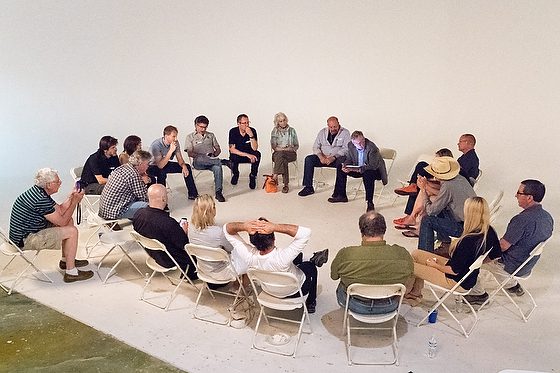
Robin Nelson brought the class into a close circle and took questions from the students. [Nikon D5, Sigma 24-105mm f/4 DG OS HSM Art Lens, ISO 2200, ƒ/4, 1/100]
I agreed to do this for no pay more than just paying it forward. Other pros helped me, but this is just creating competition.
If pros do not take the time to help students have a good foundation for entering the profession, those students will damage the industry.
I have watched so many college students and people who buy camera gear and are self taught help to destroy the industry before they must quit because they cannot make a living any more.
I want the new professionals to do things right so that the clients we all serve are excited to hire visual communicators over and over. But unfortunately, so many do such a lousy job that those who hired them want nothing to do with visual communicators again. They figure they can do the work themselves better than any pro.
Newbees have trouble pricing their work to pay their bills over time. The pricing problem is because they don’t know business practices.
Because they don’t charge realistic prices, those clients think that since they hire someone before for a specific rate, they can get professional work for that rate. Sadly there is another crop of newbies who also don’t know good business practices, and slowly, over time, the newbies leave the industry because they cannot pay their bills and erode the prices for those who were charging more of a livable wage.
I also know that I cannot always do jobs for my clients over time. There will be conflicts in scheduling. I would love to have colleagues who are true professionals in all aspects of the industry so that I can refer my clients.
If you are starting, the best place to meet other pros and get those tips like these students to have in the classroom is through organizations like ASMP and NPPA. Join them for some of the reasons I have outlined here. There are many other reasons as well.
If you are a pro, take the time to mentor young professionals and students. It will only help the industry as a whole.
People shared it 32 times through Google Plus alone. It ranks 5th of the 1098 blog posts I have written for the most read. There are 44 comments on this post. Everyone on the base was positive except for one that was more of a question. “Is all lost when most of these points have been true?”
My response was, “No. You cannot continue to fail over the long haul. Again you don’t have to do all of it yourself; you can outsource. My recommendation is to realize to be successful, you need to 1) have a good solid product consistently, 2) you need to deliver more than you promise, 2nd-mile service, and 3) WOW them. It would be best if you connected with people way beyond your product. Just think of the TV show Cheers; the people came back to the bar regularly because of friendships on top of the food and good service.”
When I reposted it, I had the most negative response for any of my blogs. So I started examining why this person was taken back by my post.
The poster slammed the blog as Listicle.
In journalism and blogging, a listicle is a short form of writing that uses a list as its thematic structure but fleshing out with sufficient copy publishing as an article. A typical listicle will prominently feature a cardinal number in its title, with subsequent subheadings within the text itself reflecting this schema. The word is a portmanteau derived from a list and article. Suggesting that the word evokes “popsicle,” emphasizing the Listicle’s fun but “not too nutritious” nature.
After reading a few more comments, I realized what I think the person was having an issue with from my article. The reviewer was struggling with a newbie vs. a seasoned pro.
In a workshop with Scott Kelby, I loved one of his comments. “If you need a hug, you post on Flickr.com.”
As an amateur, your friends and family will comment on how great of a photographer you are. However, the minute you turn Pro, that all changes.
I felt the same thing this poster indicated in his comments that we need to wrap each other in emotional support as pros. My wife pointed out that you are a pro; people expect you to have great photos. My experience is they don’t comment on you for doing.
For this article, I want to be clear that the difference between the word amateur and professional is solely the difference of hobby versus making a living. My comments are not about the quality of images because I think many amateurs produce better images than pros. Most amateurs, however, could use a dose of reality that the most significant difference for the working Pro over the amateur is business skills, not photographic skills.
As an amateur, you may join a photo club where you all help and encourage one another. Many camera clubs around me have had me speak to them and judge their competitions. I enjoy doing this and sharing some of my knowledge with them.
Professionals understand that when they go to workshops and meetings with pros, we are getting together to get better at our business skills. We may learn the same things that a camera club gets together to learn about the latest software, but we need this knowledge to remain competitive rather than take photos.
Professionals also understand they need to pay for those classes and workshops. The people teaching them are working pros that give you information that will help you make a better living.
Going Pro will be a lonely journey for several reasons. Most of all, your friends and family comments about how wonderful you are now will seem emptier if they are not hiring you to shoot for them. If they thought you were so awesome, wouldn’t they hire you?
While most professionals will help you, not everyone will be as enthusiastic that you showed up on the scene. First of all, remember in some areas of the industry, like newspapers, the opportunities are disappearing. When pros were making $200,000+ for shooting stock years ago, and now they can barely make $20,000 doing the same type of work, you showing up and taking more of the smaller slice of the pie is very threatening.
New pros must be aware of one major thing when they become pros. Just because you graduated and knew how to make beautiful images does not immediately mean there is work for you. Every client who hired photographers last year will likely hire those same photographers. When you get hired, one of those photographers often just lost that job you are shooting.
Some pros take this the wrong way and, therefore, will do everything they can to sabotage your career. Pros feel threatened if you set up shop in their town.
Now there is a great group of photographers I have been a part of that does not take this attitude. You may find one of our members like that, but I can tell you we do not encourage that. This group is ASMP.
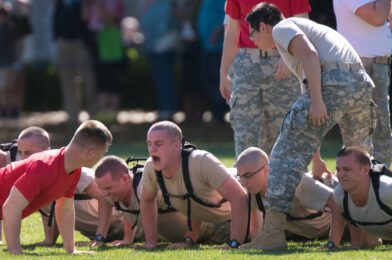
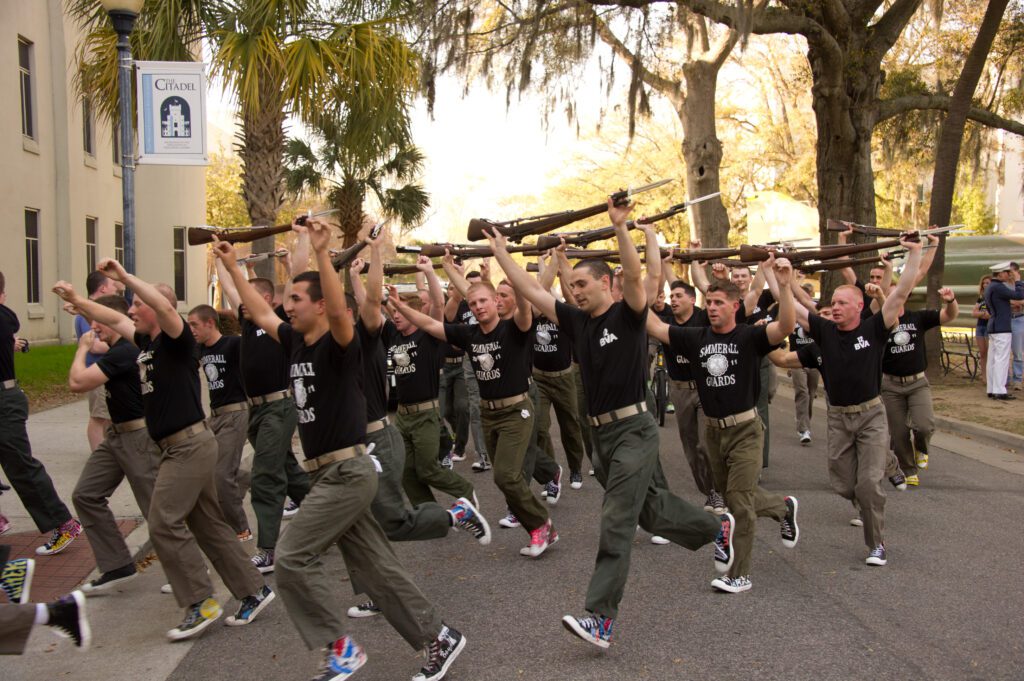
Charleston, SC The Citadel Recognition Day 2019 [Nikon D4, Sigma 120-300mm ƒ/2.8 DG OS HSM | S, Sigma TC-2001 2x, ISO 2000, ƒ/5.6, 1/4000]
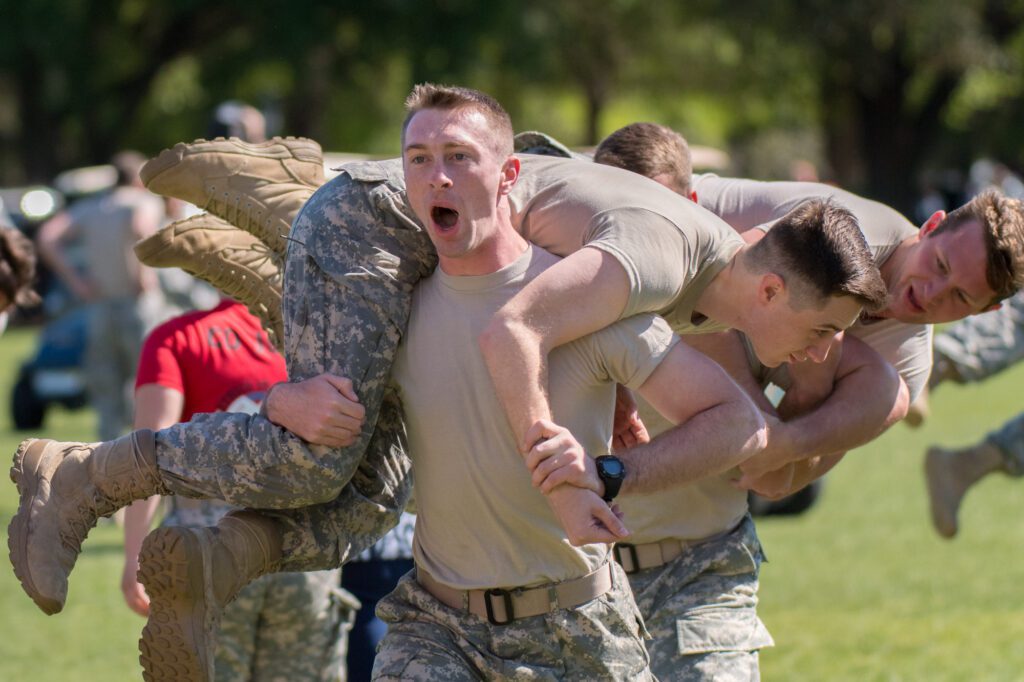
ASMP [American Society of Media Photographers] has championed business skills for photographers better than any other organization I have been a member of in my career. I joined in 1987 and have learned more through the organization and fellow members than anywhere else. Like the photo of the Citadel cadets carrying one another as they might have to do in battle to save their comrade, my ASMP fellow members took me.
To join ASMP as a member, you must get a sponsor who is satisfied that the applicant meets the eligibility requirements for Professional Membership, namely:
Good moral character and reputation, and
At least three consecutive years of experience as an imaging professional.
Now, if you are starting, we have an associate’s membership where you have the same access as a member, just not voting rights. If you haven’t proven you can run a successful business for three years straight; we don’t need you making business decisions for the organization.
We see the new photographers much differently. We work to find another chair and welcome you to our table. We take you under our wings and do everything we can to be sure you are successful.
The best things I learned right away from the start with ASMP were the importance of good business practices. I learned about how to figure out the cost of doing business. I knew that when I create estimates, the client would often try and negotiate for a lower price or more services for the same price.
ASMP worked to protect my copyright by helping to inform congress what this means for photographers to have copyright protection.
Charleston, SC The Citadel Recognition Day 2019 [Nikon D4, Sigma 120-300mm ƒ/2.8 DG OS HSM | S, Sigma TC-2001 2x, ISO 1250, ƒ/5.6, 1/4000]
My fellow ASMP members didn’t give me a group hug as I would experience as an amateur on Flickr. It felt like they took the legs out from under me, and they did. They were carrying them just like you see in this photo. They helped me by challenging me on my low prices. How are you making a living on that price?
The one thing that made me sad about the poster’s comments was that “no matter the pay,” he wouldn’t be swayed to stop shooting. You see, he is the type of new Pro that needs ASMP.
His attitude of “no matter the pay” means he will accept just about any job because he loves to shoot. After all, he said, “It’s in my blood and who I am.”
Through the years, my ASMP colleagues and I have helped countless photographers learn how to make a living and even a great living. One of those I took under my wing was a young lady who, when I met her, was a nanny and going to school full-time.
I had her assist me and talked with her answering all her questions. Then, she took on a client that had her traveling all over the state, shooting travel magazine packages for the publication. The magazine had traded out with hotels to keep costs down. So every town my assistant went to, there was a hotel she stayed in for free. So it appeared in many ways the magazine was thinking about her.
When we spent a few hours reviewing her expenses and what they paid her, she discovered she was making way below minimum wage.
When her car started to have mechanical issues, she realized she could get it fixed and continue doing the work. But unfortunately, she wasn’t making enough to cover the costs of owning a car.
The expenses were when she realized that continuing with this magazine; she wasn’t just making below minimum wage; she was paying them to shoot for them. YES!!! You heard me.
Her mother rented her a car so she could go and do the assignment, but the project didn’t pay enough to cover the rental car fees and all the other costs associated with doing the work.
Today, that young woman is not only doing better but also doing great. She not only is making a good living, but she also has staff working for her more than three people.
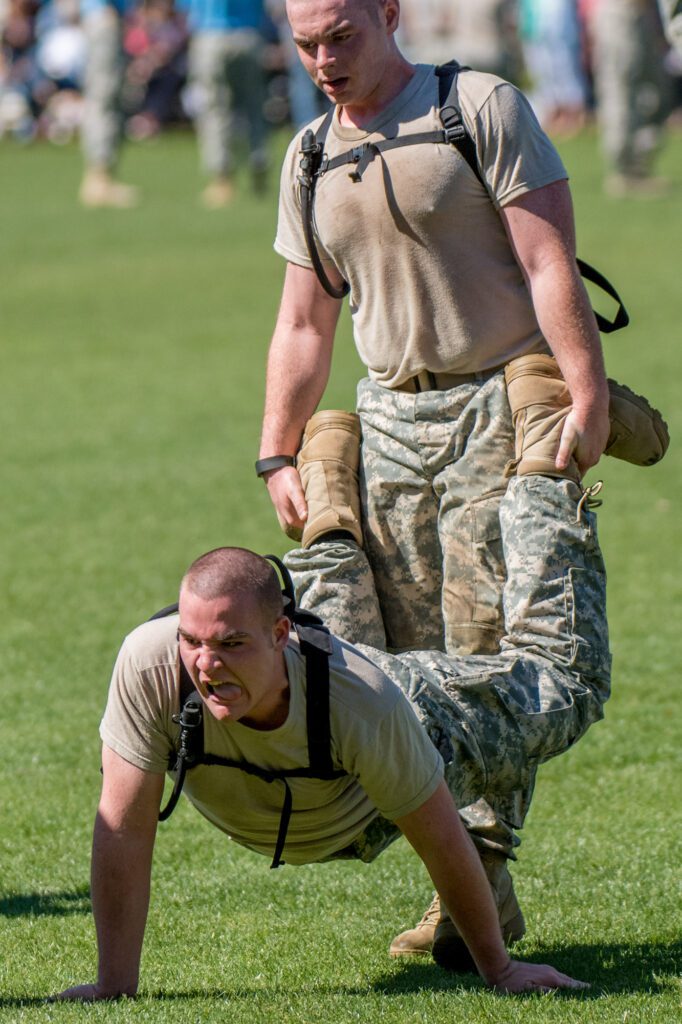
Charleston, SC The Citadel Recognition Day 2019 [Nikon D4, Sigma 120-300mm ƒ/2.8 DG OS HSM | S, Sigma TC-2001 2x, ISO 1100, ƒ/5.6, 1/4000]
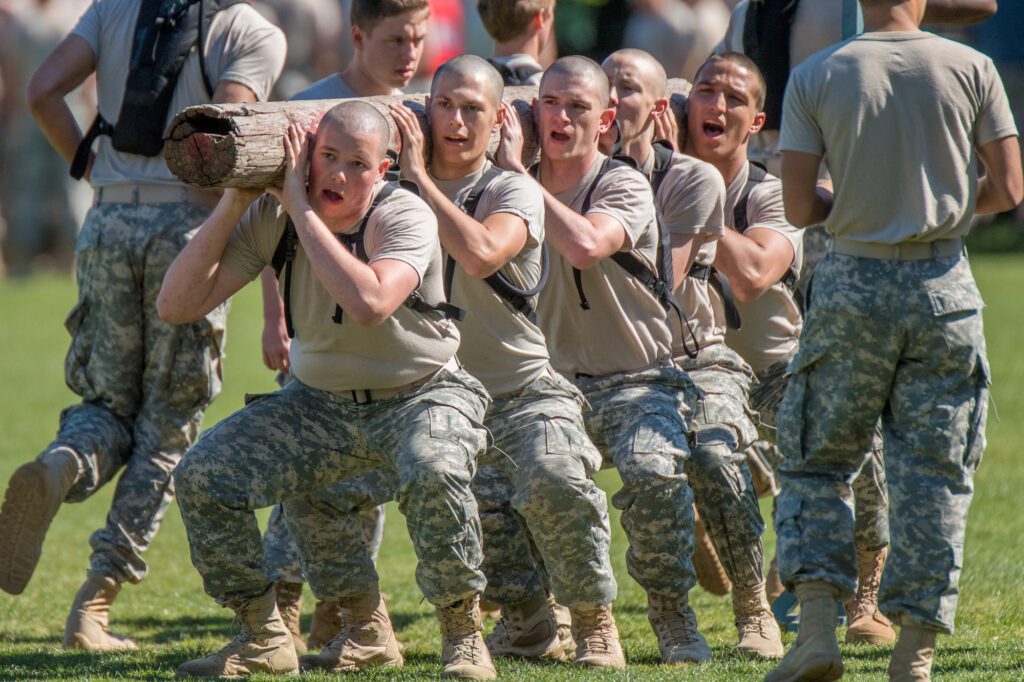
ASMP members know that photographers who do not understand business principles will not only go broke they will leave the industry worst off. Now those clients think that the rates they were paying those failed photographers were reasonable. We need you equally lift the sector just as these guys do in carrying the log. They cannot do it alone.
Turning Pro from amateur status is when you start to have adult conversations. These conversations are when you do not like everything you hear from a seasoned pro trying to help you out, but you see it as them trying to get rid of you.
Young photographers can learn something from professional bull riders. First, they started riding young calves before graduating to bullocks and then bulls. Then, between the ages of four and six, they hone their skills by “mutton busting” on sheep. You see, bull riding is one of the most dangerous sports in the world. An estimated one in every 15 bull rides ends in some injury.
I can tell you that many pro photographers feel like one in every 15 assignments ends up in some injury. We like to call that scar tissue which builds wisdom.
I recommend joining ASMP and NPPA, which has, in the last few years, changed to help freelancers even more with business practices than when I joined in 1985.
Corps Day Weekend Nikon D3S, AF-S NIKKOR 28-300mm f/3.5-5.6G ED VR, ISO 1600, ƒ/6.3, 1/320
Remember, when you turn Pro, people expect you to have great photos, so don’t go looking for a group hug like you got as an amateur.
In military training, young men come together with a diverse mix of our American landscape. Yet, those differences melt away through their training which pushes their limits to each person realizing that those strangers they met on day one are there alongside them, even willing to die for them.
You will see if you look complex enough, seasoned pros taking on a lot of fire and struggling to stay alive. ASMP members know that each of us has gone through our training for at least three years. We know we are all battle tested and helping one another.
James 3:16-18 The Message (MSG) Live Well, Live Wisely 13-16 Do you want to be counted wise, to build a reputation for wisdom? Here’s what you do: Live well, live wisely, live humbly. It’s how you live, not how you talk, that counts. Mean-spirited ambition isn’t wisdom. Boasting that you are wise isn’t wisdom. Twisting the truth to make yourselves sound wise isn’t wisdom. It’s the furthest thing from wisdom—animal cunning, devilish conniving. Things fall apart whenever you’re trying to look better or get the better of others, and everyone ends up at the others’ throats. 17-18 Real wisdom, God’s wisdom, begins with a holy life and is characterized by getting along with others. It is gentle and reasonable, overflowing with mercy and blessings, not hot one day and cold the next, not two-faced. You can develop a healthy, robust community that lives right with God and enjoy its results only if you do the hard work of getting along with each other and treating each other with dignity and honor. Waking up Sunday morning to the news of the Orlando massacre where one man took the lives of 50 people and injured another 53 people was gut-wrenching.
Today our country is more divided to me than at any other time in my lifetime. Yet, every group seems to say that all will be well if you think like us.
One of the most challenging things I have wrestled with in my faith is the concept of Free Will and, simultaneously, having an omniscient God. If God knows everything we can learn, how can you have faithful Free Will?
If God allows for our Free Will, how much should we allow each other to exercise Free Will?
John, the disciple, recorded Jesus’ prayer for his disciples.
John 17:14-17
14 I have given them your word and the world has hated them, for they are not of the world any more than I am of the world. 15 My prayer is not that you take them out of the world but that you protect them from the evil one. 16 They are not of the world, even as I am not of it. 17 Sanctify them by[d] the truth; your word is truth.
The Christian ideal is not freedom from work, but strength to do it; not freedom from temptation, but the power to overcome it; not freedom from suffering, but joy in an abiding sense of the Father’s love; not absence from the world, but grace to make the world better for our presence; not holy lives driven from the world, and living apart from it, but sacred lives spent in the world and leavening it.
I have been unfortunate for many years as I watch those who call themselves people of faith not show grace or love but rather a condemnation and hate of those who do not hold to their beliefs.
I watched as political parties wrapped themselves with what they call faith, but what I saw as a condemnation of those who didn’t believe as they did.
John 13:35 The Message (MSG)
34-35 “Let me give you a new command: Love one another. In the same way I loved you, you love one another. This is how everyone will recognize that you are my disciples—when they see the love you have for each other.”
To me, this is one of the most powerful scriptures in the Bible. It tells us how we are to live our lives. Jesus says this at the last supper and before his arrest and crucifixion. So many of us were just like Peter when he said to Jesus –
36 Simon Peter asked, “Master, just where are you going?”
Jesus answered, “You can’t now follow me where I’m going. You will follow later.”
37 “Master,” said Peter, “why can’t I follow now? I’ll lay down my life for you!”
38 “Really? You’ll lay down your life for me? The truth is that before the rooster crows, you’ll deny me three times.”
Our purpose here is to not talk about our faith as much as we are to live it. Living it is to show the love of God through our actions with others.
The power of true love is most profound with significant loss. The actions of the lone gunman in Orlando Night Club were extremely severe. Each time our country has suffered such a loss, the community responds. The stories after 9/11 were great healing to our country.
Our response should be that no matter who you are–your life matters, and you matter. Our community will always suffer when anyone dies. We suffer even more when that loss is due to violence, such as in Orlando.
Nikon D4, AF-S NIKKOR 28-300mm f/3.5-5.6G ED VR, ISO 100, ƒ/8, 1/250
This past memorial day, we celebrated those who gave their lives through the armed forces so that we can have the freedom of Free Will in our country. Memorial Day is very personal for my family.
ON THE BEACH: The first wave of Marines takes cover behind the dunes on Saipan beach during the World War II invasion of the Marianas Islands. The soldier kneeling in the sand at the far right is Carl Matthews of Texas; second from right is Wendal Nightingale of Skowhegan, Maine; standing is Lt. James Stanley Leary of North Carolina. Neither Nightingale nor Leary made it home from Saipan; both are still missing in action. Time Life photo by U.S. Marine Sgt. James Burns
I think one of the hardest things our country is going through is for those who are new to the concept of being able to exercise their Free Will. It is hard because where many are from, they could not enjoy such freedoms.
I am so thankful that I do not live in a Democracy but rather a Republic form of Government.
The chief characteristic and distinguishing feature of a Democracy is the Rule by Omnipotent Majority. In a Democracy, The Individual, and any group of Individuals composing any Minority, have no protection against the unlimited power of The Majority. It is a case of Majority-over-Man.
A Republic, on the other hand, has a very different purpose and an entirely different form, or system, of Government. Our Government is designed to protect the individual’s rights, not for a majority rule.The definition of a Republic is a constitutionally limited government of the representative type, created by a written Constitution–adopted by the people and changeable (from its original meaning) by them only by its amendment–with its powers divided between three separate Branches: Executive, Legislative and Judicial. Here, the term “the people” means the electorate.
Let us remember the words of James Madison regarding the republican form of Government:
“As there is a degree of depravity in mankind which requires a certain degree of circumspection and distrust: So there are other qualities in human nature, which justify a certain portion of esteem and confidence. Republican government (that of a Republic) presupposes the existence of these qualities in a higher degree than any other form. Were the pictures which have been drawn by the political jealousy of some among us, faithful likenesses of the human character, the inference would be that there is not sufficient virtue among men for self government; and that nothing less than the chains of despotism can restrain them from destroying and devouring one another.”
It takes more thought and purpose to create laws than it does to react. We think of how the direction we make will impact everyone. We want those laws to benefit all of us. We are careful not to create a rule that singles out one person because one day, that person could be us. We must be a community that values each person’s life.
The more I understand and study storytelling, the more I see the importance of protecting the rights of people to make their own choices. I also see that solving their problem is not possible for the main subject in a story. They must have help. Individual rights are why my belief in God and community is at the core of a good story.
Nikon D5, Sigma 24-105mm f/4 DG OS HSM Art Lens, ISO 125, ƒ/8, 1/800
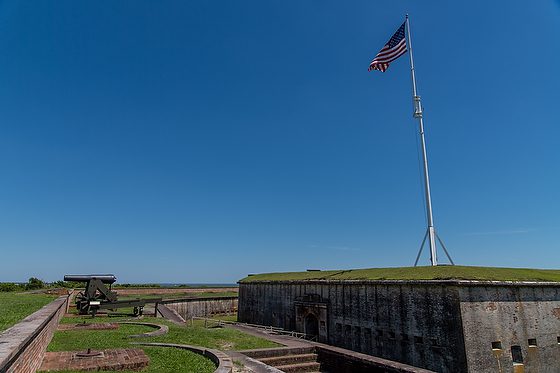
I enjoyed taking a little time during my vacation on Emerald Isle Beach to visit Fort Macon State Park. I loved using the Nikon D5 for this adventure with the Sigma 24-105mm ƒ/4 DG OS Art Lens.
Nikon D5, Sigma 24-105mm f/4 DG OS HSM Art Lens, ISO 102400, ƒ/8, 1/40
Why was the Nikon D5 so helpful versus my smartphone that everyone else was using? Try taking this photo with a phone or camera—the image’s ISO at ISO 102,400, which the smartphone cannot achieve. The room was off the big room.
Nikon D5, Sigma 24-105mm f/4 DG OS HSM Art Lens, ISO 125, ƒ/8, 1/800
I enjoyed walking around and reading the plaques, helping me learn more about the fort’s history.
Nikon D5, Sigma 24-105mm f/4 DG OS HSM Art Lens, ISO 8000, ƒ/8, 1/100
There are 26 casemates in the fort (including sally port). The room restored one of them to show the enlisted quarters during the civil war. The fort held off the union soldiers for one month as the union organized an attack. In less than 11 hours, the canons firing at the fort overpowered the regiment. Five hundred twenty-six canons hit the fort before they surrendered.
Nikon D5, Sigma 24-105mm f/4 DG OS HSM Art Lens, ISO 125, ƒ/8, 1/400
The dynamic range of the Nikon D5 was great. The wall of the Citadel portion of the fort was in shadow, but it held together just fine to the highlights.
You can even see detail in the Sally Port, which is in the deep shadow during the middle of the day sunshine.
Many years ago, I had been to the fort and knew what to expect. I just carried one lens to capture everything that I needed.
Nikon D5, Sigma 24-105mm f/4 DG OS HSM Art Lens, ISO 6400, ƒ/8, 1/100
While many people prefer a smartphone to capture their trips, I still enjoy the DSLR and mainly the Nikon D5 to capture those moments so that I can see them with my eye in person.
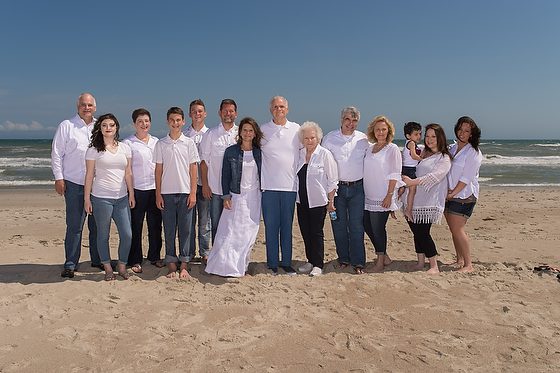
It is that time of year for my family’s annual photo at the beach. We based what we would wear on what most of us had in our closets–white shirts and blue jeans.
A couple of problems with the family facing the lighting would have been 90º to their right—. First, the background was busy with all the people on the beach, and second, the wind would be at their backs and blowing everyone’s hair to the front.
Last night I attended the ASMP Atlanta Chapter meeting, where the executive director Tom Kennedy shared the organization’s status. He was here to listen to the members and what they also see as a need for the organization.
When we asked the question, “What is the value proposition of ASMP?” is when we found that we didn’t have a straightforward answer.
WIIIFM – We realize that one of the first things most photographers ask is, “What Is In It For Me?”
“What Is In It For Me?” is a common theme that every business and organization must realize. We are here to serve our audience/customers. The tricky thing for most volunteer organizations is that those volunteering for the organization are also the audience.
We as volunteers are more prone to give of our time when we are getting something out of it.
In the FOCUS meeting last weekend Greg Thompson, director of corporate communications for Chick-fil-A, talked about this from the perspective of hiring new people to his team.
Greg listens for how long the person talks about what they want to get out of a job versus what they want to give of themselves. Then, he went on to speak about Truett Cathy.
“When you focus on what other people need and want it is amazing how you get what you want.” –– Truett Cathy
While there may be some examples out there on how to be indeed successful, I think, for the most part, that the way to certainly be successful is counterintuitive, which is why it is so difficult for people.
As we were wrapping up the meeting, Tom Kennedy talked about one of the most influential words he remembers shaping America when he was just ten years old from the inauguration of John F. Kennedy.
“My fellow Americans, ask not what your country can do for you, ask what you can do for your country.” –– John F. Kennedy
Ah Ha, a Moment for me.
Last night the Ah Ha Moment for me was hearing people talking about how they wanted to help the organization and were volunteering. The moment it clicked was when someone offered to go to the area colleges and art schools to talk about ASMP.
I have been doing that for the past fifteen years or more. I have been speaking to colleges and art programs regularly about business practices.
I realized that many of my colleagues were having the same trouble with volunteering as they do with talking to clients about work. Of course, they are more than willing to help and would if asked, but that is the problem.
By the way, when speaking to those groups, I represent ASMP. I also represent every other group I am a member of, like NPPA, Roswell Presbyterian Church, Atlanta Press Club, and many hats I wear. So you see, ASMP is doing a great deal. Just see what our members are already doing.
As members, we act on behalf of the organization informally all the time. Member’s actions are how new members will decide to join or not based on how they see us conduct ourselves. Many people join organizations because they are impressed with the members or stay away, saying they are just hypocrites.
Now I am not sure we see that we often create another problem when we ask a client if there is anything we can do to help. Sure there are times that if you have a good relationship already with a client, they may be able to tell you something, but the reality is most of the time, they would have to stop and think about their needs and then think about your abilities.
It is the same thing as someone coming to your house offering to help you. Often they would be embarrassed to let you see the inside of their house and then for them to know how YOU can help.
Possible Solution
Let’s take a problem situation: a family has just had a loved one seriously hurt in an accident and is now in the hospital. Calling the family and asking if there is anything I can do is not as effective as offering them some specific services that you can do for them.
Here are some ideas:
Can I bring you a meal today?
Can I go by your house and handle some things for you?
Cut their grass
Get their mail
Check on their pets
Pick up some clothes for you
Your children can stay at my house, and I can get them off to school for you – can I do that for you?
When someone is in a very stressful time, for them to stop and think of things you can do for them isn’t easy. Yet, this is where genuinely service-oriented people thrive and rise to the top. Be proactive and not reactive. While you think that asking if there is anything you can do is bold, it is fishing for something that you can be reactive to doing.
Volunteer Suggestions
I think I will be taking my advice and reaching out to Tom Kennedy with some things I can offer to do for the organization.
Hey Tom, I would like to volunteer by writing some blog posts and am willing to coordinate getting others to write some positions. Would this be something you could use?
Tom, I have been going to area colleges and speaking on Business Practices and could videotape one of my presentations or share my PowerPoint if that could help others do that around the country.
Tom, I would love to create a multimedia package for some of our Atlanta chapter members who are great success stories on how they are helping clients reach their goals.
I think it is easier for the organization to react to my proactive actions than for me to ask what I can do for the organization. By the way, all this bold conversation about helping your associations you might be a member of also works for how to get more jobs.
Faith Peppers, the director of public affairs and chief communications officer for the University of Georgia College of Agricultural and Environmental Sciences, recommends that communications professionals ask themselves, “What do you want to be known for?”
Peppers says she often hires for a character and may also consider if someone has particular skills like storytelling.
During our FOCUS panel discussion, Michael Schwarz said a mouthful in just a couple of minutes.
When he was new in the profession, he asked clients, “What do you want me to do?” Later he would discover that wasn’t the right question.
Listen to Michael explain this evolution in his career.
“What are you trying to accomplish with this project? Or Why are you hiring me?” is the better question. Which often is met with, “I don’t know, let me get back to you with an answer.”
While the client had a shot list, the better question helped to focus all the content and also gave Michael ideas on how to pitch some of the solutions he could deliver.
I hosted yesterday’s FOCUS [Fellowship Of Communicators Uniting Socially] meeting in Roswell, Georgia.
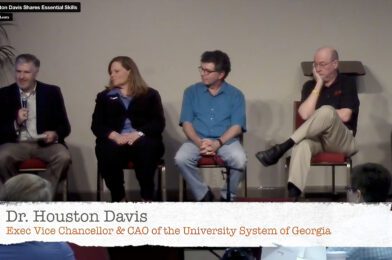
We had a panel discussion of these industry leaders; you can listen to them in the video above. They are discussing the state of the industry and tips they recommend for today’s professional communicator.
Dr. Houston Davis serves as the Executive Vice Chancellor and Chief Academic Officer of the University System of Georgia. USG comprises Georgia’s 30 public universities and colleges, including four research universities, the Institute of Oceanography, State Archives, the Public Library System, and statewide Information Technology Services. USG enrolls approximately 314,000 students and employs about 41,000 faculty and staff.
Before May 2012, Davis served as the Vice Chancellor for Academic Affairs for the Oklahoma State Regents for Higher Education and the state’s liaison on the national Complete College America initiative. Before 2007, he served as Associate Vice Chancellor for Academic Affairs for the Tennessee Board of Regents, on faculty and academic leadership for Austin Peay State University, in fiscal and academic affairs for the Tennessee Higher Education Commission, and as a regional counselor for the University of Memphis. In addition to his past professional duties, he served as director for the National Educational Needs Index project, a Lumina-funded initiative measuring educational, economic, and population pressures in the 50 states that influence policy and planning at local, regional, and national levels.
He is involved in research projects and writing on higher education governance, economic development, and accountability issues. He also serves on several national advisory groups on higher education policy, degree completion, academic preparation, and responsibility. He received his Ph.D. from Vanderbilt University with other degrees from the University of Memphis and Tennessee State University.
In addition to his professional duties, Houston Davis has served as director for the National Educational Needs Index project from 2004-2011, an initiative measuring educational, economic, and population pressures in the 50 states that influence policy and planning at local, regional, and national levels.
Dr. Davis is involved in research projects and writing on higher education access, governance, economic development, and accountability issues in higher education and serves on several national advisory groups on higher education policy, degree completion, academic preparation, and responsibility. A native of Clarksville, Tennessee, Davis received his Ph.D. from Vanderbilt University, Nashville.
Faith Peppers is the director of public affairs and chief communications officer for the University of Georgia College of Agricultural and Environmental Sciences. She is known across North America for work in agricultural issues management and crisis communication. She manages strategic communications, issues management, brand, and executive reputation management, crisis communication, and legislative relations for the college, agricultural experiment stations, and Cooperative Extension.
She holds an associate’s degree in journalism from Middle Georgia College and bachelor’s and master’s degrees in journalism and communication from Georgia State University. Before joining the University of Georgia in 1993, she spent more than ten years as an Atlanta newspaper reporter, public information officer, and marketing specialist. She has won numerous regional, national, and international awards for writing, editing, media relations, marketing, and communication training. She is an often-requested speaker on media relations, crisis communication, and other public affairs topics across North America.
She has published research and professional development papers on defining agriculture to urban audiences, effective media relations in urban markets, strategic issues management, and working and managing in a telecommuter workplace.
Her current work focuses on what promises to be the most significant social justice issue of the next decade – food security worldwide.
Michael A. Schwarz is an independent editorial and corporate photographer/videographer based in Atlanta, Georgia. Over a 30-year career, Michael has completed over 6,000 assignments for publications and corporations around the globe. His editorial client list has included USA Today, Fortune, Forbes, Business Week, The New York Times, Newsweek, Time, National Geographic Traveler, The Chronicle of Higher Education, and Sports Illustrated. His corporate client list has included The Home Depot, UPS, The Coca-Cola Company, Harvard University, Brown University, GE, Synchrony Financial, and Porsche.
Michael has a background as a photojournalist and is a 3-time Pulitzer Prize nominee. He has received numerous awards from the Pictures of the Year competition and was a winner of the Dag Hammarskjold Award for Human Rights Advocacy Journalism. Many years ago, LIFE Magazine featured Michael as one of the best young photographers in America in a special issue of their magazine. In 1998, Michael collaborated with author Ellen Spears on the book “The Newtown Story: One Community’s Fight for Environmental Justice.” Michael is a native of Baltimore and a graduate of the Rochester Institute of Technology. Michael has served on the Board of Directors of the Atlanta Photojournalism Seminar and the Atlanta Chapter of ASMP. He maintains membership in the National Press Photographers Association (NPPA), the American Society of Media Photographers (ASMP), and the Atlanta Press Club. In a recent reader’s poll sponsored by the Atlanta Press Club, Michael’s collaboration with writer Steve Sternberg, “When AIDS Comes Home,” was voted the favorite Atlanta story of the last 50 years.
In addition to his photographic work, Michael does digital photography consulting and training. His corporate clients have included: Nikon and Best Buy. He is a featured trainer with Blue Pixel Inc. and has been a lead instructor of Nikon School since 2001 and a workshop leader for the Mentor Series.
Greg Thompson is senior director of corporate communications for Chick-fil-A, Inc., one of America’s largest privately held restaurant chains with 2,000 restaurants and annual sales of almost $7 billion.
Before joining Chick-fil-A, Greg spent 25 years in worldwide management and executive positions with IBM in Atlanta, Tucson, and Tokyo. In his career at IBM and Chick-fil-A, Greg has edited several magazines and websites, produced numerous events, product rollouts, videos, and multi-media packages, and has hired countless photographers, videographers, writers, and producers – including several Pulitzer Prize winners. He has also worked as a writer, producer, photographer, and consultant for several well-known organizations.
Greg joined IBM after a career as a photographer and journalist for three newspapers and The Associated Press.
He graduated from Vanderbilt University, where he studied history, political science, and sociology while working as a reporter and photographer for the then Gannett-owned Nashville Banner.
Greg also is involved as a volunteer and consultant with several faith-based NGOs around the world. He serves on the boards of HOI, which focuses on Honduras and Nicaragua, and SCORE International, which focuses on the Dominican Republic, Costa Rica, Panama, and Cuba. Greg accompanied a SCORE medical relief team into Haiti shortly after the 2010 earthquake and worked with CRASH Japan and Samaritan’s Purse in Tohoku, Japan, after the 2011 earthquake and tsunami. In addition, he has volunteered in Honduras, the Dominican Republic, Peru, Guatemala, Nicaragua, Mexico, Cuba, Jamaica, and Cambodia.
Greg and his wife, Mary Belle, have been married 32 years and live in Marietta, Georgia.
All my trips overseas have been for humanitarian work. Humanitarian work is concerned with or seeks to promote human welfare.
During this past trip to Nicaragua, there were many opportunities to take care of primary healthcare needs. Now, the tricky thing sometimes for a humanitarian photographer is to capture and compel the audience to act.
In the homes, they didn’t have a medicine cabinet with their essential bottles of Tylenol, Ibuprofen, Aspirin, cough medicine, and Band-Aids. If they needed an aspirin, they would go to the city and buy not a bottle but just a few pills. That is all they could afford. I needed to capture the medically trained indigenous volunteers checking blood pressure or giving an IV because handing a person a small ziplock bag of ibuprofen doesn’t read quickly to the audience as medical care.
Nicaragua
The gravity of this moment with medical missionary nurse practitioner Traci Warner isn’t as apparent to the audience visually as I would have wished. Dominga is the lady in the middle with the IV above her head. Her sister is to the left and had just paused a moment from waving the fan to keep her sister comfortable.
Dominga is dying from cancer. After we visited, Dominga would die later that night.
Nicaragua
Missionary nurse practitioner Warner has much more to offer than her medical skills. During this part of life that we all will go through, Warner took the time to read Psalm 23.
Verse 4 speaks to me:
4 Yea, though I walk through the valley of the shadow of death, I will fear no evil: for thou art with me; thy rod and thy staff they comfort me.
This photo captures some of the reasons why I like working with missionaries. They care for the whole person and not just their physical needs, but they are also spiritual.
Nicaragua
If you are taking photos of humanitarian work, you must keep shooting. Sometimes, taking pictures and thinking that something better will come is a mistake. Instead, you shoot everything you can and pick the moments that best capture the work and the story’s soul.
Here, Warner is checking a lady’s skin condition with the Nicaraguan medical volunteer, who is learning about the fungal condition.
Words are paramount to understanding each of these photos. So take notes and describe what is happening in an image and why they are doing something.
Nicaragua
I like this photo of the young girl here. Now, without text, it is still a very compelling photograph. However, in the context of the images above, the picture can have even more meaning, but the words are required to help the audience feel more impact than the visual can.
The young lady leaning on the post is the granddaughter of the lady in the first photo. Having her blood pressure taken, the lady had high blood pressure, which they monitored. However, the medical team did not just give her some medicine to help lower their blood pressure; they helped her by educating her on her diet. So today, she no longer needs the blood pressure medicine but needs to monitor it.
By saving the grandmother, we saved the granddaughter’s caretaker. Now, she has someone to watch and take care of her while her parents are both out working to make ends meet for the family.
Many young girls like her are raped and abused due to a lack of adult supervision. Who would think that humanitarian aid through medical training and blood pressure pills would help save this young girl’s life?
Telling people’s stories is why I love traveling and helping improve people’s lives. How do I make things better when I am not a nurse practitioner? I help tell these stories and get people like you to give and go to make a difference.
Nicaragua
The workshop is not a classroom class only. Instead, it allows you to produce a complete project that will do what you would if you captured the story on your own. The difference is that you have teachers/coaches to help you navigate all the hurdles of storytelling.
Nikon D5, Sigma 24-105mm f/4 DG OS HSM Art Lens, ISO 640, ƒ/9, 1/100
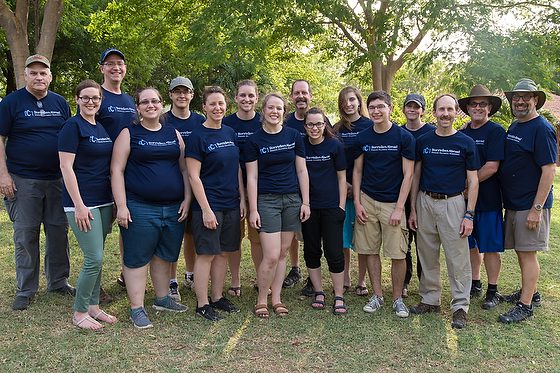
The group photo is our Storytellers Abroad Nicaragua team from this past week. Nicaragua was the third workshop. We have been to Lisbon, Portugal, and Bucharest, Romania.
Nikon D5, Sigma 24-105mm f/4 DG OS HSM Art Lens, ISO 1250, ƒ/4, 1/100
Bruce Edgar led us one morning for our devotional. Having devotionals led by the local team not only helps us get to know the missionaries of the Nicaraguan team but also helps us focus each day and ask God for guidance. With so much packed into our day with new things to learn and practice, we need a lot of help and rely on God to direct us each day.
Each day we had a different missionary lead us.
Nikon D5, Sigma 24-105mm f/4 DG OS HSM Art Lens, ISO 4000, ƒ/8, 1/100
I wanted to give you some idea of what students are doing in these workshops and the Honduras Multimedia workshop I have going on this fall and still have openings.
We take some time during the first few days where we spend time in the classroom to help you with that day’s assignment. Here is a photo from our classroom in Managua, Nicaragua.
Nikon D5, Sigma 24-105mm f/4 DG OS HSM Art Lens, ISO 20000, ƒ/8, 1/100
We first review all the settings for your camera, microphones, and Adobe Premier. Then, we practice recording each other. We spend the Sunday shooting around in some churches where many of our subjects attend, and then we interview like here. On that Monday, leaders try to get out with everyone during the week to help observe you working and give tips.
Nikon D5, Sigma 24-105mm f/4 DG OS HSM Art Lens, ISO 100, ƒ/4, 1/640
While some of the students were jumping right into the shooting up and personal with the subjects, we would help those who were shyer and reserved to learn how to take control of the story and get the content they needed to tell the story more effectively.
Nikon D5, Sigma 24-105mm f/4 DG OS HSM Art Lens, ISO 2000, ƒ/4, 1/100
We start in the classroom and quickly get you out with your subject, shooting for 3 to 5 hours for three days. At the end of your time with the issue, you come back, ingest all your cards, and make notes. After this, you sit with one of the instructors to review your work.
We ask you to identify each of the storyline elements in your story. Your outline will look something like this:
Subject/Character – A little information about the person you are covering
Their family
Their work
Their volunteer work
Conflict/Problem – What is the problem that they cannot solve on their own
Guide/Resource – who is helping them, and what resources are available or lacking?
Assignment – What does the guide/mentor recommend to help solve the problem for the subject?
Actions – What actions has the subject taken
Outcome – Is it a Tragedy or Comedy?
CALL TO ACTION – We add one more step in the story process: asking the audience a straightforward question and directions on how to get involved. Again, we are not teaching you to entertain with a story but rather to engage the audience until they take action and get involved somehow.
Nikon D5, Sigma 24-105mm f/4 DG OS HSM Art Lens, ISO 1600, ƒ/4, 1/100
Many of our students have been shooting for years and taking videos or photos to help missions or NGOs tell their stories. So we spend a lot of time helping them break bad habits and giving them the tools to help them do a better job as storytellers.
Stages of Learning
There are stages of learning. Here are the six primary steps, listed from the most rudimentary to the highest levels of comprehension:
Knowledge (memorizing, recalling)
Comprehension (expressing ideas in new forms)
Application (transfer of learning to a unique situation)
Analysis (breaking a communication down into its parts)
Synthesis (creating something new by putting pieces together)
Evaluation (judging value based on standards)
Stages of Learning (from LeRoy Ford’s book “Design for Teaching and Training)
We understand how one learns, so the course is designed to move you to the final stage, where you are functioning at the highest level of evaluation.
We are training you to identify a story and how to produce it so that it connects with the audience and elicits a response, which we call the CALL TO ACTION.
Nikon D5, Sigma 24-105mm f/4 DG OS HSM Art Lens, ISO 1100, ƒ/4, 1/100
Here I am giving some examples to the class. We then explain how we use visuals to communicate and direct the audience to understand. You will see an example of each thing you learn, then you will also know why we do it a certain way, and then you get to practice those skills yourself. The good thing is each day, we give you feedback on how well you performed. If you fall short, we will send you back to fix it.
Nikon D5, Sigma 24-105mm f/4 DG OS HSM Art Lens, ISO 2200, ƒ/4, 1/100
In the past few trips, we had some storytellers capture the workshop’s storyRob Llewellyn, who also works with ESPN, jumped in to help one of the students while we were busy with the other students.
Nikon D5, Sigma 24-105mm f/4 DG OS HSM Art Lens, ISO 14400, ƒ/11, 1/100
Before we leave the country, we do a screening for the subject, the missionaries, and friends. The screening helps us realize there is an absolute deadline to complete this project.
Photo by Rob Llewellyn
Here is a photo of Jeff Raymond, Team Leader; James Dockery, teacher; and Stanley Leary, a teacher in downtown Managua, Nicaragua. Please consider joining Stanley Leary and Gary S. Chapman in Honduras for a similar workshop from October 29 – November 5, 2016. Honduras Workshop information.
We haven’t chosen a location or dates for the 2017 Storytellers Abroad workshops, but be sure to bookmark this in your browser and check back often to see about our future seminars.
We made a video while in Lisbon, Portugal, to explain the workshop.
Cookie Consent
We use cookies to improve your experience on our site. By using our site, you consent to cookies.