Why You Can’t Find Those Photos You Paid That Photographer to Shoot

Reading Time: 2 minutes

Imagine this: you’re rushing to put together a presentation, social media post, or annual report, and you know there’s a perfect photo from that event you paid a photographer to capture. But no matter where you look, you can’t find it. Sound familiar?

The problem isn’t just where the photos were saved—it’s how they were saved. Let’s unpack why this happens and what can prevent it.


The Common Ways Photos Get Lost

  1. The “I’ll Just Download It” Approach
    You received a link to download the photos, saved them to a random folder on your computer—maybe named something vague like “Event Photos March 2023”—and forgot about it. Over time, that folder got buried in your hard drive or lost when you switched devices.
  2. Cloud Chaos
    You uploaded the images to Google Drive, Dropbox, or another cloud service, but they’re scattered across folders without clear labels. Searching for “event” or “team photos” brings up dozens of results, none of which you need.
  3. Cryptic File Names
    Your photographer sent you files like “IMG_2451.jpg” or “DSC_9876.jpg.” Those names mean nothing to you, and without additional information, finding specific photos becomes a guessing game.

The result? You waste time searching—or worse, give up entirely.


A Better Way to Organize Photos

Now, picture this: you’re not just staring at random file names the next time you open your photo folder. Instead, each photo has invisible “notes” attached to it. These notes include details like:

  • Who is in the photo (names of key people)?
  • What is the photo about (event name or description)?
  • When it was taken (exact date and time).
  • Where it was taken (specific location).

These details act like breadcrumbs, leading you straight to the photos you need without wasting time searching or guessing.


How Does This Happen?

The secret is hiring a photographer who delivers beautiful images and prepares them for your future self. This is done by embedding helpful details (called metadata) into each photo before handing them off to you.

For example:

  • Instead of sending you “IMG_1234.jpg,” the photographer embeds names, event details, and location data into the image.
  • You can search for photos by person, event, or place—even if years have passed.

This is especially useful for organizations with long histories or global operations. When your team needs images for storytelling, marketing, or archiving, these details make it easy to find precisely what you’re looking for.


Why It Matters for You

Without these details, those photos become just a pile of pretty pictures no one can use. Years from now, no one in your organization will remember who was in that group shot, what event it was from, or even where it was taken.

While cloud storage or AI tools can help sort photos by basic features (like faces or colors), they can’t tell the full story. That story—those specific details—can only come from the photographer who was there.

So next time you hire a photographer, ask them: Will my photos be ready for the future? If they embed details into the pictures, the answer will be yes.


Want to make sure your photos are as organized as they are stunning? Let’s talk. Together, we’ll create visuals that are as easy to find as they are to admire.

Tagged :

The Art of Real Estate Photography – Why a Pro Makes All the Difference

Reading Time: 2 minutes

When it comes to selling a home, first impressions are everything. Recently, I had the pleasure of working with a client preparing to sell their home. They wanted their listing to stand out in a competitive market, so they called me to photograph their property, knowing the importance of showcasing it in the best possible light—literally.

Today, I’ll explain what went into this shoot and why professional photography is worth the investment. I’ll also share a few before-and-after shots to see the transformation and the final gallery images I delivered to the client.

The Challenge: Turning a House into a Home Buyers Will Love

When I first walked into the home, I could see the potential. It was a beautiful property but didn’t show its best side under standard lighting conditions like most homes. Harsh shadows, uneven light, and cluttered spaces can distract buyers. Even the best smartphone couldn’t do justice to this space without the right tools and techniques.

The Process: Professional Tools for Professional Results

Here’s how I approached this project:

  1. Tripod for Stability and Precision
    A steady tripod is non-negotiable in real estate photography. It allowed me to take multiple exposures of the same shot, ensuring every detail was perfectly sharp.
  2. Multiple Exposures for HDR Magic
    The dynamic range of most spaces is too much for a single photo to handle. Bright windows often blow out, or the corners of a room fall into darkness. I used multiple exposures to capture the highlights and shadows, blending them seamlessly for a balanced final image.
  3. Flash to Eliminate Shadows
    Even with multiple exposures, natural light often isn’t enough to create a clean, inviting look. I used off-camera flash to fill the shadows, making the spaces feel bright, open, and welcoming. This also ensured accurate and vibrant colors.
  4. Post-Processing Expertise
    The final step was combining all these elements in post-processing. The magic happens here, from blending exposures to fine-tuning colors and removing minor distractions.

The Results: Before and After

The lead photo shows some before-and-after examples from the shoot. On the bottom, you’ll see how the space looked with essential lighting and a smartphone attempt. On top of that, you’ll see the transformation after applying professional techniques. Notice how the room looks brighter, the colors are more vibrant, and the space is more inviting.

The Final Gallery

Here are some of the final images that were delivered to the client. These photos that buyers will see first can distinguish between a home sitting on the market or selling quickly.

Why It Matters

Smartphones are great for casual snapshots but can’t compete in real estate photography. A professional approach ensures every detail is considered, from lighting to composition to post-processing. It’s an investment that pays off by attracting more buyers and showcasing your property at its best.

If you’re preparing to sell your home, don’t leave your first impression to chance. Let me help you create a visual story that excites buyers about your property. Contact me today to learn more about my real estate photography services.

Tagged :

Revitalize Your Photography Archive: A Guide to Organizing Years of Photos Without Workflow

Reading Time: 3 minutes

Getting organized might feel overwhelming if you’re a photographer with years’ worth of scattered digital files on CDs, DVDs, old external hard drives, or legacy software like Apple Aperture. However, reining in your archive is incredibly freeing: it speeds up your workflow, safeguards your work, and brings order to the creative chaos. Organizing your images is not just about tidying up; it’s about finally making your entire library accessible and preserving it for the future.

Embrace the Benefits of a Cohesive Archive

Having an organized archive means finding images fast, saving time on projects, and even improving your creative process as you discover patterns and themes. The mental map you’ve held onto for years—remembering vaguely where images were stored among stacks of discs or folders—will shift as you create a new order. Recognize that, initially, this reorganization might seem confusing as old habits and paths give way to a system, but this transition brings long-term clarity and efficiency.

Converting Aperture Libraries to Lightroom Classic

If you’ve relied on Aperture, you know it’s no longer supported on newer macOS versions, which makes tools like Avalanche for Lightroom invaluable for transitioning smoothly to Lightroom Classic. Avalanche maintains original file structures, recreates folders and album hierarchies, transfers keywords, and preserves face tags. It even handles edits like exposure, contrast, and other basic adjustments using machine learning. If Lightroom doesn’t support specific Aperture edits, Avalanche places those images in a review folder so nothing is lost in the shuffle. Avalanche provides a straightforward browser interface that detects all connected drives, so you don’t have to hunt for archived files.

For more details on using Avalanche to migrate Aperture libraries, you can check their website for guides and system requirements.

Why Upgrade to a NAS

Many photographers store files across multiple hard drives, but this approach carries significant risk. Hard drives can fail, get misplaced, or become corrupted over time. A Network-Attached Storage (NAS) system like Synology provides a centralized, secure archive beyond essential storage with RAID configurations, creating redundant copies to protect against single-drive failures.

Synology NAS systems can also monitor each file’s health and automatically repair corrupted data using features like Btrfs (a file system known for its data integrity and self-healing properties). This setup ensures that if bit rot or corruption occurs—common risks for files stored on standalone hard drives—the NAS can automatically correct the error using redundant copies.

Incorporating a NAS into your workflow is especially beneficial for photographers, as it supports the 3-2-1 backup rule: keeping three copies of each file on two different types of storage, with one copy stored offsite. Using a NAS with Lightroom lets you securely access your files from any networked device, streamlining your workflow and future-proofing your archive with built-in data protection.

Workflow Overview: From Ingesting to Organizing

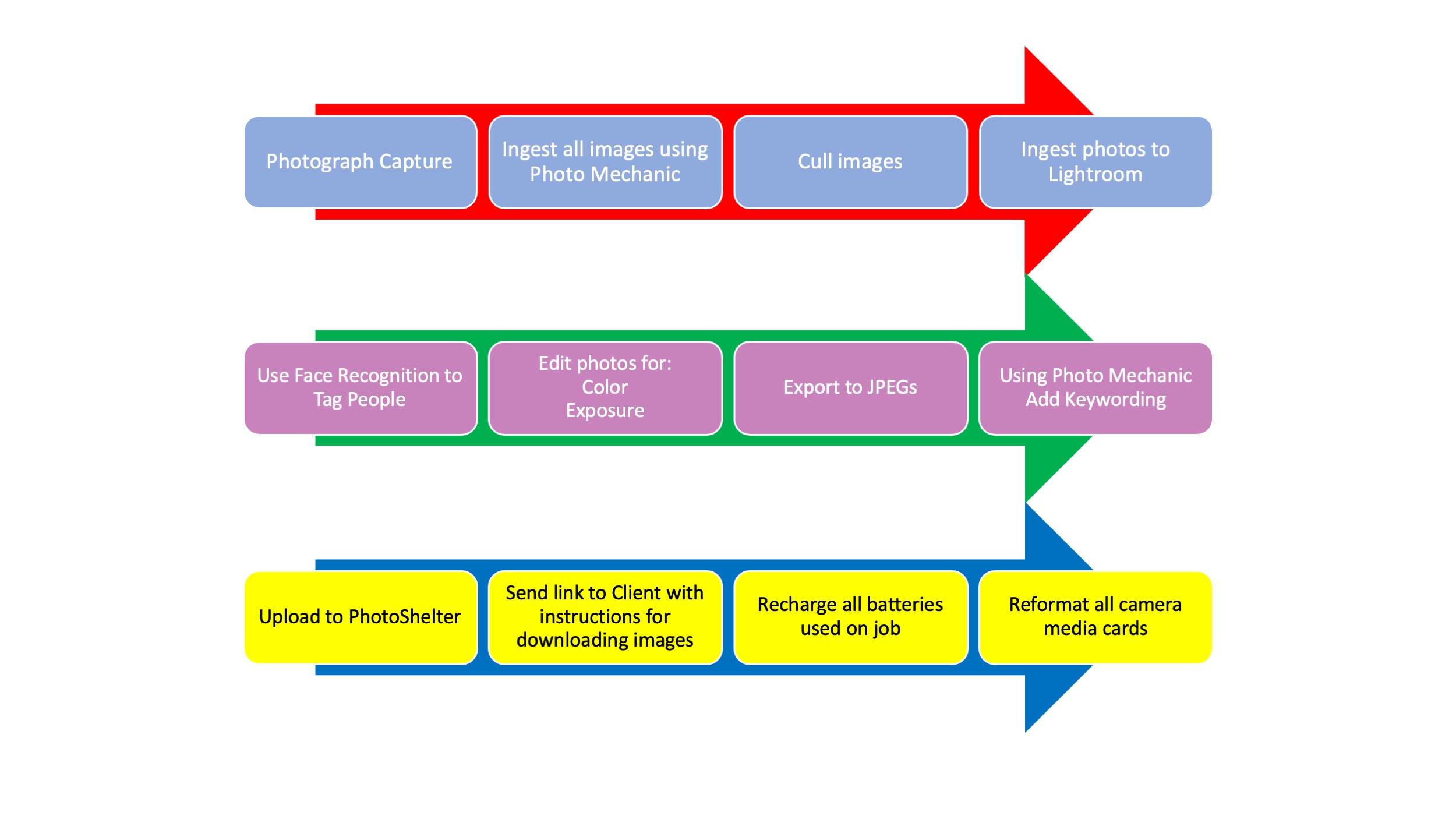
To create a seamless workflow: (my workflow)

  1. Ingest & Cull with Photo Mechanic Plus: Start using Photo Mechanic for initial file naming, culling, and basic metadata. This keeps your files organized and saves you time in Lightroom.
  2. Edit in Lightroom Classic: After importing culled files into Lightroom, edit for color, exposure, cropping, and dodging/burning. Lightroom offers powerful tools to enhance image quality without altering the original file.
  3. Final Storage: Export JPEGs and store them in a cloud-based system like PhotoShelter, and include them in your Photo Mechanic catalog for easy retrieval. This dual system ensures your photos are secure and accessible.

Visualizing Your Setup

To illustrate this organization, imagine your NAS as the center of your workflow, supporting your archive and daily work needs. All files are backed up in the NAS, and Lightroom accesses files directly for edits. Photo Mechanic is the initial entry point for organizing new images. With cloud integration, your JPEGs and essential metadata remain accessible to clients and collaborators, ensuring your archive is well-organized and actively helpful.

This process will take time, but as your new system takes root, you’ll gain flexibility, speed, and creative control over your work.


If reading this makes you feel ready to take the plunge but unsure where to start, I’d be delighted to help you transform your photo archive into a structured, easy-to-use library. From converting Aperture files to setting up a customized NAS system and streamlined workflow, I offer one-on-one consultations to make your process as efficient and user-friendly as possible.

To get started, you can reach me directly at Stanley@StanleyLeary.com or call (404) 786-4914. Let’s work together to put you back in control of your images and create a powerful, organized archive you’ll enjoy using.

Tagged :

The Unseen Side of Running a Photography Business: Backups, Bookkeeping, and Staying Organized

Reading Time: 3 minutes

When you envision a photography business, the highlights probably involve the thrill of capturing unforgettable moments, the satisfaction of delivering powerful visual stories, and the creative freedom of being your boss. But there’s a side that often goes uncelebrated, which has less to do with creativity and more to do with critical systems that keep a business running smoothly.

For instance, as a working photographer or videographer, your workflow goes far beyond taking photos or editing videos. Much of the effort lies in managing files, backing up assets, handling finances, and staying organized. Today, I’m breaking down the less-glamorous but essential elements: transitioning to a more robust 3-2-1 backup plan with a NAS (Network-Attached Storage), improving file integrity, and bookkeeping—all of which keep me from spending sleepless nights wondering if I’ve lost precious work or missed an expense.

File Integrity and the 3-2-1 Backup Plan.

In the digital age, your work must be stored securely and reliably. I’ve been using the 3-2-1 backup method for years, which involves keeping three copies of every file: two stored locally but on different devices and one stored offsite. This approach minimizes the risk of losing work due to drive failures or disasters.

Recently, I’ve been upgrading one of my “2” backups to a NAS system instead of a standard external hard drive. The beauty of a NAS lies in its ability to manage file integrity actively. Unlike a basic hard drive, which simply stores data, a NAS includes software that continually checks file health and alerts you to any issues. This software runs integrity checks, like checksum verification, which can detect even tiny file corruptions before they become a bigger problem.

The NAS is a more reliable backup, and I’m also using it to back up my and my wife’s computers. This setup is a massive step up from Mac’s Time Machine, a good tool for automatic backups, but Mac’s Time Machine lacks some of the active management features that NAS software provides. With the NAS, I have a better handle on what’s happening with each file, and I can run scheduled backups from both devices directly to it, centralizing and safeguarding everything in one spot.

Bookkeeping: Staying on Top of Finances

Alongside technical tasks, managing finances is another crucial, ongoing aspect of my business. I use Quicken to track all bank and credit card transactions and rely heavily on its categorization feature, especially as tax season approaches. This organization keeps me aware of my expenses, categorizes them for easy tax reporting, and helps me see spending patterns—something you don’t want to overlook.

In addition to tracking transactions, I scan and attach all business-related receipts to each Quicken transaction. This small habit saves me hours when filing taxes and protects me if I ever need to verify an expense. Scanning and organizing receipts may seem tedious, but it’s part of keeping my business documentation accurate and audit-proof.

Consistency: The Key to Staying Organized

The thing about financial organization is that you can’t let it build up and then tackle it sporadically. Waiting too long to log transactions can lead to confusion, forgotten details, and even missed fraudulent charges. There have been times when I’ve uncovered incorrect charges simply by staying on top of my records.

For instance, this consistent oversight helps me catch subscriptions I may have forgotten to cancel. As you grow your business, these small amounts can add up, so staying proactive is essential. And as tempting as it might be to put off bookkeeping, regularly updating your records will keep you aware of your cash flow and allow you to stay financially nimble.

For Freelancers: The Payoff of Organization

For those freelancing in photography or videography, this level of organization and attention to backup protocols may initially feel excessive. But it’s worth it. Keeping your files secure and your finances organized frees you to focus on what you do best—creating. By investing a little extra time and effort in these practices, you’re ultimately protecting both your work and your business.

Remember, the “back end” of your business—the part clients never see—plays a massive role in your ability to deliver work reliably and sustainably. Taking these steps now to ensure file safety and financial accuracy will help you operate confidently and with peace of mind as you move forward.

Tagged :

Friday Night Lights with the Nikon Z9: Workflow and Shooting Tips

Reading Time: 2 minutes

Capturing high school football under the Friday night lights is all about preparation, precision, and a solid workflow. Here’s how I approach it, from setting up at the stadium to the final image uploads.

Preparation and Setup

I arrive early to set up and ensure my Nikon Z9’s settings are dialed in. I start by creating a custom white balance with an ExpoDisc to capture the colors accurately under stadium lighting. This step is essential for achieving true-to-life tones, especially with inconsistent lighting.

[NIKON Z 9, NIKKOR Z 100-400mm f/4.5-5.6 VR S, Mode Aperture Priority, ISO 25600, 1/250, ƒ/5.6, (35mm 340)]

Gear and Initial Setup

  • Camera: Nikon Z9
  • Lens: NIKKOR Z 100-400mm f/4.5-5.6 VR S, perfect for action shots across the field
  • White Balance: Custom setup with ExpoDisc
Using AI background mask

Workflow Steps

  1. Ingest Photos: I load all photos into Photo Mechanic to cull and add metadata. This allows for quick organization and eliminates unnecessary shots.
  2. Editing in Lightroom: I import the best images into Lightroom after culling. I adjust backgrounds using AI masking to reduce distractions, allowing the players to stand out more. I also use AI Denoise for cleaner images, which is invaluable under low light.
  3. Export and Sharing: After editing, I export the images to JPEG. I upload the finished files to my PhotoShelter account via Photo Mechanic, resizing select pictures for social media sharing on Facebook and Instagram.
[NIKON Z 9, NIKKOR Z 100-400mm f/4.5-5.6 VR S, Mode = Aperture Priority, ISO 25600, 1/400, ƒ/5.6, (35mm = 130)]

Shooting Tips for High School Football

  • Stabilize and Track: Use the NIKKOR Z 100-400mm f/4.5-5.6 VR S lens for sharp, action-packed shots, leveraging the Nikon Z9’s focus tracking to keep up with fast-paced plays.
  • Stay Dynamic: Anticipate the action and adjust positioning around the field for varied angles.
  • Lighting Adjustments: Dial-up ISO as needed; the Z9 handles higher ISO settings well. However, consider making background edits to mitigate distractions.

With a streamlined workflow and attention to detail, each game becomes a storytelling canvas, capturing the energy and excitement of high school football.

Tagged :

Why IPTC Metadata is Superior to File Names for Organizing Photos

Reading Time: 4 minutes

As a professional photographer, efficiently organizing and identifying your photos is critical to streamlining your workflow and maximizing productivity. Whether managing your archives or sharing a collection with a client, the method you choose for organizing images can make or break your efficiency. Many photographers start by naming files and sorting them into folders, but there’s a much better system available: IPTC metadata.

In this post, I’ll explore why using IPTC metadata to tag and identify your images is far superior to relying solely on file names and folders. I’ll also share ideas for incorporating photos or graphics to make your metadata work visually intuitive.


What is IPTC Metadata?

IPTC metadata refers to information embedded directly into the image file itself. This can include captions, keywords, photographer information, copyright details, location data, and more. Unlike file names and folders external to the image, IPTC metadata remains with the image no matter where it goes, ensuring your photos are constantly organized, searchable, and protected.


1. Consistency Across Platforms

Have you ever moved a batch of photos from one folder to another, only to lose track of where things are? One significant benefit of IPTC metadata is that it stays with your image across platforms. Whether the image is stored on your local hard drive, uploaded to a cloud service, or shared via a client portal, the metadata goes with it. This means your images can always be identified—no matter where they end up.


2. Granular Searchability

Metadata lets you attach keywords, descriptions, and other identifying information directly to your images, making them far more accessible to search and retrieve later. If you need to find photos of a specific event, subject, or location, you can search by the metadata fields instead of trying to recall file names or folder locations.


3. International Standardization

IPTC metadata follows global standards, meaning it works across different software, platforms, and industries. Whether you’re using Adobe Lightroom, PhotoMechanic, or another editing tool, IPTC metadata is recognized. This standardization is a massive advantage in professional settings where collaboration and consistency are essential.


4. Context Preservation

File names only hold so much information; folders often become vague or repetitive. With IPTC metadata, you can store critical context about an image, such as the names of people featured, location data, or even a short story behind the shot. This helps you and clients or collaborators who need to quickly understand the image’s backstory.


5. Managing Large Collections

For photographers managing thousands of images, manually renaming and sorting files into folders can quickly become overwhelming. IPTC metadata enables you to batch tag and organize photos faster and more accurately. Met metadata makes an image’s details readily searchable without complex file structures.


6. Intellectual Property Protection

Another considerable advantage is the ability to embed copyright information directly into your photos. With IPTC metadata, you can include your name, copyright date, and usage restrictions, ensuring that anyone using the image can quickly identify its creator. This is particularly important in today’s fast-paced digital world, where photos are frequently shared online.


7. Enhanced Client and Team Collaboration

Clear organization is vital to smooth the process when sharing an extensive photo library with a client or team. IPTC metadata allows clients to search for images based on keywords or descriptions rather than manually sifting through hundreds of files. This leads to quicker image selection and a more seamless collaboration process.


Conclusion

While organizing images with file names and folders can work for small collections, using IPTC metadata elevates your workflow to a professional level. It provides consistency, powerful searchability, standardized organization, and intellectual property protection—all in one comprehensive system. By embedding this information into the image file, you’re future-proofing your photo organization and making your work more accessible to clients and collaborators.


Tagged :

Navigating the Ever-Changing Photography Industry: How Professional Photographers Can Thrive

Reading Time: 3 minutes

The photography industry has undergone significant changes over the past few decades, with each wave bringing challenges and opportunities. Photographers have faced numerous disruptions from the transition of film to digital, the commoditization of stock photography, the rise of smartphones, the impact of the pandemic, and the advent of artificial intelligence. But does this mean the professional photographer is a fading presence in society? Absolutely not. Here’s how professional photographers can stay in business and thrive in this evolving landscape.

Major Shifts in the Photography Industry

Transition from Film to Digital: The shift from film to digital revolutionized how photographers work. It democratized photography by lowering entry barriers, allowing more people to take up photography as a hobby or profession. However, it also meant photographers had to adapt to new technologies and workflows.

Stock Photography Market Changes Platforms like Getty Images, influenced by the tech industry and individuals like Bill Gates, commoditized stock photography, driving prices down. This made it harder for photographers to earn a living solely through stock images, pushing many to diversify their services.

The Rise of Smartphones High-quality smartphone cameras put powerful photographic tools into the hands of the masses. This increased competition reduced the perceived need for professional photographers for casual and even some commercial photography needs.

The impact of the COVID-19 pandemic halted many in-person events, significantly impacting photographers who relied on weddings, conferences, and other gatherings. Even as the world has started to recover, many businesses have cut back on hiring photographers due to budget constraints or shifting priorities.

The Advent of Artificial Intelligence AI can now generate images and enhance photos, presenting both a threat and a tool for photographers. AI-driven tools can assist in editing and managing images, but they also raise concerns about the authenticity and value of human-created photography.

Despite these challenges, there are several strategies professional photographers can employ not just to survive but thrive:

Embrace Technology and Continuous Learning Stay updated with the latest camera technology, editing software, and AI tools. Use these advancements to enhance your work, streamline your workflow, and offer new services that add value for your clients.

Specialize and Differentiate: Find a niche where you can excel and stand out. Whether it’s commercial photography, portraiture, event photography, or a specific style, being known for something unique can set you apart from the competition.

Offer a Full-Service Experience Go beyond just taking photos. Provide end-to-end solutions, including pre-production planning, post-production editing, and even marketing services for your clients. Storytelling, which I excel at, is a powerful tool for connecting with clients and creating lasting value.

Build Strong Relationships Networking and maintaining solid client relationships can lead to repeat business and referrals. Personalized service and excellent customer experiences can make a big difference in client retention.

Leverage Social Media and Online Presence Use social media platforms to showcase your work, tell your story, and engage with a broader audience. A solid online presence can attract new clients and create additional revenue streams through print sales, workshops, and more.

Diversify Your Revenue Streams Explore different ways to monetize your skills. This can include teaching photography workshops, creating online courses, selling prints, or offering consulting services for businesses looking to improve their visual branding.

Focus on Authenticity and Quality In a world flooded with images, high-quality, authentic photography stands out. Focus on producing work that resonates emotionally and tells compelling stories. This can create a strong connection with your audience and clients, making your work more valuable.

Conclusion

While the landscape for professional photographers has undoubtedly changed, opportunities still abound for those willing to adapt and innovate. You can survive and thrive in today’s photography industry by embracing new technologies, honing in on your unique strengths, and continuously finding ways to add value to today’s clients. As a storyteller and brand builder, I’ve seen firsthand the power of authentic, compelling photography. It’s about keeping up with the times while staying true to the art of storytelling through imagery.

Here’s to thriving in the ever-changing world of photography!


Feel free to connect with me, Stanley Leary, for personalized photography services and workshops that can help you elevate your visual storytelling and branding. Together, we can navigate this dynamic industry and create impactful stories that resonate.

Tagged :

How to Choose the Best Photo to Engage Your Audience: A Guide for Nonprofits and Businesses

Reading Time: 3 minutes

In today’s visually driven world, selecting the right photo can significantly affect how your audience engages with your content. Whether promoting a nonprofit cause or marketing a business, the right image can capture attention, evoke emotions, and tell a compelling story. Here’s a guide to help you pick the best photo to engage your audience effectively.

The Top Question to Ask

Does this photo tell a compelling story or evoke an emotional response?

This is the most crucial question you need to answer. A photo that tells a story or evokes an emotional response will naturally engage your audience more effectively. It’s the emotional connection that makes a photo memorable and impactful.

Additional Questions to Consider

  1. Is the subject of the photo clear and well-composed?
    • Ensure the main subject is easily identifiable and the composition draws the viewer’s eye to the focal point. Clarity and focus are crucial to keeping the viewer’s attention.
  2. Is the photo high-quality in terms of resolution, lighting, and clarity?
    • A technically sound photo with good lighting, sharp focus, and high resolution is essential for a professional look. High-quality images reflect well on your brand.
  3. Does this photo align with our brand identity and message?
    • The image should be consistent with your brand’s tone, style, and values. It should reinforce what your brand stands for and the message you want to convey.
  4. Is the photo relevant to the content it accompanies?
    • The image should enhance and complement the text or video paired with it, providing context and relevance. Irrelevant images can confuse the audience and dilute your message.
  5. Does the photo stand out in a crowded feed?
    • Consider whether the image is visually striking enough to capture attention amidst other content. Unique and eye-catching photos are more likely to stop a user from scrolling past.
  6. Is there a clear context or setting in the photo?
    • Photos with a recognizable context or setting can help tell a more detailed story and make the image more relatable. Context adds depth to your narrative.
  7. Is the photo culturally sensitive and appropriate for our audience?
    • Ensure the image is respectful and appropriate for your target audience, considering cultural and social norms. Sensitivity to these factors can prevent misunderstandings and backlash.
  8. Does the photo include a human element or emotional expression?
    • Images featuring people, especially with visible emotions, tend to connect better with viewers. The human element makes your content more relatable and engaging.
  9. Is the photo unique and authentic?
    • Authentic and unique photos stand out more than generic or staged images, making them more engaging. Authenticity builds trust with your audience.
  10. Does the photo inspire action or provoke thought?
    • An engaging photo should encourage the viewer to think, feel, or act in a specific way, supporting your call to action. The best photos motivate and inspire.
  11. Is the photo versatile for different platforms and uses?
    • Consider if the image can be effectively used across various platforms (social media, website, print) and formats (thumbnail, banner, etc.). Versatility ensures you get the most out of each image.
« of 52 »

Conclusion

Choosing the right photo involves more than just picking a pretty picture. It requires a strategic approach to ensure the image attracts attention, effectively conveys your message, and resonates with your audience. Remember, the top priority is to choose a photo that tells a compelling story or evokes an emotional response. By asking these additional questions, you can ensure that your visuals support your overall communication goals and maximize engagement.

Investing in high-quality visuals, especially those created by seasoned professionals, can significantly enhance your marketing efforts. Professionals bring technical proficiency and storytelling skills crucial for creating impactful images. This investment ensures that the money spent on videos and text content is supported by strong visuals, maximizing the overall impact of your campaigns.

For expert advice and services in creating powerful visual content, contact Stanley Leary, your trusted storyteller and brand builder.

Stay connected, and let’s create visuals that resonate and inspire action!


Thank you for being part of our journey to making impactful visual storytelling a reality. Together, let’s create visuals that resonate and inspire action.

Best regards,

Stanley Leary

Tagged :

Putting People First: The Key to Business Success

Reading Time: 2 minutes

In business, success is often measured by profits and growth. However, amidst pursuing financial gains, it’s easy to overlook the most crucial element: people. Simon Sinek, a renowned author and motivational speaker, emphasizes the importance of understanding people and nurturing relationships to achieve business success. But how does this principle translate into actionable strategies for entrepreneurs and business owners?

Sinek proposes a paradigm shift where people are valued slightly more than profit. He suggests a delicate balance, perhaps with people holding a 51% importance over profit’s 49%. This philosophy challenges the traditional mindset that prioritizes financial gains above all else. Instead, it advocates for placing the well-being and development of employees and customers at the forefront.

Consider two hypothetical CEOs: one prioritizes growth above all, with people seen as a means to achieve financial goals, while the other places people at the center, recognizing that by caring for their employees, they will naturally drive the company towards success. Which leader would you choose to work for? The answer seems clear – the one who values people as more than just tools for profit.

This principle holds for large corporations, freelancers, and small business owners. When it’s just you or a small team, the responsibility for nurturing relationships falls squarely on your shoulders. Whether you’re a solopreneur or have a handful of employees, prioritizing their well-being is ethical and essential for business growth.

Cristina Bruma, translator (left), and nurse Tamara Bielefeldt collaborate to gather vital information for this patient’s healthcare needs at Casa de Cultură in Mărăndeni, Fălești District, Moldova.

So, how does this focus on people translate into practical business strategies? It starts with your marketing approach. Instead of solely promoting products or services, emphasize the human element. Show your audience that your business isn’t just about transactions; it’s about building meaningful connections and caring for individuals.

Moreover, when it comes to recruitment, prioritize candidates who align with your values and demonstrate a genuine concern for people. Look for individuals who not only possess the necessary skills but also share your commitment to fostering relationships and prioritizing the well-being of others.

Ultimately, business success hinges on understanding that people aren’t just a means to an end—they’re the heart and soul of your enterprise. By prioritizing relationships and demonstrating genuine care for employees and customers, you’ll drive financial success and cultivate a thriving and sustainable business built on trust, loyalty, and human connection. So, as you chart your path to success, remember: it’s not just about profits; it’s about people.

Tagged :

Unlocking the Power of Piggyback Assignments: Maximizing Content and Collaboration

Reading Time: 2 minutes

In the dynamic world of freelance photography and videography, every assignment presents an opportunity to innovate and deliver exceptional value to clients. I’m constantly seeking creative strategies to elevate my services and provide clients more than they expect. One such strategy that has proven immensely beneficial is the concept of piggyback assignments.

Imagine this scenario: I’m halfway across the globe on an international assignment for a department within an organization. Rather than confining myself to the confines of that one project, I seize the opportunity to reach out to other departments within the same organization. The goal? I aim to offer my services while I’m already in town, maximizing efficiency and value for the client.

The rationale behind piggyback assignments is simple yet compelling. Since the cost of international travel has already been incurred, extending my stay to capture additional content for another department comes at a significantly reduced rate for the client. It’s a win-win situation – the client gains extra value for their investment while I optimize my time and resources.

However, despite the potential benefits, I’ve encountered resistance from organizations hesitant to embrace this approach. Budget constraints and rigid planning often stand in the way, with many managers focused solely on their departmental goals and budgets. Yet, organizations can unlock a world of possibilities by breaking down these barriers and adopting a more collaborative mindset.

So, how can we overcome these barriers and harness the full potential of piggyback assignments? Here are some key strategies to consider:

Highlight Cost Efficiency: Emphasize the cost-saving aspect of piggyback assignments. By leveraging existing travel expenses, clients can access additional content at a fraction of the cost compared to a separate assignment.

Showcase Added Value: Illustrate the extra value that piggyback assignments can bring. Whether it’s capturing supplementary footage, conducting cross-departmental interviews, or documenting multiple facets of the organization, piggybacking allows clients to maximize their content output without breaking the bank.

Emphasize Collaboration Opportunities: Encourage clients to think beyond their departmental silos. Organizations can foster collaboration, knowledge sharing, and cohesive brand identity by coordinating coverage across various teams or initiatives.

Flexibility is Key: Highlight the flexibility inherent in piggyback assignments. Piggybacking offers a tailored solution to fit the client’s requirements, whether extending the stay on the front or back end of the primary assignment or adjusting the scope to accommodate additional content needs.

By embracing the concept of piggyback assignments, clients can optimize their resources and foster synergy and connectivity across different areas of their organization. It’s time to break free from the constraints of traditional budgeting and embrace the boundless possibilities of collaborative storytelling. Together, we can build bridges, capture moments, and unlock the full potential of every assignment. Join me on this journey, and let’s make every project an opportunity for innovation and collaboration.

Tagged :

The Importance of Pro Bono Work for Small Business Owners: A Story of Community Impact

Reading Time: 2 minutes

It is easy to get caught up in pursuing profits and growth in business. However, for many small business owners, a more profound motivation drives their work: the desire to positively impact their community. One powerful way to achieve this is through pro bono work—offering your services for free to individuals or organizations in need. Let me share the importance of pro bono work, using my experience with the Roswell Fire Department as an example.

Building Relationships and Trust

Pro bono work provides a unique opportunity to build relationships and establish trust within your community. When I began offering my photography services to the Roswell Fire Department, I didn’t just capture images – I became a part of their team. Through my work, I forged strong bonds with the firefighters and gained their trust, leading to additional collaboration opportunities.

Showcasing Skills and Expertise

By offering your services pro bono, you can showcase your skills and expertise to a broader audience. My partnership with the Roswell Fire Department allowed me to demonstrate my ability to capture compelling images, which attracted the attention of other clients impressed by my work.

Expanding Your Portfolio

Pro bono projects offer a chance to diversify your portfolio and explore new opportunities. My experience with the fire department enabled me to add impactful images of firefighters in action to my portfolio, showcasing my versatility as a photographer and expanding my appeal to potential clients in related industries.

Making a Difference in the Community

The most rewarding aspect of pro bono work is the opportunity to make a difference in the lives of others. By volunteering my time and talents to support the Roswell Fire Department, I played a small part in honoring the bravery and sacrifice of our local heroes. Knowing that my photography could help raise awareness of their crucial work brought a sense of fulfillment beyond any financial reward.

Marketing and Publicity

While the primary goal of pro bono work is to give back, it can also provide valuable marketing and publicity opportunities. My partnership with the fire department garnered attention from local media outlets, resulting in positive press coverage that helped raise awareness of my business and attract new clients who admired my commitment to community involvement.

Conclusion: Making an Impact Beyond Profit

In conclusion, pro bono work is not just about giving back – it’s about making an impact beyond profit. By offering your services for free, you can build relationships, showcase your skills, expand your portfolio, make a difference in your community, and attract positive attention to your business. So, the next time you’re considering investing your time and talents, remember the power of pro bono work to create meaningful change in the world around you.

Tagged :

THE POWER OF ROUTINE: A PHOTOGRAPHER’S JOURNEY

Reading Time: 2 minutes

For individuals like myself, who are part of the autism spectrum, routine isn’t just a preference; it’s a vital component of our daily lives. Over my extensive career as a professional photographer spanning over 40 years, I’ve discovered the immense value of routine in navigating the complexities of my craft.

Autism often brings with it a strong affinity for order and predictability. This sentiment resonates deeply with me, as I’ve found that adhering to a structured workflow significantly enhances my ability to produce exceptional photos and videos. While this might seem like a personal quirk, it stems from a fundamental aspect of autism: the need for stability and consistency.

In the fast-paced world of photography, where digital workflow is paramount, routine becomes even more critical. My meticulously crafted workflow is the cornerstone of my creative process, guiding me through each project with precision and efficiency. Following a familiar routine, I can navigate the complexities of shooting, editing, and delivering high-quality work to my clients.

One of the key insights I’ve gleaned from my experience is the profound impact routine has on reducing stress and anxiety. While demanding projects and tight deadlines, sticking to my established routine provides a sense of calm and control. This improves my overall well-being and enhances my ability to perform at my best.

Moreover, routine acts as a catalyst for productivity and creativity because after many years of adhering to a workflow formula, it frees my mind. By streamlining my process and eliminating unnecessary variables, I can focus my energy on capturing the perfect shot or crafting a compelling narrative. This laser-like focus is essential in an industry where attention to detail can make all the difference.

Of course, there are times when the demands of my profession push me outside my comfort zone. Back-to-back projects and unforeseen challenges can disrupt my carefully curated routine, leading to feelings of unease. However, I’ve learned to adapt and persevere, drawing strength from the resilience that routine has instilled in me.

In essence, routine isn’t just a preference for individuals with autism—it’s a superpower. By embracing the need for order and structure, I’ve transformed my neurodiversity into a distinct advantage in the competitive world of photography. Through consistency, dedication, and a steadfast commitment to my craft, I’ve unlocked new levels of success and fulfillment, proving that routine is the key to unlocking my photography potential.

Tagged :