Believe: The Word We Hang on the Wall When We Can’t See What’s Coming

Reading Time: 4 minutes

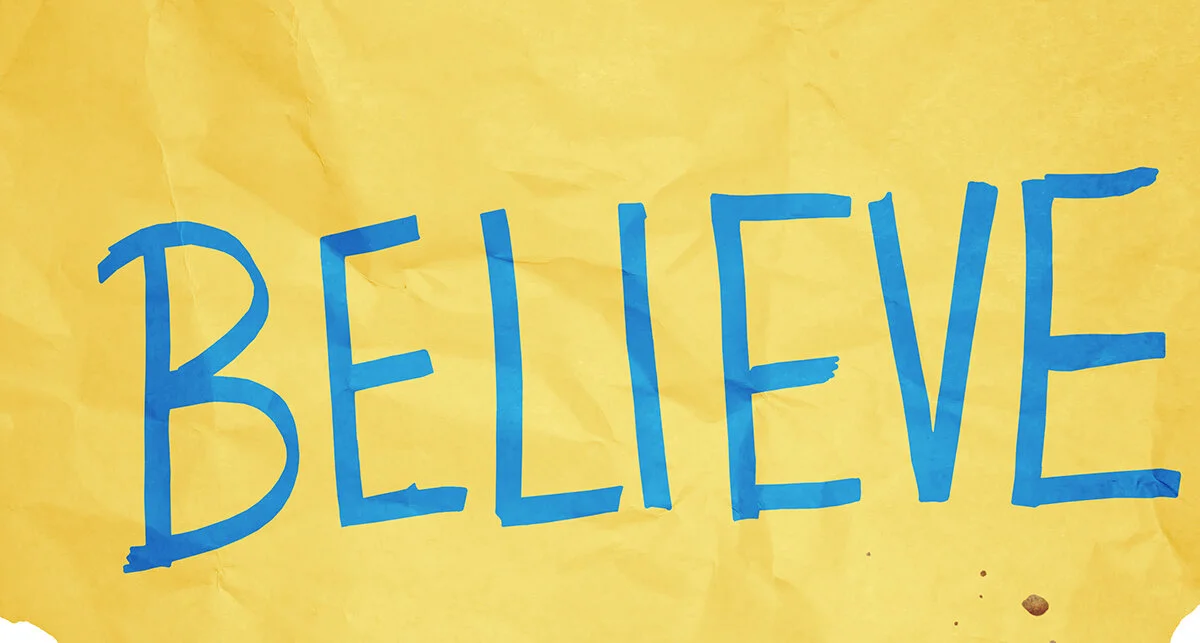
Seven letters. All caps. Handwritten on a piece of yellow construction paper and taped above a locker room door with athletic tape, crooked on purpose.

That’s the “Believe” sign from Ted Lasso — one of the most talked-about props in recent television. Ted put it up during his first week coaching AFC Richmond, and it became something closer to scripture than decor. When the team’s spirit cracked, players touched it on their way to the pitch. When Nate, wrestling with his own insecurity, tore it in half and dropped it on Ted’s desk, the show made something visible that most of us feel but rarely say out loud: belief is fragile, and someone can wound you by wounding what you believe in.

But here’s what I keep coming back to. In season three, the sign starts peeling off the wall on its own — no villain required, just time and tape and gravity. Ted takes it down himself and tells the team something worth sitting with: belief was never in the paper. It comes from the heart, the head, the gut — and it gets crowded out by the ordinary junk we all carry: envy, fear, shame. The sign was never the point. It was a pointer.

A Word Older Than the Locker Room

Sports teams didn’t wait for Ted Lasso to figure this out. Locker rooms have hung that word, or something like it, for generations — because coaches have always known that talent isn’t enough. A team has to believe it belongs on the field before it can win on it. The Atlanta Falcons even hung their own BELIEVE sign in a press conference room after a comeback win, borrowing straight from the show, because the metaphor was already doing real work in their locker room before the cameras caught it. Belief, it turns out, is a discipline you practice before it’s a feeling you have.

And long before any of us understood locker rooms or television, most of us were handed our first lesson in belief on a much smaller stage: a chimney, a plate of cookies, and a jolly stranger who somehow knew whether we’d been good. Santa Claus asks something of children that Ted Lasso asks of grown men in cleats — believe in something you cannot verify, because believing changes how you move through the season.

Christian faith asks for something similar, though it names it more plainly. Faith, as the New Testament puts it, is “the assurance of things hoped for, the conviction of things not seen.” Believers don’t arrive at their faith through a spreadsheet of proof. They choose it — again and again, especially on the days the evidence points the other way.

The Thread That Connects All of It

Put these side by side — a torn locker room poster, a chimney story, a centuries-old confession of faith — and a pattern emerges. In every case, someone is being asked to trust a future they can’t yet see, and often the visible evidence argues against them. The team is down at halftime. The presents haven’t appeared yet. The prayer hasn’t been answered yet. And still: believe.

That’s not naivety. It’s a decision about which truths will steer you when the facts are incomplete — which they always are, because none of us gets to see how our story ends while we’re still living it.

Storytellers understand this instinct better than almost anyone, because it’s the same posture a story asks of its reader. Every great story — whether it’s a novel, a docuseries, or a photo essay — asks the audience to believe in a character before that character has proven themselves. We root for the protagonist before we know if they’ll succeed, because the story has given us a reason to trust the journey even without knowing the ending. That’s the covenant between storyteller and audience: I don’t know exactly how this turns out, but I trust it’s going somewhere worth following. It’s the same covenant Ted Lasso made with a locker room, the same one Santa makes with a five-year-old, the same one faith makes with the unseen.

How We Practice Believing

Belief that only shows up when the evidence is convenient isn’t really belief — it’s just agreement. The kind of belief that gets a losing team through a season or a person through a hard year has to be practiced. Here’s a working list of what that practice looks like:

  1. Name what you believe, out loud or on paper. Ted’s sign worked partly because it was written down and visible. Vague hope evaporates; a stated belief can be returned to.
  2. Expect it to get torn. Something will test what you believe — a loss, a doubt, a person who tears it in half. That’s not proof it was wrong. It’s proof it mattered enough to attack.
  3. Understand the object was never the point. The sign, the tradition, the ritual — these are pointers, not the thing itself. When Ted’s sign started peeling on its own, he didn’t replace it. He located belief back inside the people who needed it.
  4. Clear out what crowds’ beliefs. Coach Lasso named his own list: envy, fear, shame. Most of us are carrying a version of that list, and it’s worth naming yours specifically, because vague junk is harder to clear than named junk.
  5. Choose it again, especially when the score is against you. Belief proven only in victory isn’t belief — it’s a victory lap. The real practice happens at halftime, down two goals, when quitting would be easier and more defensible.
  6. Let community carry you when your own belief runs thin. Isaac touching the sign, followed by the rest of the team — nobody has to believe alone. Faith communities, teammates, and even an audience following a story all lend each other belief on days when it’s in short supply.
  7. Look for the unseen truths that have already proven reliable. Belief isn’t a blind leap into nothing — it’s usually built on some track record, some prior faithfulness, some pattern that’s held before. Santa’s promise felt believable to a child because someone trustworthy told them about it.

None of us can see the whole story we’re living. We get this scene, this chapter, this season — and we’re asked, again and again, to decide what we’ll trust to guide the next choice. Maybe that’s why a torn piece of yellow paper became one of the most talked-about props on television. It wasn’t really about football, or even about a fictional coach. It was about all of us, standing in front of our own locker room door, deciding — one more time — to believe.