Hardship Doesn’t Make You Creative. Neither Does Comfort.

Reading Time: 4 minutes

I’ve spent a career pointing a lens at people — in boardrooms, on porches, at parades, in the quiet moment before someone realizes they’re being photographed. Somewhere along the way, I learned that the real story isn’t the isolated subject; it’s the subject in relationship — to their environment, their people, their calling. You can’t understand someone by cropping everything else out of the frame.

I was reminded of that watching an ABC interview with Wynton Marsalis, recorded for America’s 250th birthday. He talked about growing up around musicians in his father’s band who never made it out from under addiction, about a mother who lived with mental illness her whole life, about a brother whose autism nobody around them had a name for yet. It would be easy to build a tidy narrative out of that — hardship forged the genius. Marsalis refused to let the story be that simple:

“You could grow up hard and not be able to play anything or you grow up easy and be great.”

Read that twice. He’s not saying struggle guarantees depth, and he’s not saying comfort guarantees shallowness. He’s saying the correlation a lot of us assume — that suffering is the price of admission for great art — doesn’t actually hold up. Some people are handed nothing and produce nothing. Some people are handed everything and go on to produce something extraordinary. And the reverse is just as true. Whatever creativity draws from, it isn’t simply owed to you or extracted from you based on how hard your life has been.

Hawaii Tropical Botanical Garden — A moth orchid (Phalaenopsis) blooms in shades of purple and white.

The Myth We Keep Telling Ourselves

There’s a seductive story in creative circles — that you have to have suffered to have something worth saying. I’ve believed versions of it myself, standing behind a camera at events where someone’s whole life visibly shows on their face, thinking that’s where the “real” photograph lives. But Marsalis’s own words push back on that instinct. He immediately widened the frame:

“Some people can paint flowers better than any person ever painted a flower. Some person only paints scenes of war.”

Neither of those painters is more legitimate than the other. The one who paints flowers isn’t naive, and the one who paints war isn’t more serious. They’re both just working from whatever true material they were given — and that material isn’t rationed out according to who deserves it or who’s earned it through pain.

Everyone’s Raw Material Is Different — Not Ranked, Just Different

This is where it gets useful for the rest of us who aren’t jazz composers. Marsalis didn’t romanticize struggle, and he didn’t romanticize ease either. He framed both as simply the material he was given — the way another person might be given a stable home, or financial security, or an easy relationship with the world. Different raw material, not a better or worse starting line.

That’s the thing I keep relearning behind the camera. Every person I photograph has a completely different set of raw material than the person before them. The retired veteran at an American Legion dance, the kid at a Juneteenth celebration, the pastor, the small business owner trying to explain what they do in thirty seconds — none of them are working with the same clay, and none of them had to earn the right to have a story by suffering enough first. My job isn’t to go looking for the hardship to make the photograph “real.” It’s to find the shape each person’s particular material already wants to take, whatever that material happens to be.

Salvador Urbina, Chiapas, Mexico — Children of local coffee farmers gather for a group photo in the highlands community of Salvador Urbina, where families have grown coffee for generations.

The Question Is What You Choose to Focus On

If neither hardship nor privilege determines what you’re capable of making, then something else has to be doing the real work. Marsalis pointed at it almost in passing. He said that when he visits people’s homes, someone — usually a woman in the family — pulls out the photo album and walks him through the family history. And he’s noticed something: nobody ever shows the worst pictures. We curate. We choose what to focus on.

He wasn’t being cynical about it. He was naming the actual skill underneath creativity, the one that has nothing to do with your starting circumstances: the ability to look honestly at everything you were given — the beauty and the ugliness both — and decide what the story is actually about. That’s a discipline. It’s learnable. It doesn’t arrive automatically with a hard childhood, and it isn’t blocked by an easy one.

That’s the whole job, isn’t it? Not just for musicians. For anyone trying to tell a true story about a person — including the story you’re telling about yourself.

Find Something New to Play

There’s a line in the interview I keep coming back to. Marsalis said his father used to tell him, instead of playing the same old stuff, why not find something new to play. Marsalis asked what that “new thing” even was. His father’s answer:

“Just listen to the person next to you for a change.”

That’s the entire discipline of documentary work in eight words. You don’t manufacture a new angle by trying harder to be original. You get it by actually listening — to the person in front of you, to what their particular gift is, to what they’re carrying that nobody else is carrying quite the same way.

Everybody’s got a flower or a war scene in them. The work pays enough attention to know which one you’re looking at and to tell it honestly.


Source: ABC News interview with Wynton Marsalis, recorded at Chicago’s Symphony Center for America’s 250th anniversary coverage.

Beyond the Elevator Pitch: Why Your Business Story Needs a Visual Voice

Reading Time: 3 minutes

Do you have an elevator pitch?

If you’re a business owner, chances are the answer is yes. You’ve trimmed it down over months or years — cut the fat, sharpened the hook, practiced it until it sounds natural instead of rehearsed. You can deliver it in the time it takes an elevator to climb six floors.

Here’s the question I want to ask next, and it’s the one almost nobody can answer yes to:

Have you ever turned that pitch into something visual?

Not slides behind you while you talk. Not a logo on a business card. I mean an actual visual version of your story — photographs, video, images — something a potential client can see, share, and remember after the elevator doors open and you’ve walked away.

Ron Blomberg, foreground, the former New York Yankee who became Major League Baseball’s first designated hitter in 1973, works out with friends Glenn Prince, left, and Steve Gordon at OneLife Fitness in Alpharetta on Friday, June 26, 2026.

Words Fade. Pictures Stay.

I’ve spent over 40 years telling stories with a camera — for newspapers, nonprofits, churches, and small businesses across North Atlanta. If there’s one thing four decades behind a lens has taught me, it’s this: people don’t remember what you told them. They remember what they saw.

A well-rehearsed pitch might land in the moment. But a month later, when that same person is trying to recall who you were and why they should call you, the words are gone. What sticks is a face. A moment. An image that made them feel like they already knew you before you shook hands.

The Gap Between Speaking and Showing

Most entrepreneurs have invested real time into their verbal pitch — workshopping it, testing it at networking events, refining the wording until it’s tight. Very few have made that same investment in a visual version of the same story.

That’s not a knock on anyone. It’s just where the work usually stops. The pitch gets written. The visuals never get made. And so the story that could be doing work for you 24/7 — on your website, in your proposals, across social media, in a client’s inbox — never leaves your mouth.

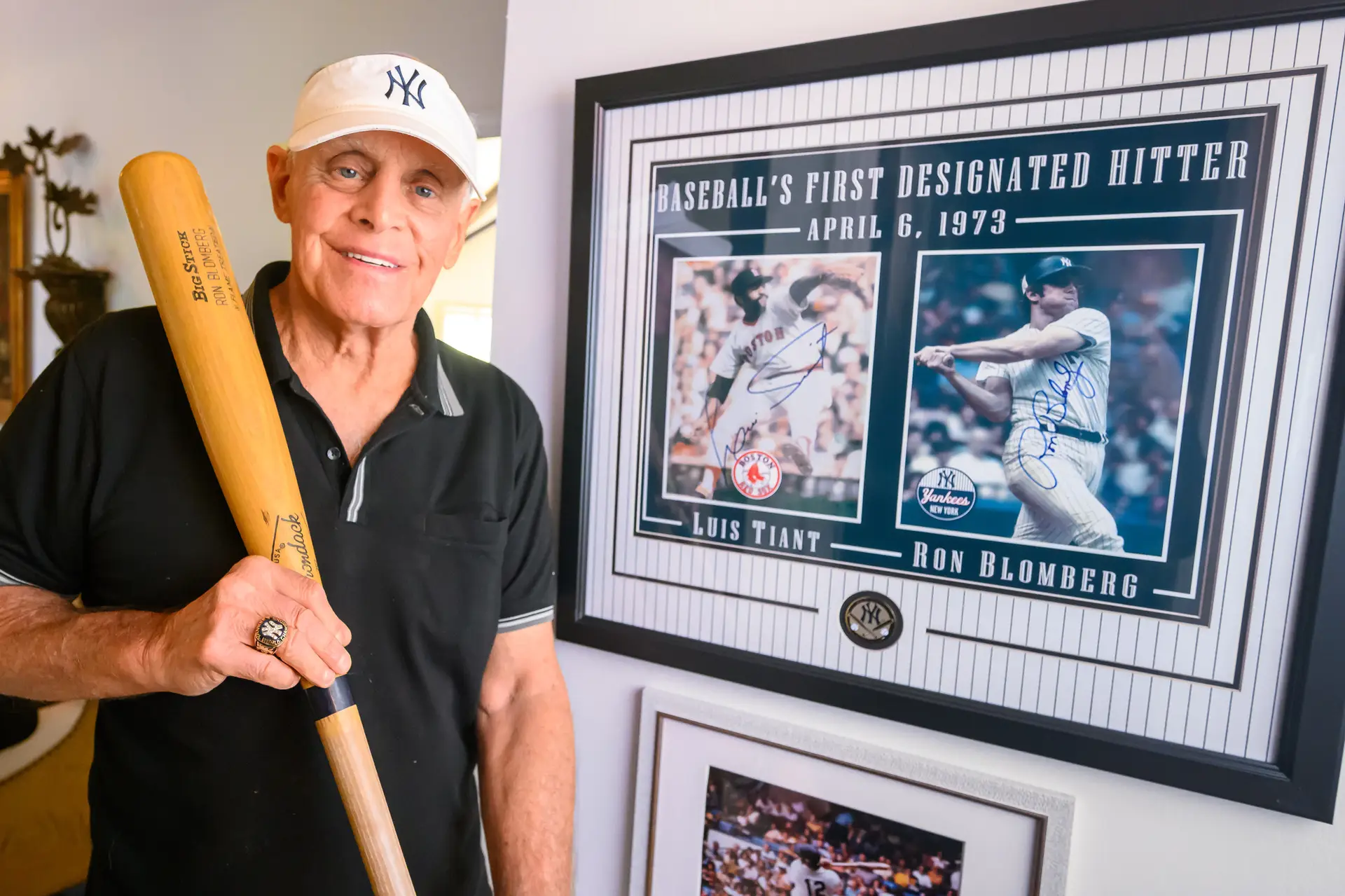
Ron Blomberg stands in front of a framed Sports Illustrated cover at his Roswell home on Friday, June 26, 2026. The June 21, 1973, issue — titled “Pride of the New Yankees” and photographed by Neil Leifer at Yankee Stadium — featured Blomberg alongside teammate Bobby Murcer during his breakout season as baseball’s first designated hitter.

What This Actually Looks Like

Turning a pitch into visual storytelling doesn’t mean a slick corporate video with a voiceover. In my experience, the most effective visual pitches are the simplest ones:

  • A short series of portraits and environmental photos that show who you are and how you work
  • A few minutes of video — you, in your element, telling the same story you’d tell in an elevator, but now something a client can watch on their own time
  • Images of your work in action, paired with the real story of a client you helped

The goal isn’t production value. It’s proof — visual evidence that backs up every word of the pitch you’ve already perfected.

A Question Worth Sitting With

So here’s where I’ll leave you: you’ve got the pitch. Have you told your clients’ stories, too — the ones about how you helped them, in pictures they can actually see? If the honest answer is no, that’s not a failure. It’s just an opportunity that’s been sitting there, unclaimed.

I help business owners across North Atlanta turn the story they already tell into something visual — portraits, brand photography, and short documentary-style video that outlasts a single conversation.

Two Decades Online: A Look Back at My Digital Trail

Reading Time: 2 minutes

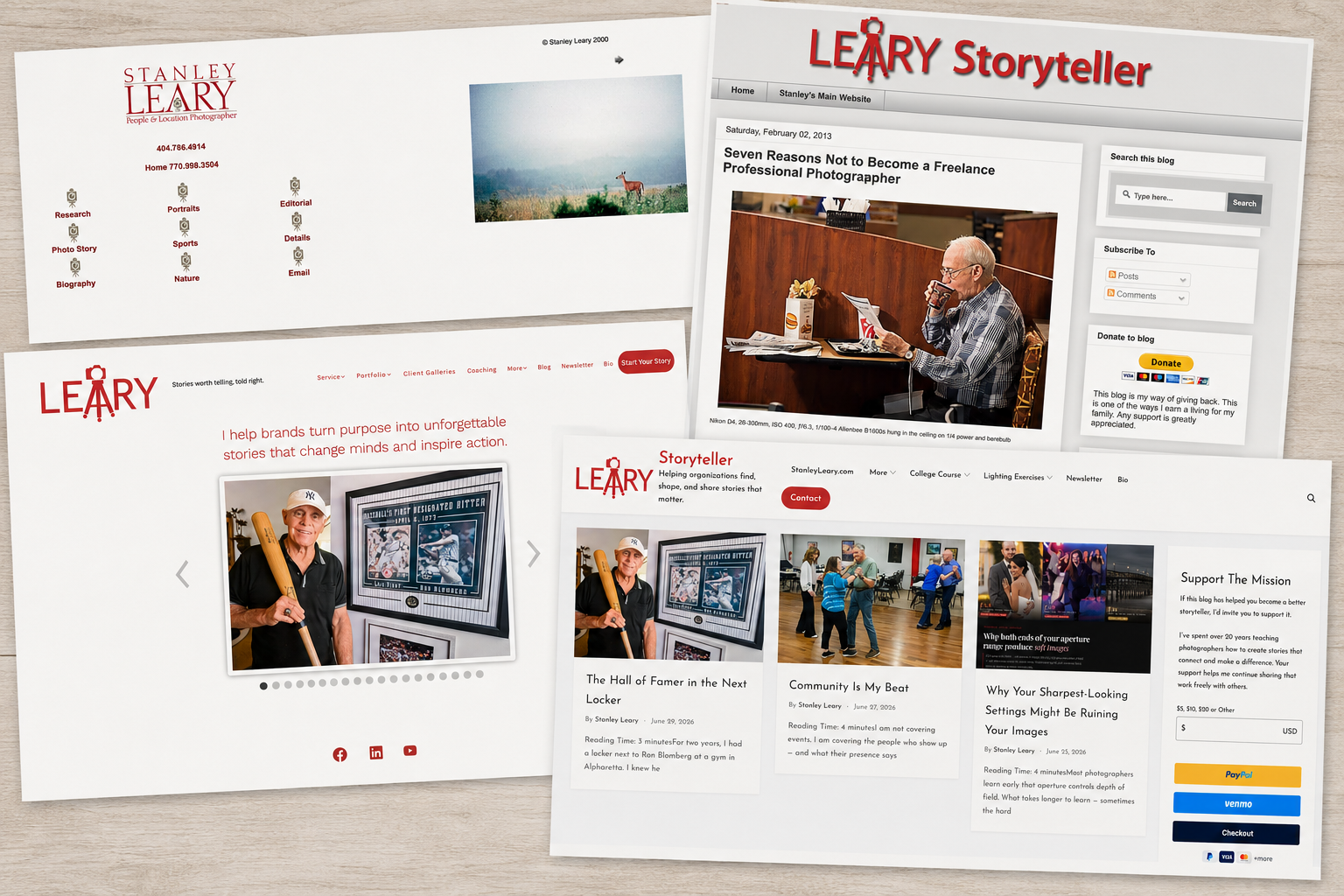
I recently went digging through the internet’s memory to piece together my own digital history — everywhere I’ve shared my work online since I first got a photo on the web. What I found surprised even me. Here’s the trail, in order, with links so you can follow along.

2001 — LearyPhoto on CompuServe

My earliest known web presence was a personal photography page hosted on CompuServe’s “Our World” platform, under the name LearyPhoto. The Wayback Machine has a capture from June 6, 2001 — which means this page, or one very close to it, was live right around the time web archiving itself was just getting started.

I also later registered a dedicated domain, learyphoto.com, though it’s no longer live today.

March 21, 2006 — I Start Blogging

In February 2006, I began teaching photography to YWAM students in Kona. Seeking a way to share tips and lessons beyond the classroom, I started a blog on March 21, 2006. My earliest post I can find, titled “West Africa,” was published on Blogger under the name Storyteller:

That blog ran for a decade or more, covering gear reviews, technique breakdowns, and behind-the-scenes stories from assignments. A few favorites from along the way:

2001–2010 — Building a Photo Archive

Alongside the writing, I was building out a professional photo archive on PhotoShelter, organized by decade. The earliest bucket covers 2001–2010, holding ten separate galleries from that stretch of my career:

2009 — PictureStoryteller.com

By September 2009, I was writing regularly at PictureStoryteller.com, a blog dedicated to photography education and visual storytelling. My earliest dated post there:

That blog has grown into hundreds of posts over the years, covering everything from technique and gear to the philosophy behind the work — much of it shaped by my mentor, Don Rutledge:

Present Day — StanleyLeary.com and Appen Media

These days, my main hub for client work is StanleyLeary.com, and I write and photograph for Appen Media, covering North Atlanta communities — Alpharetta, Roswell, Milton, Johns Creek, Sandy Springs, and Cumming.

Find Me Elsewhere

Why This Matters

Looking back at 25 years of digital breadcrumbs, what strikes me isn’t the platforms — CompuServe, Blogger, WordPress, PhotoShelter, Appen Media’s CMS — it’s that the throughline never changed. Whether I was posting on a free CompuServe page in 2001 or filing a story for Appen Media this year, I’ve always been doing the same thing: finding people, learning their stories, and doing my best to tell them honestly. The platforms come and go. That part hasn’t.

If you’ve stumbled across any of my old work I haven’t mentioned here — an old print, a forum post, a guest article — I’d love to hear about it. Drop me a note.