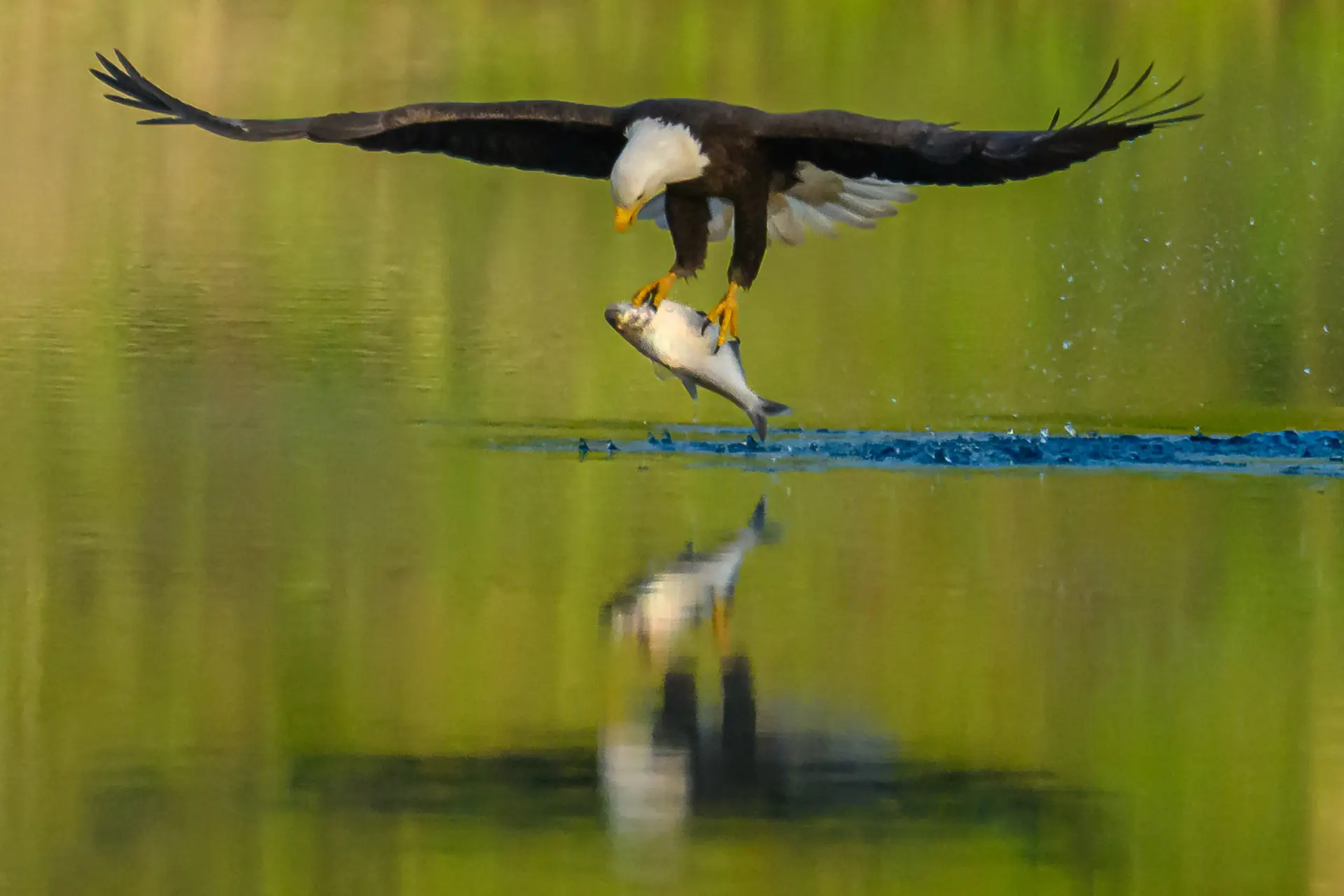
[NIKON Z 9, NIKKOR Z 100-400mm f/4.5-5.6 VR S Z TC-1.4x, Mode = Manual, ISO 4500, 1/2500, ƒ/8, (35mm = 560)]
The first time I photographed a Bald Eagle fishing, it happened in the first 20 minutes.
Perfect light. Perfect timing. Perfect moment.
And if I’m honest, that moment spoiled me.
Because ever since then, I’ve gone back to the same lake in Mountain Park over and over again… chasing that same kind of image. And what I’ve mostly found instead is an eagle perched high in a tree—60 feet up—doing what eagles seem to do best.

Nothing.
Or at least, what looks like nothing.
It will sit there for hours. Watching. Waiting. Conserving energy. And then, without warning, it’s gone—off the lake and out of sight before you can even react.
That’s when it started to hit me:
The eagle isn’t in a hurry.
It doesn’t chase every opportunity.
It doesn’t waste energy.
And it certainly doesn’t perform on demand.
Matthew 6:25-27 25 “Therefore I tell you, do not worry about your life, what you will eat or drink; or about your body, what you will wear. Is not life more than food, and the body more than clothes? 26 Look at the birds of the air; they do not sow or reap or store away in barns, and yet your heavenly Father feeds them. Are you not much more valuable than they? 27 Can any one of you by worrying add a single hour to your life?
The Photographer’s Reality
If you want that dramatic shot of an eagle in flight, talons extended toward the water, you need more than just luck.
You need:
- The right gear—something that can track focus on a fast-moving subject
- The right settings—already dialed in before anything happens
- The right light—because light is everything
- And most of all… the right level of attention
Because when the moment comes, it’s already happening.

At this particular spot, the best light is early morning. The sun comes from behind my right shoulder as I face the lake, giving the scene shape, detail, and life.
In the afternoon? It’s backlit. The subject turns into a silhouette.
On cloudy days? The light goes flat. No dimension. No drama.
Same location. Same subject. Completely different results.
The Lesson Most People Miss
Here’s what I’ve come to realize:
The eagle isn’t struggling to survive.
It’s operating with intention.
It waits for the right moment—when the odds are in its favor—and then it acts decisively.
That’s not laziness.
That’s efficiency.

What This Means for Business
A lot of people approach their work like photographers chasing an eagle—running from one opportunity to the next, hoping something works.
But the better approach?
Think like the eagle.
Here are a few takeaways I’ve been reminded of:
1. Not Every Opportunity Is Worth Chasing
Just because something moves doesn’t mean you should react. The best results often come from restraint.
2. Preparation Happens Before the Moment
Your camera settings should already be dialed in. In business, that means your messaging, skills, and systems need to be ready before the opportunity arises.
3. Light Matters More Than You Think
In photography, bad light ruins good subjects. In business, poor timing or the wrong context can do the same thing.
4. Patience Is a Strategy, Not a Weakness
Going back day after day isn’t failure—it’s part of the process. The shot you want might take time.
5. You Can’t Rush What Isn’t Ready
Wildlife photography can’t be staged. And neither can meaningful results in business. Some outcomes require time, space, and the right conditions.
Why This Matters for Clients
This is also why you don’t see many clients commissioning wildlife photography.
Because the honest answer to “How long will it take?” is:
“I don’t know—but I know what it will require.”
And most people aren’t comfortable with that level of uncertainty.
They want predictable. Repeatable. Controllable.
But the most powerful images—and the most meaningful stories—don’t always work that way.

The Bigger Picture
Every time I go out hoping to photograph the eagle, I come back with something else—herons, cardinals, cormorants… moments I wouldn’t have seen if I stayed home.
And maybe that’s part of the lesson too.
You go after one thing.
But if you’re paying attention, you come back with something even more valuable.


