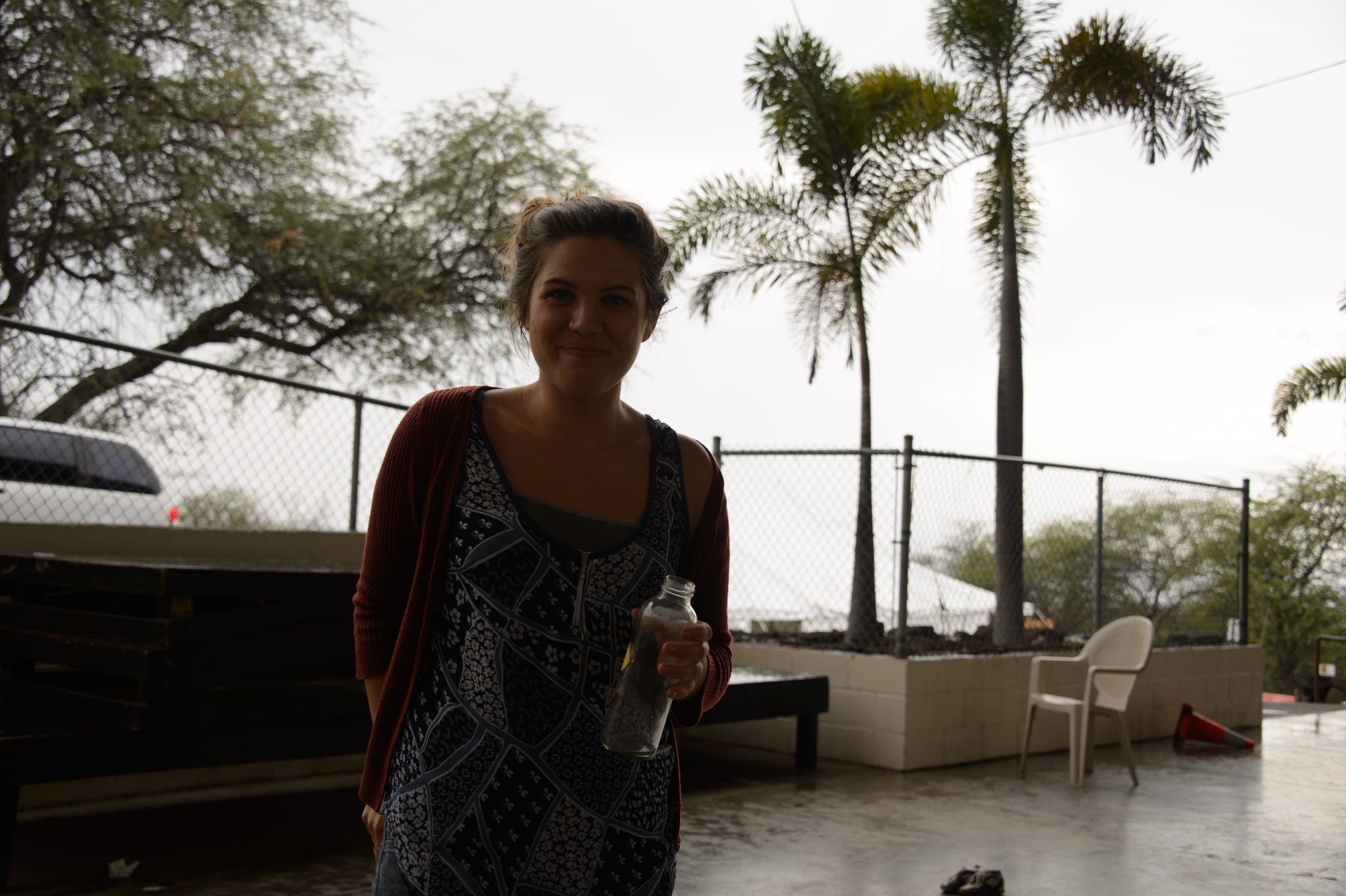
Off-camera flash and gels for the sky

Reading Time: 2 minutes

When I get this kind of situation on a cloudy day in Kona, Hawaii, sometimes I fix it with flash.

By using an off-camera flash, I set the flash to be 2 stops over the available light, and the camera I underexposed by -2 stops.

While this made the photo much better, the color didn’t pop in the background.

Here I added a CTO +1 and did a custom white balance for the flash on the model’s face. I could have dialed the white balance to tungsten and been very close.

I put a CTB +1 on the flash in the last photo and then did a custom white balance. Because the camera compensates for the blue in a flash, it adds orange to the scene. So where the flash hits the model is now the proper color temperature.

So, which one do you like the best? Do you want a flash or add a blue or orange filter to change the background?

The environmental portrait

Reading Time: 2 minutes

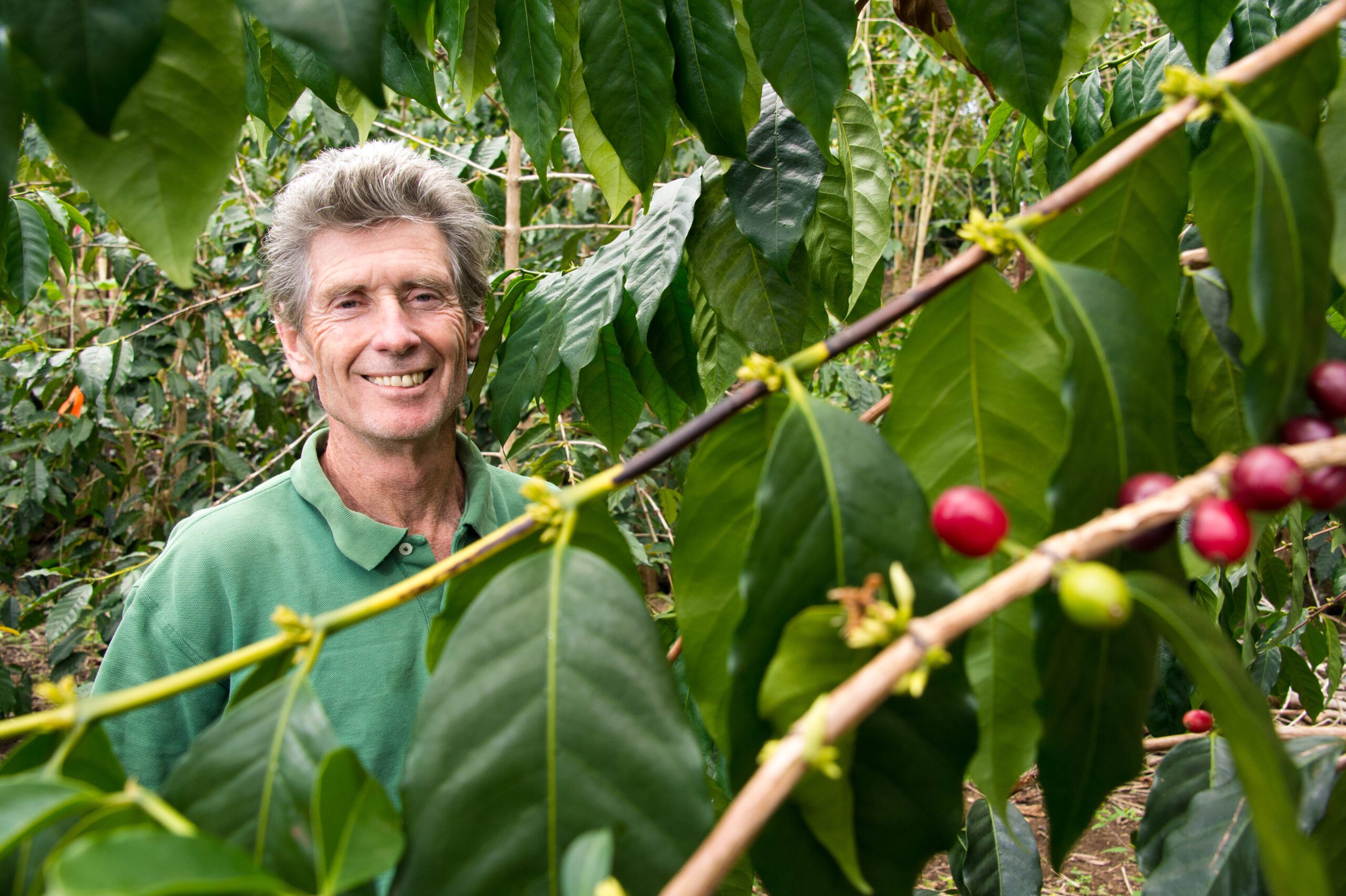
Tom Butler, coffee farmer on the Big Island of Hawaii. Tom sells the incredible 100% Kona coffee.
Nikon D4, 28-300mm (300), ISO 2000, ƒ/10, 1/200 – Off camera fill-flash using the Nikon SB-900 pointed at the coffee farmer.  The Flash is on the Pocketwizard TT5 and being triggered by the Mini TT1 on the Camera with the AC3 to control the output of the flash. Flash is 0 EV and the camera is 0 EV. A second Flash is setup the same way but on different channel at -3 EV pointed at the coffee on the branch.

Before I start this blog I want to thank Tom Butler for letting me photograph him. If you want some great 100% Kona coffee you can go to his website http://paradisefoundhawaii.com.

The environmental portrait is the bread and butter of the working photojournalist.  I wanted to show you three options I did for a portrait of a coffee grower in Hawaii.

I had to really look for the cherry looking coffee berries on the trees. It wasn’t the time for harvesting, that had already been done earlier. This is the season for pruning.

This first choice you see here I tried to tie the coffee plant in with the coffee farmer.

The second choice has the coffee farmer in front of the plant rather than behind it as in the first photo.

The last choice I asked him to pick some of the coffee and present it to me for the photo.

You most likely like one of the three better than the other. However, the professional photographer will give options to the photo editor. The editor knows then that I worked the situation and tried to give them some options.

Which one is your favorite and why?

My response to all those who ask how to do “Missions Photography”

Reading Time: 6 minutes

Young photographers and old, but all those fairly new to missions, want to know how to start photographing missions. Their attitude and communication says they are ready and should be doing this now. This is my opportunity to empty out all those emotions that are running through my head and articulating what I’m feeling, without risking saying something to someone that I’ll regret. So here is that letter I often write to get it off my chest and never send. By the way this could also apply to doing NGO work as well.


Dear ___________________:

I get contacted almost weekly from someone wanting to do missions work.  Your request to know how to get into the field is similar to all those other contacts. You reference seeing others going on mission trips or even a short term trip yourself. Your desire seems to be to do this full-time using your photography to capture missions.

Let’s just be honest with one another—traveling the world and taking pictures just sounds fun. It has to be better than what I am doing here every day.

I believe there are four phases to becoming a missions photographer: 1) The call; 2) The Preparation; 3) The Affirmation & 4) The Corporate Sending.

The Call

You hear the call from God that this is what he wants you to do. How you hear that call is different for every person. One of the most famous calls is of Isaiah in the Bible.

Isaiah 6:8

Then I heard the voice of the Lord saying, “Whom shall I send? And who will go for us?”

And I said, “Here am I. Send me!”

The Preparation

If you were called to be a ditch digger, a doctor, a pastor or a communications person each of these would require you to become more proficient and develop that talent.

For the most part this would entail some formal training and some on the job training. Doctors go to college, then medical school and then they do a residency. My recommendation for most photographers wanting to cover missions abroad is to get some formal classroom training, work with some pros and then do a residency type of position for a year or two, just like the medical doctors do.

The Affirmation

You need others to affirm this call. Before a person is accepted into a Seminary to further their biblical studies they must have a letter of affirmation from a sending church. So to a photographer should have this same type of an affirmation where people are confirming not just that you know photography but are using it now to further the gospel.

The Corporate Sending

You need a client who is willing to pay for the content you are creating. Some missions agencies of different denominations have positions for journalists and photojournalists. You must go through an interview process just like you would if you were to be a church planter. They want to see examples of you doing now what they will send you to do somewhere else.


Where are you on these steps?

From your correspondence with me it appears you think you are ready now, but I have some hard questions for you.

What are you doing in missions right where you are?  Would God call someone to do missions photography in your neighborhood?

God hasn’t put you in Africa or somewhere else—he has you here. You are in a mission field. Do you think it is all that different just because you are in a different town, state or country?

You are like so many others who live right here with me in Georgia.  Right near me in Clarkston, GA are refugees from all over the world. There is even a book on one of these groups “The Lost Boys of Sudan.” Here is a link to that book http://www.amazon.com/Lost-Boys-Sudan-American-Experience/dp/0820328839.  Missions of the cross-cultural experience it is right there.

I am sure there are opportunities in your community for a cross cultural experience if that is where you need to serve.

Here is a NGO that works with the refugees http://friendsofrefugees.com in Georgia.

How will it be any different for you to shoot in some city in Africa than right where you live? Too many “Christians” think that missions are like a worship service. Missions is so far removed from a worship experience. Missions agencies send their missionaries to those places of highest need. Those places are where there is less than 2% of Christians in the population. This is like going to solitary confinement as compared to going to a place where the people are like you.

If you don’t like working in the secular world now, then you are not ready for the mission field.

Now up to this point I have only addressed your willingness to do mission work. Now I want to address another concern I have for missionary work.

Do you think God deserves our very best effort? Based on the assumption he would want us to do everything we could to be prepared, how well prepared are you for the call? Have you taken the talents you have been given and refined these?

Christ selected 12 disciples and then spent three years training them before they were sent out completely on their own for good. He did an internship program with them where they went out and then reported back to him.

Lets just say you have really prepared as best you can. You went to a photography school and got your training. Now you are working somewhere to get your apprenticeship time in. Just like a medical doctor must do a residency, so too you must work somewhere with supervison.

Now comes another perspective. Who will send you? If you think agencies or churches will be the supportive body to help pay for the expenses of you traveling the world to tell the story of missions why would they send you?

Another way to think of this, think of it like National Geographic Magazine. Should they send you to cover a story or someone like a William Allard, Joe McNally, Steve McCurry, Joanna Pinneo or some of their many proven professionals?  I would think they would send the person who has a strong portfolio and track record of delivering content.

So too the church and agencies should send the person best because it is good stewardship of what God has entrusted them. Sending someone because they are willing is a good way to burn relationships on the mission field.

I hope you see mission coverage can be where you are now. You should be producing content of the stories in your neighborhood. If you are able to produce solid content right where you are now—which is the mission field, then those groups that can send you to foreign mission fields will see you as a good stewardship choice for them.

Remember the Apostle Paul was not readily affirmed by the disciples. Church history shows us there is a time from his calling until the time he was sent out as missionary from the church. Paul’s Damascus road experience was when he was about age 34 [Acts 9:1-9]. Paul was not sent by the church until he was age 47 with Barnabas [Acts 13:2-3]. He preached in the synagogues in between, but sent out was not for years. He first worked in his neighborhood. If it was good enough for Paul, why not you?

This may sound harsh, but I feel you need to hear this from someone and it might as well be me.

Maybe the thing you need to do is pray for God’s guidance and let him lead you. You might be surprised at all the doors that open through him verses by our own hands.

Sorry I am so pushy with this, but I am really sad to see so many people wanting to go overseas when the largest mission field in the world is here. More missionaries come here of all types of faiths to proselytize than any other country of the world. Who should God send to your neighborhood or city to do mission work? Could it be that he has already called someone–YOU?

Your backyard is your first mission field. This is where you will refine your craft and get the affirmation of others. It is here that your friends will then recognize your calling and send you.

Your call doesn’t always mean now, but you now knowing your path. Keep the faith and fight the good fight.

Stanley

Stanley Leary
Storyteller
Roswell, Georgia
404-786-4914
mailto:stanley@stanleyleary.com | www.StanleyLeary.com
http://blog.Stanleyleary.com   http://twitter.com/stanleyleary  http://www.facebook.com/stanley.leary

9 things you need to do before going freelance full-time

Reading Time: 4 minutes
Stanley teaching at YWAM School of Photography 1 in Kona, Hawaii [Photo by Dennis Fahringer]
 
Here is a checklist I recommend going through to go full-time freelance. You may think of even more to add to this list.
 
Microsoft Excel Home Budget Template

Create a home budget – You need to have a budget on what you need to survive. This includes housing, food, healthcare, car payments and entertainment to name just a few. My recommendation is if you have Microsoft Excel is to use their home budget to help you get a solid number of what you need to live. Break this down from yearly to monthly amounts.

NPPA Cost of doing business calculator

Create a business budget – You need to know all the expenses beyond your home budget that you need to run your business that also can be written off your taxes as legitimate business expenses. I recommend using the National Press Photographer Association’s “Cost of doing business calculator.” Some things that you could be moved from your home budget to this list would be your phone. You will need to know what you need to run your business monthly and yearly. Things like a website, advertising, Internet connection and other items are things you must have even if you are not shooting a job.

6 months of savings that is equal to both your home and business budgets combined – This is a bare minimum you will need. The odds are pretty high that you will not have a regular stream of income for anywhere between 6 to 18 months.

Don’t quit your full-time job until it gets in the way of your freelance business – I would even recommend seeing if you can go from full-time to part-time with your employer so you are transitioning over a longer period of time. You can offer to go on contract with them and give them 2 – 3 days a week and then you have 3 – 4 days to build your business.


Buy all necessary equipment before you go full-time – You really need to have your basic camera gear, computers, software and any office equipment that you need to do your business paid for before you start freelancing. While you may have budgeted a figure each month for the business for all this equipment you will be putting some of this money away for when things break or need replacing.

Debt free – Ideally having no debts except for a house payment would be perfect. I do want to spell out why this is very important. If you purchase things on credit you could be paying 10% to 20% more for everything you purchase. When the difference between paying bills and going bankrupt is often just a very thin line your business failure is much higher by carrying unnecessary debt.

Synchronize your photography ambitions with your lifestyle desires – If you want to be a war photographer and have a family these are two incompatible desires. You might be able to delay your family dream for a while, but most likely will have to change what you photograph later. Another example is photographing for nonprofit or faith based group and be family oriented. Often these groups pay so little and many expect the photographers to raise their own support. Examine your ambitions. Maybe the reason you want to do certain kind of photography is really your desire to help people. When you get to this core value there maybe other ways to shoot for say green companies that have more money to pay a livable wage.

Alex Garcia, photographer for the Chicago Tribune, talks with a student about her work during the student practicum at the Southwestern Photojournalism Seminar in Fort Worth, TX last February.

Find a business coach/mentor – they do not need to be a photographer; just a successful businessperson will do just fine. They can help listen to your issues about running your business and ask questions that help guide you to being successful.

Create a business plan – If you need a loan to start you will need a business plan for the bank. If you are set, still do a plan for yourself. It will help guide you and make decisions that you need to make every day. This will be your compass. You can contact the US Small Business Administration in your area and they can help you. Often this is free.

Can you think of suggestions to add to the list?


Seven Reasons Not to Become a Freelance Professional Photographer

Reading Time: 3 minutes

7) Not a self-starter—In your first year or so you will be getting up with no photo shoots on your schedule. You must be able to fill your day with something that will be productive. If you are someone that takes initiative and rarely needs someone to tell you what you should be doing at work, then you might make it as a professional photographer.

6) Procrastinator—You may know what you need to do each day, but you can easily get distracted and not stay on task. If you have seen the movie “UP” then you will recognize the comment—Squirrel.  I know a good number of former photographers who just didn’t get around to doing what they should have been working on and now they are no longer working professional photographers.

Nikon D4, 70-200mm, ISO 6400, ƒ/2.8, 1/100–Marc Broussard

5) Hate rejection—If you get easily discouraged then you do not want to go into business for yourself—in any field. Just because your family and friends think you are a great photographer is not the same as everyone lining up to pay you to take photos. If you have people lining up and begging you to shoot things for money—then this is way different and makes you the only person I know to be in that situation. Successful photographers are only selling to 5 – 10% of those people they have contacted. 90 – 95% of the time they are rejected.

4) Poor Negotiator—For the most part photography is not so cookie cutter. This is very true for the commercial photographer. Each job is different from the rest and requires you to price differently. Due to this there tends to be a lot of negotiating with clients. Sometimes this may sound harsh when someone is trying to get you to lower your price.

Nikon D4, Sigma 120-300mm ƒ/2.8 DG OS HSM S, 2X, ISO 10000, ƒ/4, 1/2000

3) Do not like taking direction—many “artists” tend to think they know better what they need to create. Unless you are going to be a “fine art photographer” then you will need to execute other people’s ideas. You will need to learn how to bend to keep a client and get paid.

2) Do not like sitting at a computer for long periods—You will need to spend time editing your work for sure, but you will spend a lot of time connecting with people through emails, website, blogs, creating printed materials and searching the web for clients to name just a few of the things you will need to be doing on a computer.

Nikon D4, 85mm ƒ/1.4, ISO 200, ƒ/1.4, 1/80

1) No business skills—You need to understand pricing of your services that will help you make a profit for the long haul is not easy to do. You also have to be a risk taker in running your own business. Almost nothing is a sure bet and you will have to put money behind ideas that may or may not work. You also need to know how to market yourself to the world.

Now you don’t have to be good at all these things, but they all must be done to remain a professional photographer. You can outsource some of these, but the outsourcing will cost more than if you did them yourself. At a certain point in your growth of your brand you will find it necessary to outsource some of this to grow your business.

You might think of more things to add to this list–but freelancing full-time is not for the faint of heart.