Most companies know the value of a good story, but do not know how to tell their own story. Leary has a process to find and tell stories that communicate how they change lives, so that their companies grow again.
Some of his clients include Chick-fil-A, Newell-Rubbermaid, Coke, Georgia Tech, and The Carter Center.
Leary’s work has taken him across the United States and beyond — to Chile, Peru, Burkina Faso, Canada, France, Ghana, Guatemala, Haiti, Honduras, Mexico, Nicaragua, Portugal and Romania.
The experiences of this award-winning communications allow him to engage audiences with storytelling that builds organization’s brand. His U.S. clients find that ability translates into making their messages cross-culturally relevant with diverse American audiences and within the mainstream media.
Prior to forming his own company, Leary worked on staff for The Hickory (N.C.) Daily Record and theCOMMISSION magazine in Richmond, VA. For nine years he was on staff with PR team at Georgia Institute of Technology, Atlanta, Ga.
Leary is also a teacher. He enjoys sharing his expertise with others. He has taught storytelling and brand building at Grady College of Journalism and Mass Communication, University of Georgia, Athens, Ga.; The University of the Nations, Kona, Hawaii; Reinhardt College, Waleska, Ga.; Berry College, Rome, Ga.; Portfolio Center, Atlanta, Ga.; and Dallas (Texas) Baptist University.
He also has been a guest lecturer at World Journalism Institute, Washington, D.C.; Southwestern Photojournalist Conference, Fort Worth, Texas; Art Institute of Atlanta, Ga.; American Society of Media Photographers. Atlanta (Ga.) Chapter; and the Southeastern Photographic Society, Atlanta Ga.
Clients often contract him to teach their staffs to become more visually effective in building their brand.
Leary lives in Roswell, Ga., holds degrees in social work and communications, and is married to Dorie Griggs. They have three children.
If your goal is to get people to understand what you do, words will get you there.
If your goal is to get people to care, trust you, and ultimately take action, you need to lead with visuals.
This isn’t about creativity. It’s about how people make decisions.
Simon Sinek popularized the idea of starting with Why, but the reason it works goes deeper than messaging strategy.
It’s rooted in how the brain functions.
The part of the brain responsible for decision-making responds first to emotion, not language. Only after someone feels something do they begin to justify that decision with logic.
Neuroscientist Antonio Damasio found that when people lose access to emotional processing, they don’t become more rational—they become unable to make decisions at all.
People don’t act because they understand.
They act because something moves them.
Where Most Organizations Miss the Mark
Most organizations lead with information:
What they do
How they do it
Why it matters
But by the time they explain all of that, they’ve already lost part of their audience.
Because they started with the part of the brain that analyzes instead of the part that decides.
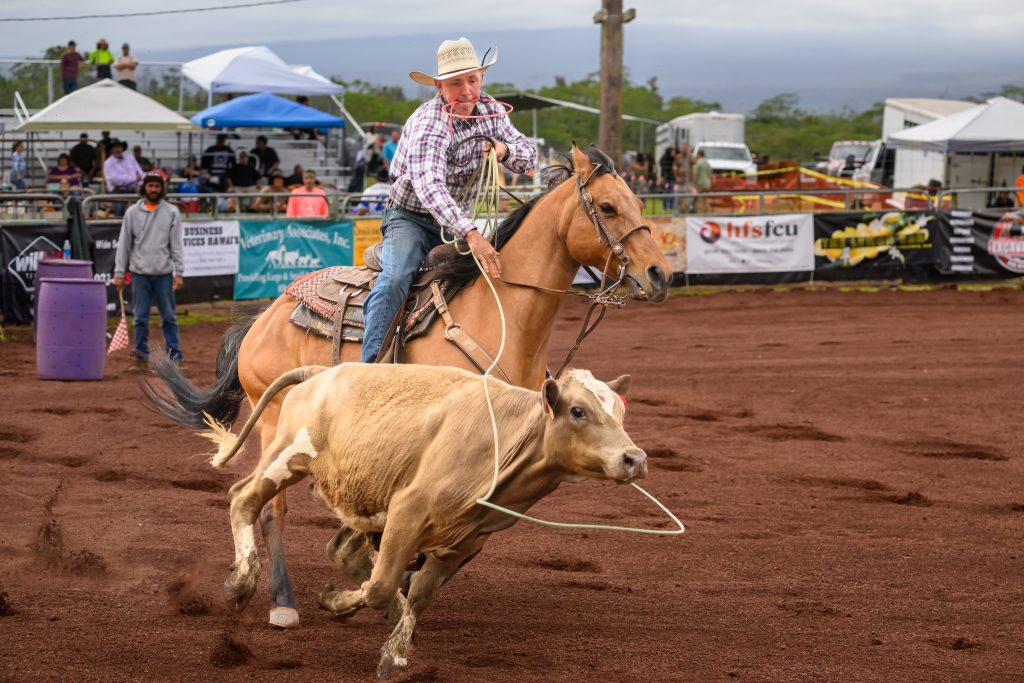
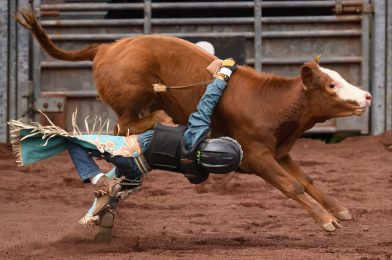
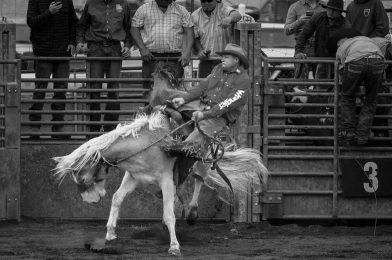
A skilled cowboy demonstrates precision and speed during the Panama Stampede Rodeo roping competition at the Equestrian Center Complex on Stainback Highway, Hilo, Hawaii.
Why Visuals Work
A strong visual communicates in a way words simply can’t.
In a fraction of a second, an image can create:
Trust
Connection
Urgency
Empathy
Before someone reads a headline… they’ve already formed an impression.
That’s the moment that determines whether they lean in—or move on.
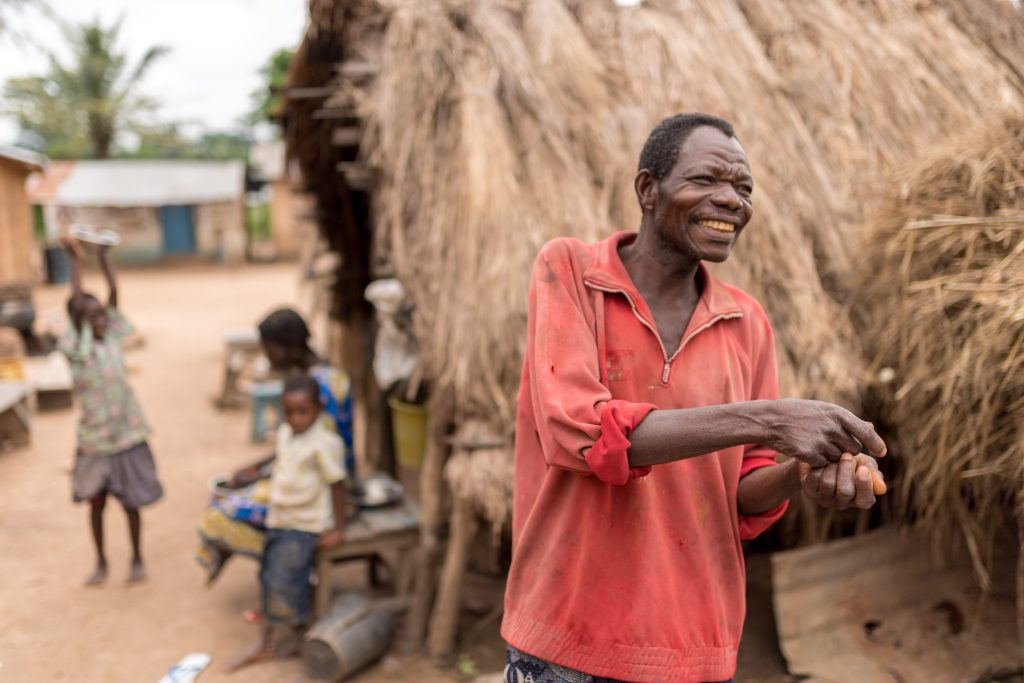
Charlatan Witch Doctor of Fetishes in Togo, West Africa
What This Means for Your Organization
Visual storytelling shouldn’t be something you “add on” at the end.
It should be part of how you lead.
When done well, visuals:
Capture attention faster
Build trust earlier
Make your message more memorable
Move people toward action
Your words still matter—but they work best when they support something your audience already feels.
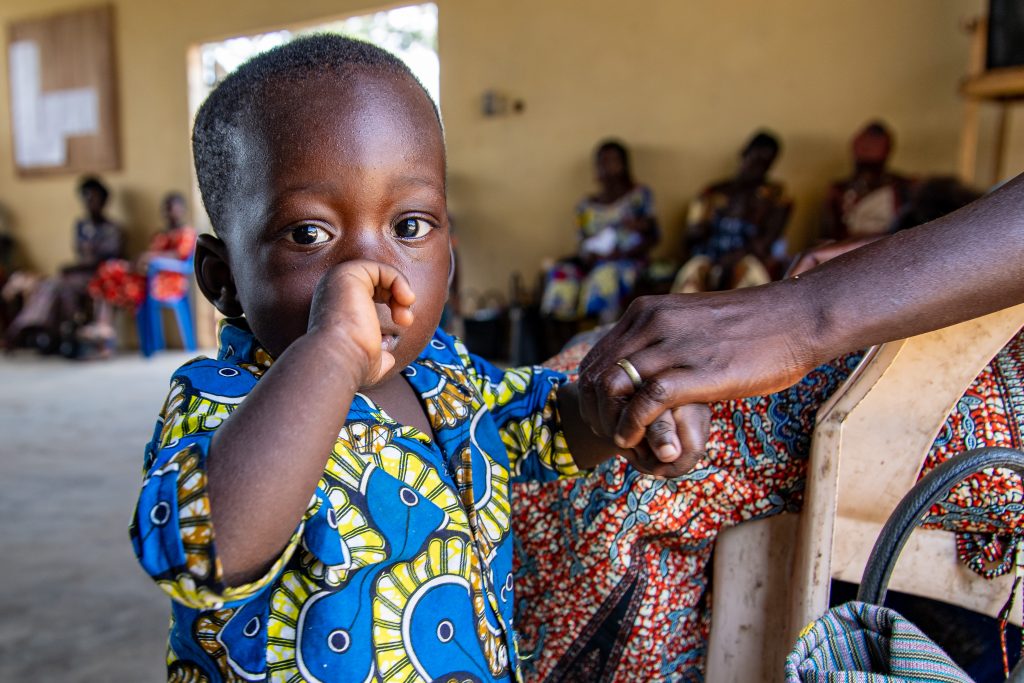
Little boy during church service at Eglise Baptiste Biblique in Adeta, Togo, West Africa.
How to Get the Most From a Visual Storyteller
If you’re going to invest in photography or video, the biggest mistake is treating it like a checklist item.
A visual storyteller should be part of how you think—not just how you document.
Here’s how to make that shift:
Bring them in early The earlier a storyteller understands your goals, the more intentional the work becomes. They’re not just reacting—they’re helping shape what gets communicated.
Share the real objective Don’t just assign coverage. Explain what success looks like. Who are you trying to reach? What do you want them to feel or do?
Focus on people Audiences connect with people, not programs. The more your visuals reflect real human moments, the stronger your connection will be.
Think beyond one use Strong visuals should serve you across platforms—your website, social media, presentations, and fundraising. This is an investment in your communication system, not a one-time deliverable.
Let visuals lead Start with something that makes people pause. Then use your words to guide them deeper into the story.
The Bottom Line
If you want to be understood, explain what you do.
If you want to be remembered—and chosen—help people feel something first.
That’s where decisions are made.
And that’s where the right visual story makes all the difference.
Most freelancers I meet are exhausted—and it’s not just from the workload.
It’s from the way we’ve been trained to think about our work.
We default to binary thinking:
Success or failure
Booked or broke
Good client or bad client
Win or lose
It feels clean. Simple. Manageable.
But it doesn’t match reality.
“It’s complicated.”
Those words hang on the wall of Ken Burns’ editing room. They also capture how he understands history.
“It’s complicated.”
Not as an excuse. Not as avoidance. But as truth.
Because history—like creative work, like life, like freelancing—doesn’t fit into neat categories. It resists reduction. It refuses to be flattened into simple answers.
And yet, freelancers often try to do exactly that with their own careers.
We label projects as either successful or a failure. We label clients as either ideal or toxic. We label seasons as either “good” or “bad.”
But most of the time, it’s more honest to say: it’s complicated.
The project that felt like a mess might become the portfolio piece that opens doors later. The client who stretched you the most might have actually sharpened your craft. The slow season might have been the space where your thinking finally caught up to your ambition.
Nothing is as clean as we want it to be in the moment.
The Trap of Certainty
Burns has also said something that cuts even deeper into how we operate:
The opposite of faith is not doubt. Doubt is central to faith. The opposite of faith is certainty.
Freelancers tend to crave certainty:
A predictable income
Clear outcomes
Stable demand
But certainty is an illusion in creative work.
When you demand certainty, you start shrinking your decisions:
You avoid risk
You say yes too quickly
You prioritize safety over growth
And ironically, the more you chase certainty, the less resilient your work becomes.
Because this line of work was never built on certainty—it’s built on trust.
Trust in your skills when the outcome isn’t guaranteed. Trust in relationships that take time to mature. Trust in yourself when the path isn’t clearly marked.
Doubt isn’t the enemy of that kind of work. It’s part of it.
The Infinite Game
Simon Sinek describes life and business as an infinite game.
There is no final scoreboard. No finishing line where everything is settled. No moment where you “win” freelancing.
The only real question is: are you still playing?
That changes everything.
A slow month isn’t failure—it’s part of the rhythm. A project that didn’t land isn’t an ending—it’s data. A season of uncertainty isn’t a verdict—it’s a chapter.
You stop asking, “Did I win?”
And start asking, “Am I still becoming the kind of freelancer I want to be?”
A Better Way to See Your Work
When you step out of binary thinking, your work becomes lighter—and deeper at the same time.
You begin to see:
1. Progress over perfection You’re not trying to nail every project. You’re building a body of work over time.
2. Complexity over judgment You stop rushing to label experiences and start learning from them.
3. Longevity over moments You’re not defined by your last job. You’re defined by the arc of your work.
A Better Question
Instead of:
“Did this go well or badly?”
Try:
“What is this becoming?”
“How does this fit into the larger story of my work?”
“What am I learning that I couldn’t have learned any other way?”
Because freelancing isn’t a series of wins and losses.
It’s a long conversation with your craft, your clients, and your own growth.
Most people think great photography is about what happens when the shutter clicks.
It’s not.
It’s about everything that happens before and after.
Recently, I had a simple request from Jim Rasmussen. He was speaking at a devotional at Chick-fil-A’s Support Center and wanted “good photos if possible.”
That phrase—if possible—is where most photographers miss the opportunity.
Because that’s exactly where you decide whether you’re going to meet expectations…or exceed them.
The Assignment Was Simple. The Opportunity Was Not.
Jim didn’t ask for storytelling coverage.
He didn’t ask for behind-the-scenes moments.
He didn’t ask for environmental portraits, networking interactions, or a complete visual narrative of the morning.
But that’s what he needed.
So I showed up early—before the moment most photographers would consider “start time.”
And that changed everything.
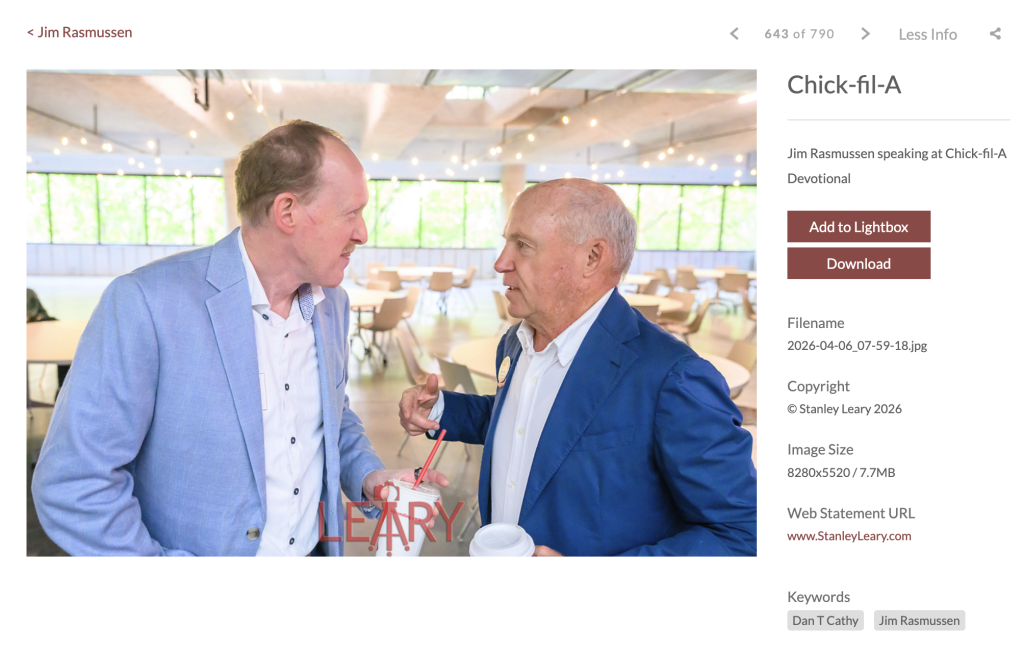
Before the devotional began, Jim Rasmussen reconnects with Jonathan Morrow—a relationship that goes back to when Jonathan was still in college and his mother worked alongside Jim. Moments like this remind us that the story often starts long before the program begins.
The First Layer of “Above and Beyond”: Show the Whole Story
By arriving early, I didn’t just photograph a speaker.
I documented anticipation.
I captured Jim connecting with people as they arrived—including leadership moments with people like Dan Cathy.
Those images matter.
Because for someone like Jim, the story isn’t just what he said—it’s who he impacted.
During rehearsal, I was able to step in close and capture a perspective that would have been distracting during the live presentation. These are the moments most people never see—but they’re exactly where you create the kind of images that elevate the entire story.
The Second Layer: Anticipate What the Client Doesn’t Know to Ask For
Most clients don’t think in terms of visual storytelling.
They think in terms of coverage.
So while Jim asked for photos of his talk, I made sure to:
Capture rehearsal moments
Photograph audience reactions
Frame him with his slides
Stay afterward for relationship moments
Those are the images that actually get used.
The Third Layer: Respect the Client’s Time
The event ended at 9:25 AM.
Jim had images in his inbox by 1:30 PM.
That’s not normal.
That’s intentional.
Fast delivery isn’t just a “nice touch”—it’s often the difference between content being used…or forgotten.
The Fourth Layer: Add Value They Can’t See (But Feel)
This is where professionals separate themselves.
Here’s what Jim didn’t ask for—but absolutely benefits from:
Clean, curated selects
I shot over 2,000 frames. He received 790 strong images.
No one wants to dig through mediocrity to find gold.
Intelligent metadata (this is a big one)
Using tools like Adobe Lightroom Classic, I tagged people in the photos.
That means later, when Jim needs:
A photo with a specific executive
A moment with a key connection
Images for a particular audience
He can find them instantly.
That’s not just organization—that’s usability.
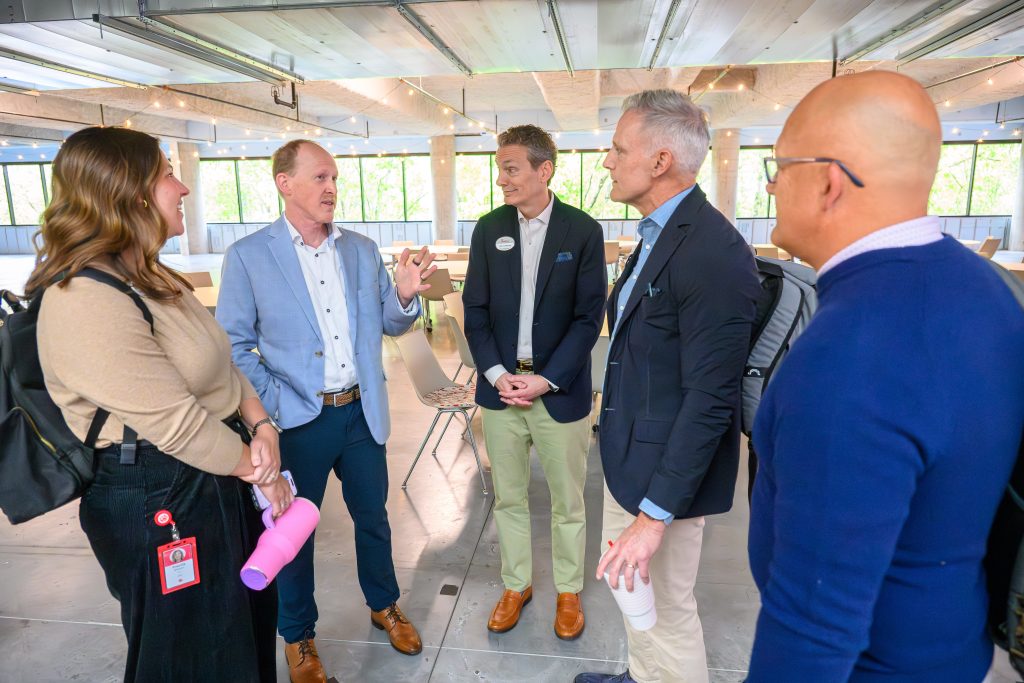
A moment of reflection as Jim Rasmussen shares his journey of being called from his role at Chick-fil-A into a new season of serving operators, staff, and community leaders through financial planning. Listening in this moment are, left to right, Priscilla Nicholson, Jim Rasmussen, Jeff Henderson, David Farmer, and Shane Benson—a gathering of leadership leaning into a story of purpose, transition, and calling.
Technical problem-solving
Low light? High ISO? No problem.
Selective noise reduction, exposure balancing, and batch editing ensured consistency across the gallery.
Not flashy work—but critical work.
Long-term security
Every image exists in three places.
Because losing a client’s photos isn’t a mistake—it’s a failure of professionalism.
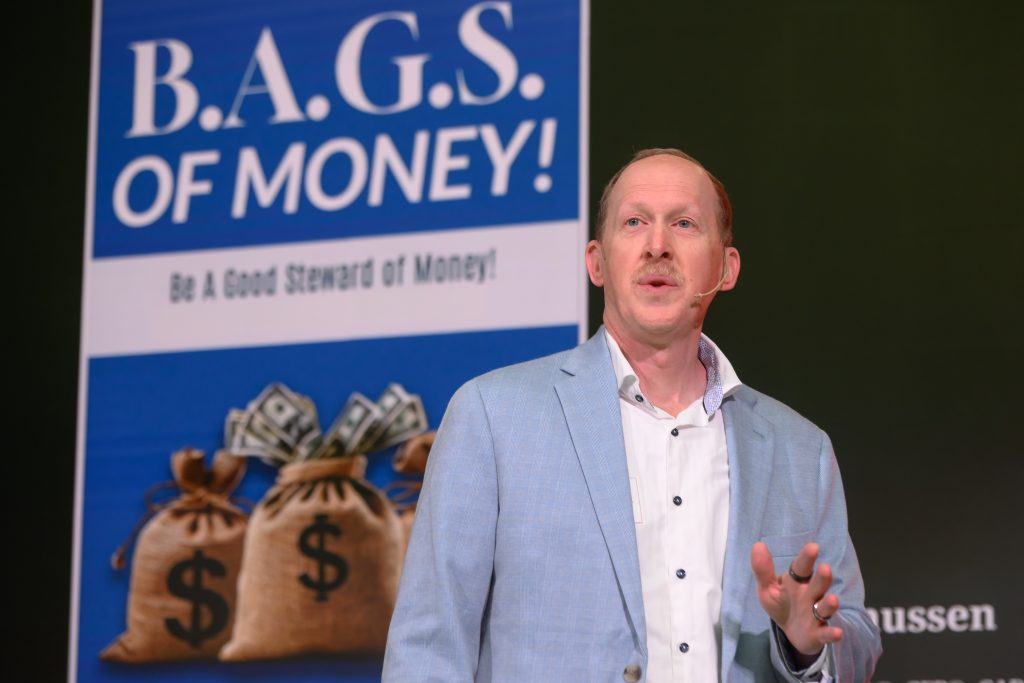
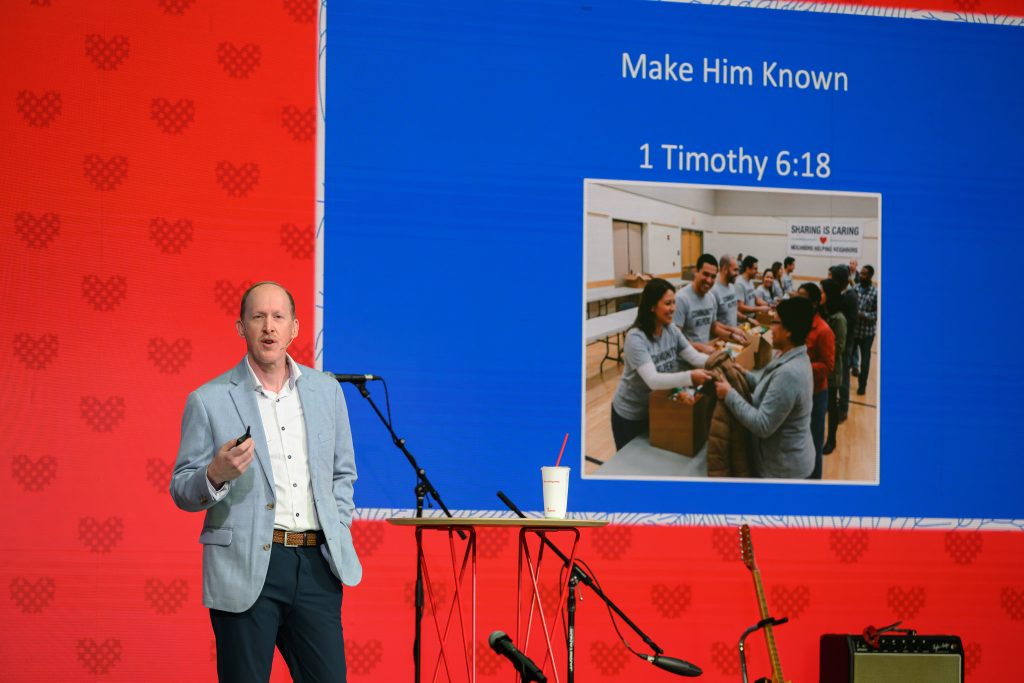
As Jim Rasmussen speaks, the message behind him reinforces the heart of his story—clearly stating a purpose centered on making God known to others. In that moment, the words on the screen and the words being spoken aligned, creating a simple but powerful reminder that leadership is most impactful when purpose is made visible and lived out in real time.
The Fifth Layer: Make It Easy to Say Yes Again
Delivery wasn’t just about sending files.
It was about creating a smooth experience:
Easy-to-access gallery via PhotoShelter
Clear communication
Invoice included and ready
Even tools like FotoBiz help streamline the business side so the client never feels friction.
The Result
At 3:00 PM, Jim replied:
“WOW Stanley! This is awesome.”
That response wasn’t about the photos alone.
It was about the experience.
The Real Lesson
Going above and beyond isn’t about doing more work.
It’s about doing the right work—especially the parts the client doesn’t know to ask for.
That’s where trust is built.
That’s where repeat business comes from.
And that’s where you stop being seen as a vendor… and start being seen as a partner.
Practical Takeaways
For Photographers
1. Show up before the moment starts The story begins long before the “official” start time.
2. Shoot what’s happening—and what it means Moments + context = usable storytelling.
3. Cull aggressively Your client hires you to make decisions, not just images.
4. Speed matters more than perfection Timely delivery increases usage dramatically.
5. Use metadata like a pro Tag names, locations, and context. You’re building a searchable archive, not just a gallery.
6. Solve problems quietly Noise, bad lighting, cluttered backgrounds—handle it without making it the client’s concern.
7. Build systems, not just workflows Backup, delivery, invoicing—these should run smoothly every time.
For Clients
1. Don’t just hire a photographer—hire a problem solver The best creatives bring ideas you didn’t think to ask for.
2. Share the bigger picture The more context you give, the better the storytelling.
3. Value speed and usability—not just quantity Images you can quickly find and use are far more valuable than thousands you can’t.
4. Think beyond the event Great images should serve you long after the moment is over—marketing, branding, storytelling.
5. Invest in relationships, not transactions The more a photographer understands you, the more value they can create.
If you’re a photographer, this is the difference between getting hired once…or becoming indispensable.
And if you’re a client, this is how you recognize the difference.
Emotion is the difference between a photo that informs and one that stays with someone.
In photojournalism, you’re not just documenting what happened—you’re helping people feel why it matters. Anyone can record an event. What separates strong visual storytelling is the ability to recognize moments that carry weight, tension, and humanity—and to be ready when they unfold.
The challenge is that emotion isn’t staged. It’s fleeting, often subtle, and easy to miss if you’re only focused on the obvious action. As a photojournalist, your job is to go beyond the surface and anticipate the moments that reveal truth.
Here are some ways to consistently create photographs with more feeling and impact:
1. Stay longer than feels comfortable
Deadlines and access can pressure you to move on quickly, but emotions often follow the peak action.
When the speech ends, when the crowd thins, when the subject exhales—that’s when people become real again. Give moments time to unfold.
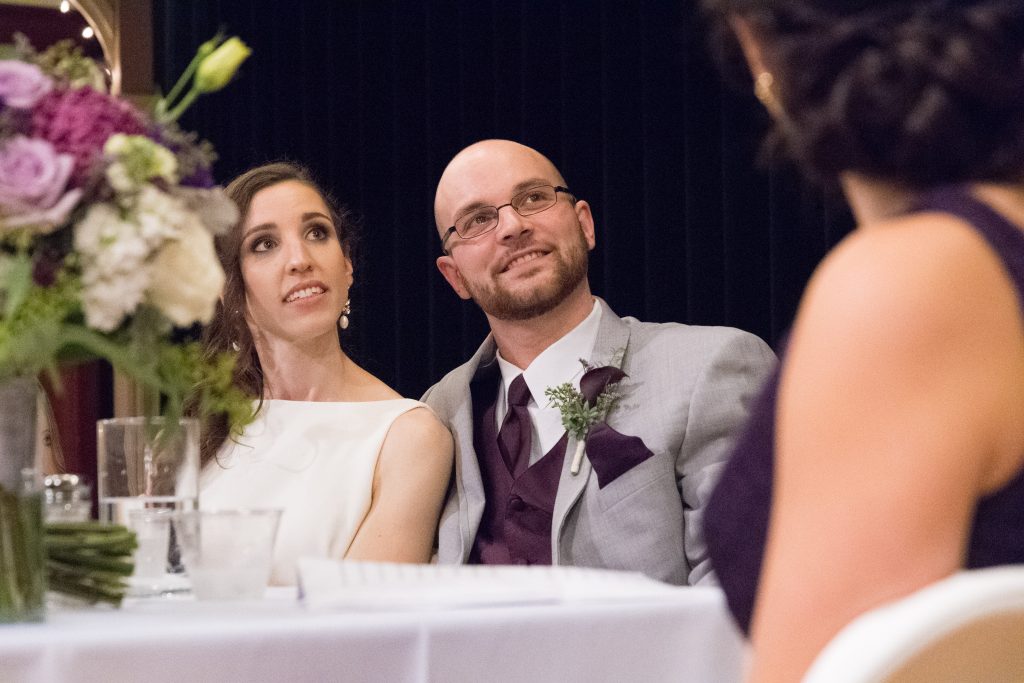
Elizabeth Wall & Andrew Thompson Wedding
2. Watch for transitions, not just peak action
The peak moment is important, but the emotional truth is often just before or after it.
Look for:
the reaction instead of the event
the quiet after the chaos
the connection between people
Those in-between moments often tell a deeper story.
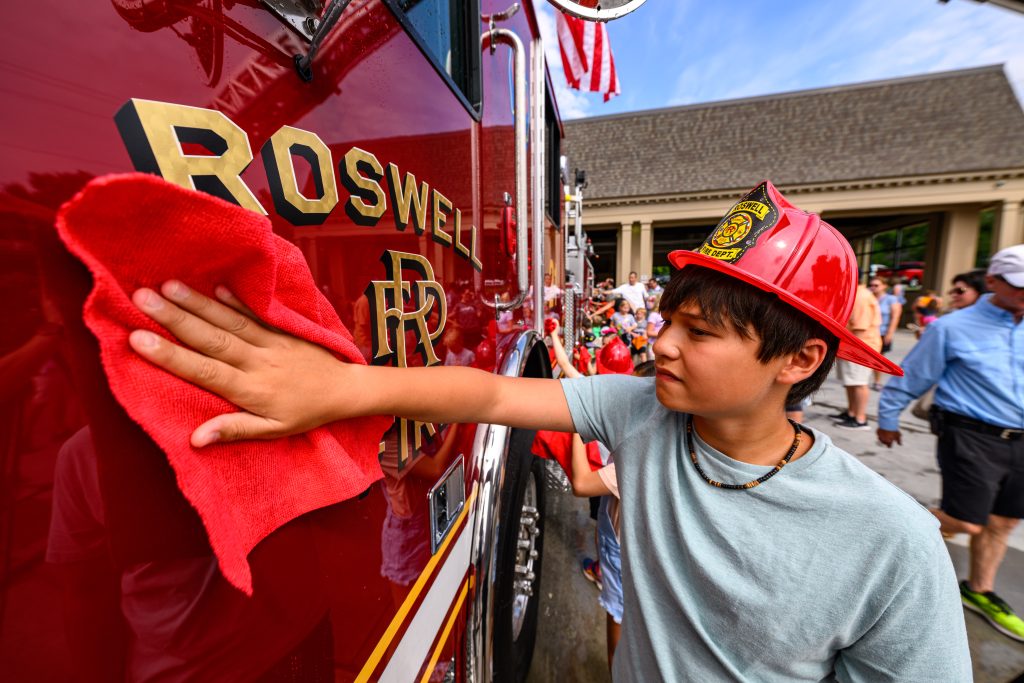
Truck 21 Push-In Ceremony and Station 21 Open House
3. Get physically closer
Being close isn’t just about composition—it’s about connection.
When you’re physically present:
expressions carry more weight
viewers feel immersed
distractions fall away
If you’re too far back, the audience stays detached.
4. Shoot with intent, not just reaction
Coverage is expected. Insight is what elevates your work.
Ask yourself:
What is this story really about?
Who is most affected?
Where is the emotional center?
When you understand the narrative, you can anticipate rather than chase moments.
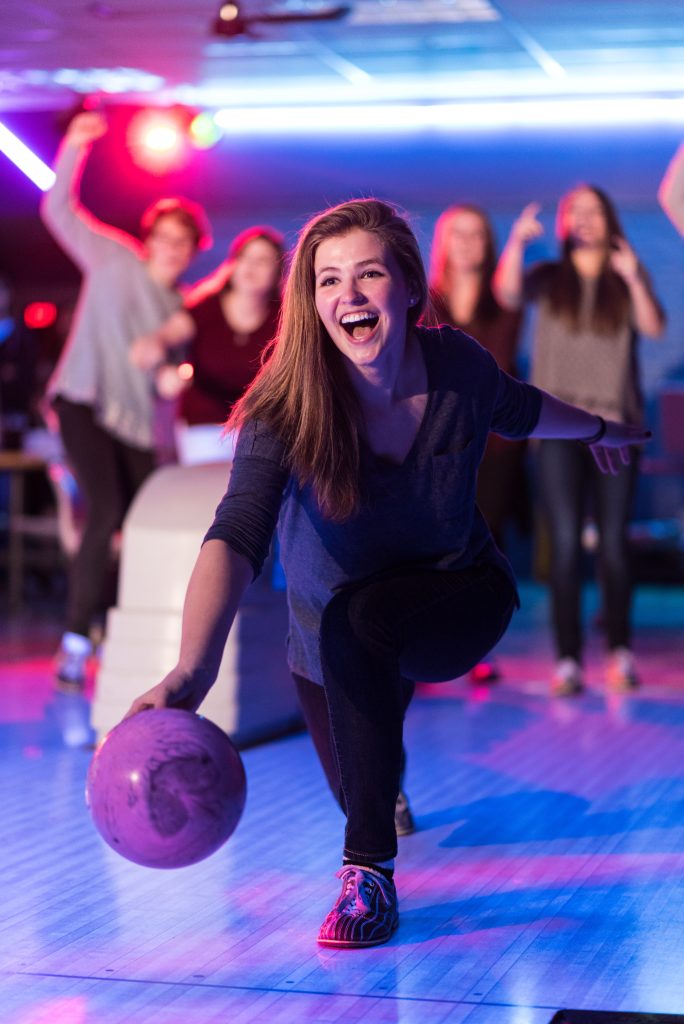
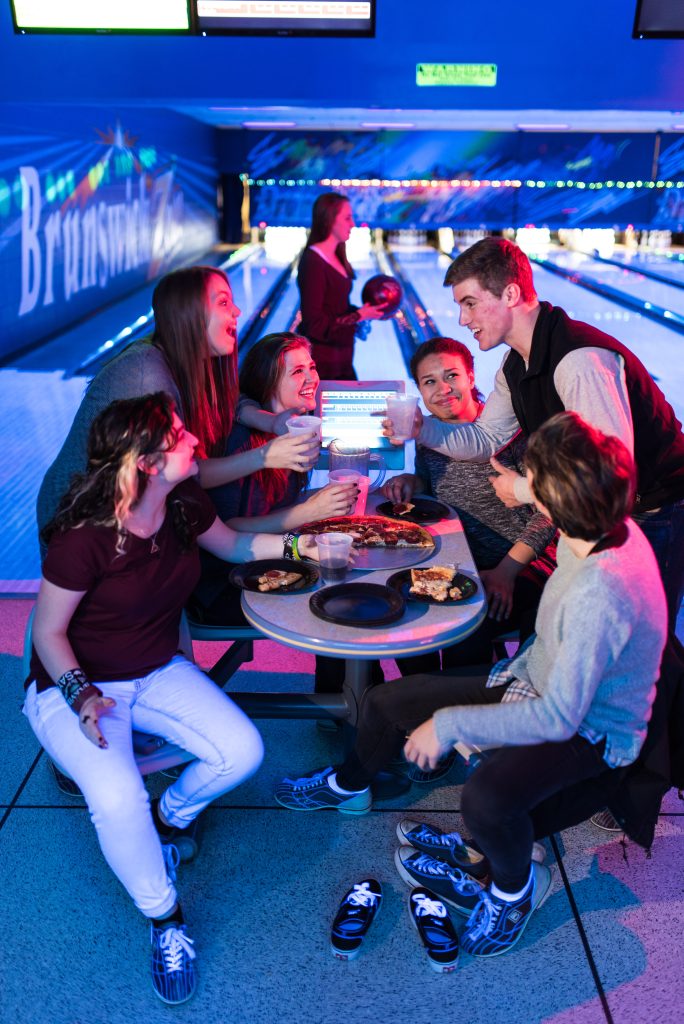
Cosmic Bowling
5. Use light to reinforce the story
Light is part of the storytelling language.
Soft, natural light can emphasize vulnerability
Harsh light can add tension or conflict
Shadows can suggest isolation or uncertainty
Expose correctly—but more importantly, use light to support what the moment is saying.
Cosmic Bowling
6. Include context when it strengthens meaning
A single face can show emotion, but context explains it.
Think about when to:
Step back and include the environment
Show relationships between people
Reveal what’s at stake
The “why” behind the emotion is often what makes an image powerful.
7. Build trust quickly
Access is more than being allowed in—it’s being accepted.
Even in fast-moving situations:
Acknowledge people
Show respect
Be present without being intrusive
The more trust you build, the more authentic the moments you’ll witness.
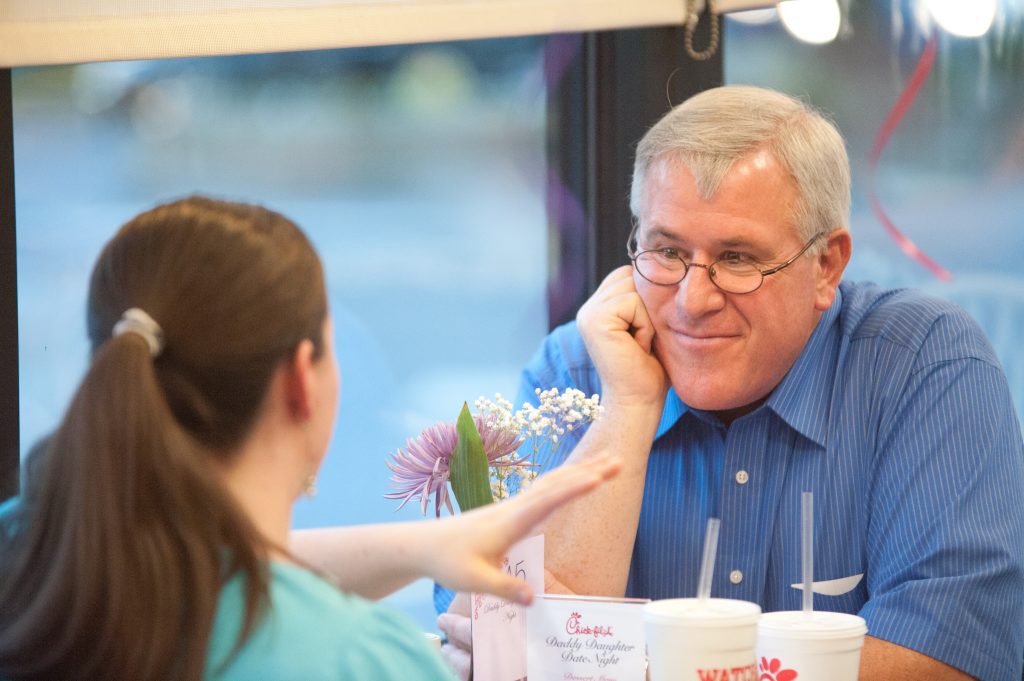
Daddy Daughter Date Night
8. Wait for alignment
Strong images often come when multiple elements come together:
Expression
Gesture
Composition
Timing
That alignment rarely happens instantly. It takes patience and awareness.
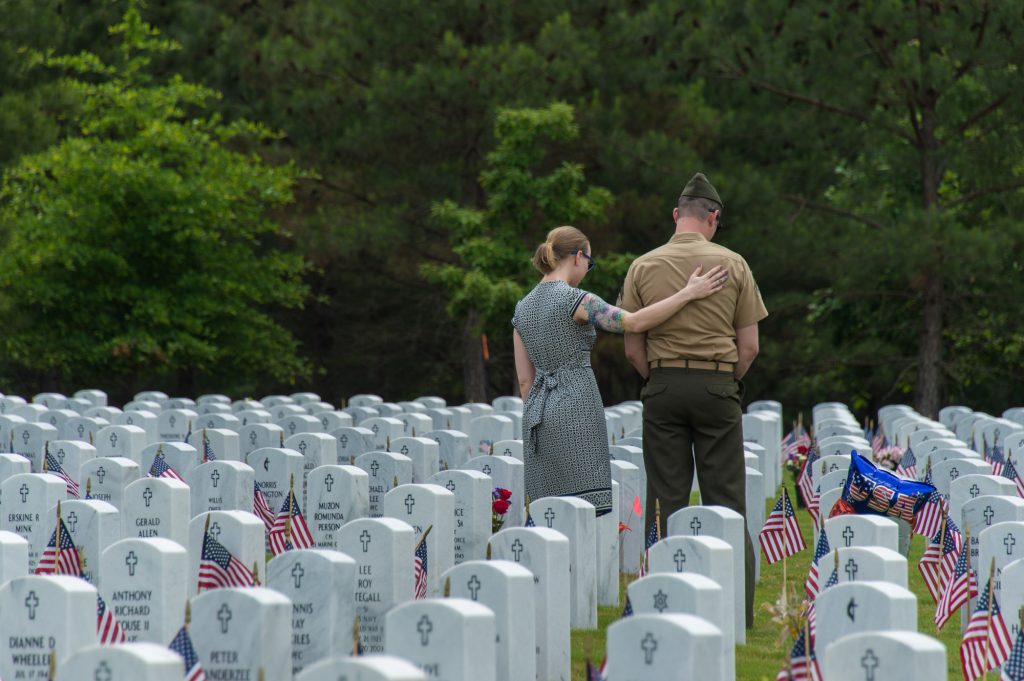
Memorial Day @ Georgia National Cemetery
9. Edit for emotional impact
When selecting images, think beyond technical quality.
Ask:
Does this image make me pause?
Does it reveal something meaningful?
Will someone remember this?
The strongest photo isn’t always the cleanest—it’s the one that communicates.
10. Stay emotionally engaged
You are your most important tool.
If you become detached, your work will reflect that. But when you stay engaged—curious, empathetic, aware—you begin to see moments others overlook.
In the end, powerful photojournalism isn’t just about being in the right place at the right time. It’s about recognizing when something real is happening—and having the patience and awareness to capture it in a way that others can feel.
Most organizations don’t struggle with knowing they need better visuals or stronger storytelling—they struggle with knowing where to start.
Some need a single, powerful story to clarify who they are. Others need a steady flow of content to stay visible and relevant. And many are somewhere in between.
That’s why I’ve created four clear service tiers designed to meet you wherever you are and grow with you as your needs expand.
Think of it as a ladder. You can step in at the right place today—and move up as your storytelling needs grow.
1. Brand Story Sessions
This is where clarity begins.
In a focused session, I help you identify and shape the core story of your brand or organization. We define what you do, why it matters, and how to communicate it visually and emotionally.
This is ideal if you need direction, a refresh, or a strong foundation to build everything else on.
2. Brand Content Package
Once your story is clear, you need the visuals to support it.
This package creates a set of intentional photos and video content designed around your messaging. It’s structured to give you a library of assets you can use across your website, social media, presentations, and marketing.
Think of this as your storytelling toolkit.
3. Content in a Day
Fast, focused, and highly productive.
We dedicate a full day to capturing a wide range of content in your environment. It’s designed for organizations that need a large volume of usable, high-quality storytelling assets in a short timeframe.
You walk away with months of content ready to deploy.
4. Monthly Storytelling Package
For organizations that never want to fall behind in their storytelling.
This ongoing partnership ensures you consistently have fresh, relevant content being created. It keeps your brand visible, your message current, and your audience engaged throughout the year.
It’s storytelling without gaps.
The Big Idea
You don’t need to figure everything out at once.
You just need the right next step.
Whether you’re starting with clarity, building your first content library, or committing to ongoing storytelling, these tiers are designed to support real growth—not overwhelm.
Ready to Begin?
If you’re unsure where to start, that’s exactly what I help with. Most clients begin with a conversation and then step into the level that fits their current season.
Let’s build your story in a way that actually works in the real world.
Over the past year, I’ve photographed many meaningful moments.
Stories of faith. Stories of service. Stories of people doing quiet, important work that most never see.
But this week, something different happened.
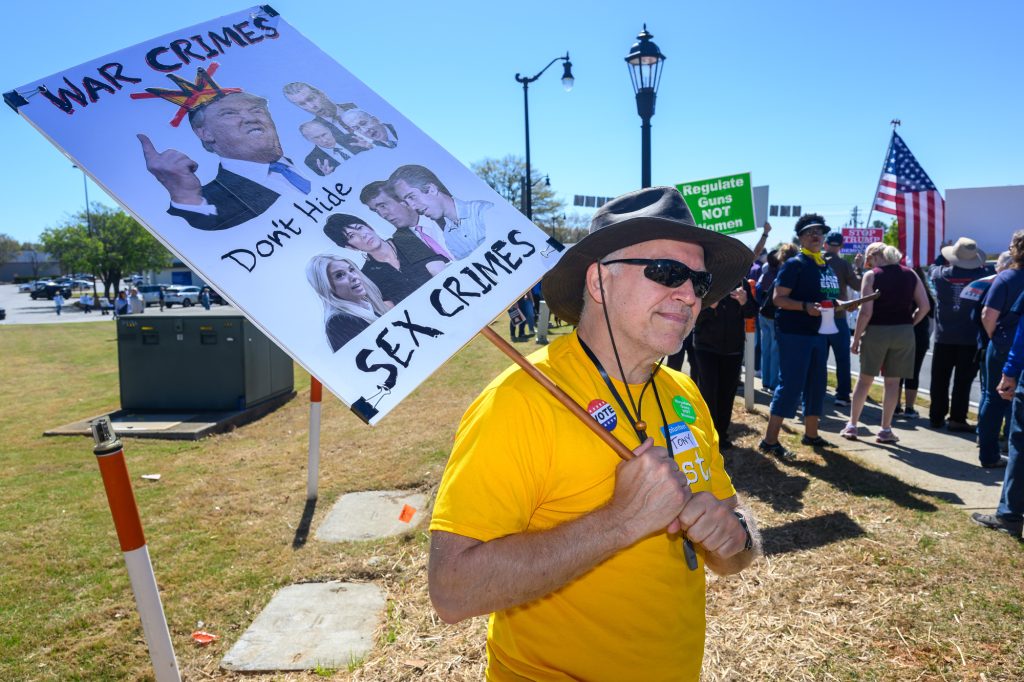
My photojournalistic coverage of the “No Kings” protest in Roswell—shot for ZUMA Press—reached more people on Facebook than almost anything I’ve shared all year.
18,000+ views. And more striking—over 93% of those views came from people who don’t even follow me.
That got my attention.
Not just because of the numbers—but because of why.
What People Engaged With… Wasn’t Just the Photos
Alongside the images and a short video, the comments began to come in.
Some supportive. Some critical. Some are deeply passionate. Some… deeply personal.
And as I read through them, something became clear:
People weren’t just reacting to a protest. They were reacting to their own story.
One person talked about gas prices and the cost of living. Another talked about constitutional concerns and government overreach. Another spoke about global politics and national security. Others shared beliefs about faith, freedom, and the country’s future.
At first glance, it appears to be a disagreement.
But if you slow down and really listen…
It’s not just disagreement. It’s people telling you how life is going for them.
We Don’t Just Argue Ideas—We Defend Our Lived Experience
What I saw in the comment thread is something I’ve seen for years as a storyteller:
When people feel strongly about something, it’s usually not abstract.
It’s personal.
The cost of gas isn’t just economic—it’s whether someone can visit family.
Immigration isn’t just policy—it’s about safety, identity, or opportunity.
Government decisions aren’t just headlines—they shape how secure or uncertain someone feels about their future.
So when people “dig in their heels,” it’s often because:
They’re defending their experience of reality.
And that’s why these conversations get so intense.
Because it feels like more than being disagreed with.
It feels like being dismissed.
The Hardest Thing: Listening First
As I watched the back-and-forth unfold, I kept coming back to one thought:
The hardest thing for any of us to do… is to listen first.
Not to respond. Not to correct. Not to win.
Just… to understand.
And honestly, that’s not easy.
Because listening requires something we don’t talk about enough:
Compassion.
Not agreement. Not approval.
But a willingness to say:
“Help me understand how you got here.”
As a Storyteller, I Ask Myself This Question
Covering moments like this, I wrestle with something:
Am I helping… Or am I just stirring the pot?
When a story gets attention like this, it clearly touches something deeper.
It brings people out. It gets them talking. Sometimes arguing.
But maybe that’s not the whole picture.
Maybe what storytelling really does—at its best—is this:
It forces us to see our neighbors.
Not as headlines. Not as labels. But as people… standing on a street corner, holding a sign, trying to be heard.
What If We Took One More Step?
It’s one thing to listen.
It’s another to care.
What if, instead of stopping at “I hear you,” we asked:
“How can I help?”
Because the truth is—
Every single one of us has needed help at some point. And every single one of us will need help again.
That’s part of being human.
And maybe that’s the piece we’re missing in so many of these conversations.
Not better arguments. Not louder voices.
But a deeper recognition that:
The person on the other side of the conversation is carrying something real.
Why I’ll Keep Telling These Stories
I don’t expect everyone to agree with what they see in these images.
That’s not the goal.
The goal is to document. To witness. To help people be seen and heard.
But if those stories also lead us to:
Listen a little longer
Assume a little less
and care a little more
Then maybe it’s doing more than just “getting attention.”
Maybe it’s doing what storytelling is meant to do.
There are moments when a story is best understood in layers—what you see from a distance, and what you feel when you’re standing inside it.
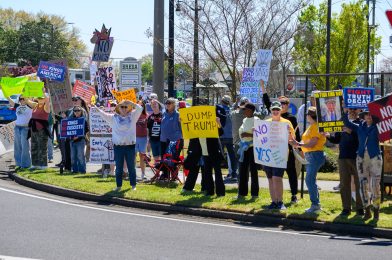
Today’s “No Kings” rally at the corner of Holcomb Bridge Road and Alpharetta Highway in Roswell, Georgia, was one of those moments.
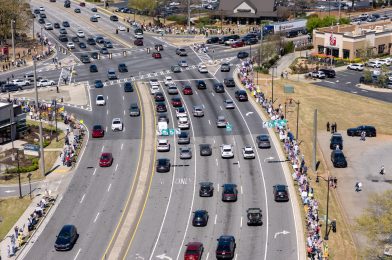
From the ground, it was a gathering of individuals. From the air, it became something else entirely.
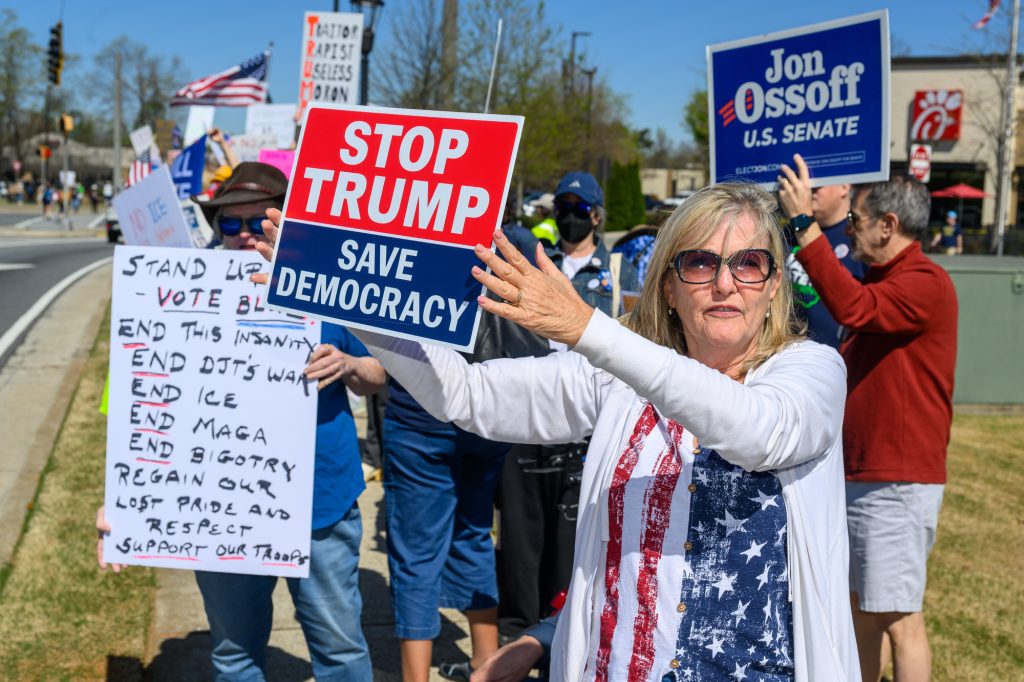
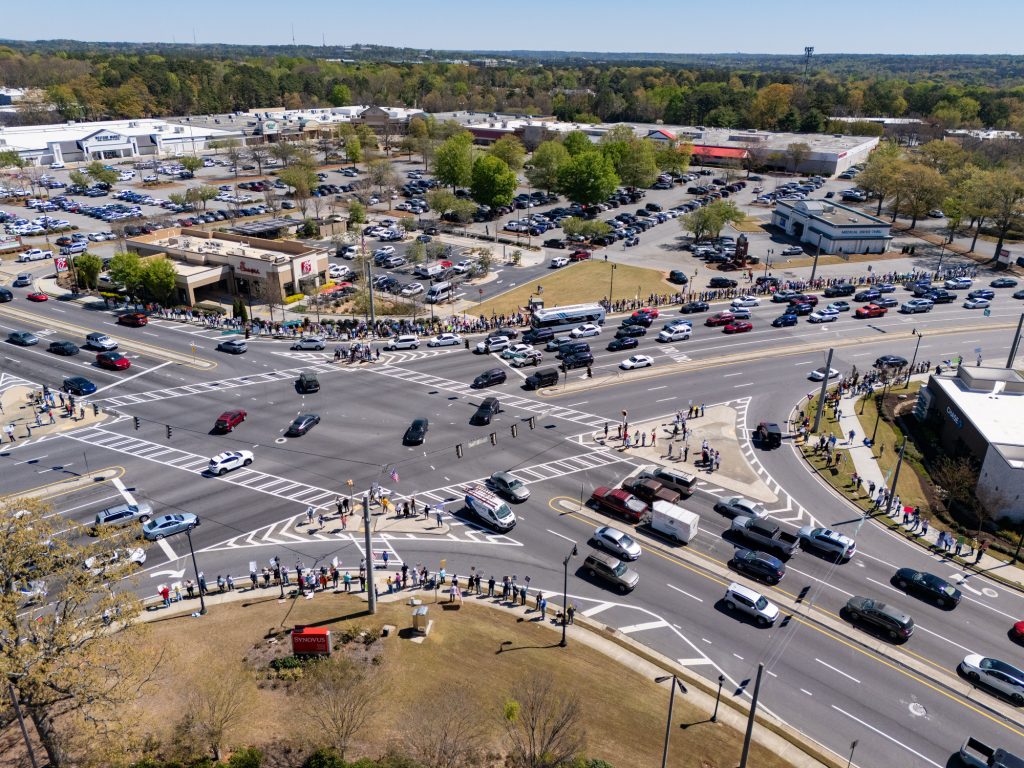
Demonstrators gathered Saturday at the Corner of Holcomb Bridge & Alpharetta Hwy in front of Chick-Fil-A, Holcomb Bridge Road & Alpharetta Highway, Roswell, GA for a No Kings rally aimed at protesting perceived executive-overreach.
From Above: Scale You Can’t Feel on the Ground
The first thing that stood out from the drone was simply the size of the turnout.
More than 400 people had signed up for the event, but what actually unfolded on the ground was easily double that number. From above, the crowd filled the intersection and surrounding areas in a way that signage and sidewalks alone couldn’t contain.
It wasn’t just density—it was movement. People arriving, gathering, shifting, crossing streets, and forming clusters of conversation and expression. From that height, the message wasn’t in any single sign. It was in the presence.
On the Ground: Faces, Messages, and Moments
At street level, the story became personal.
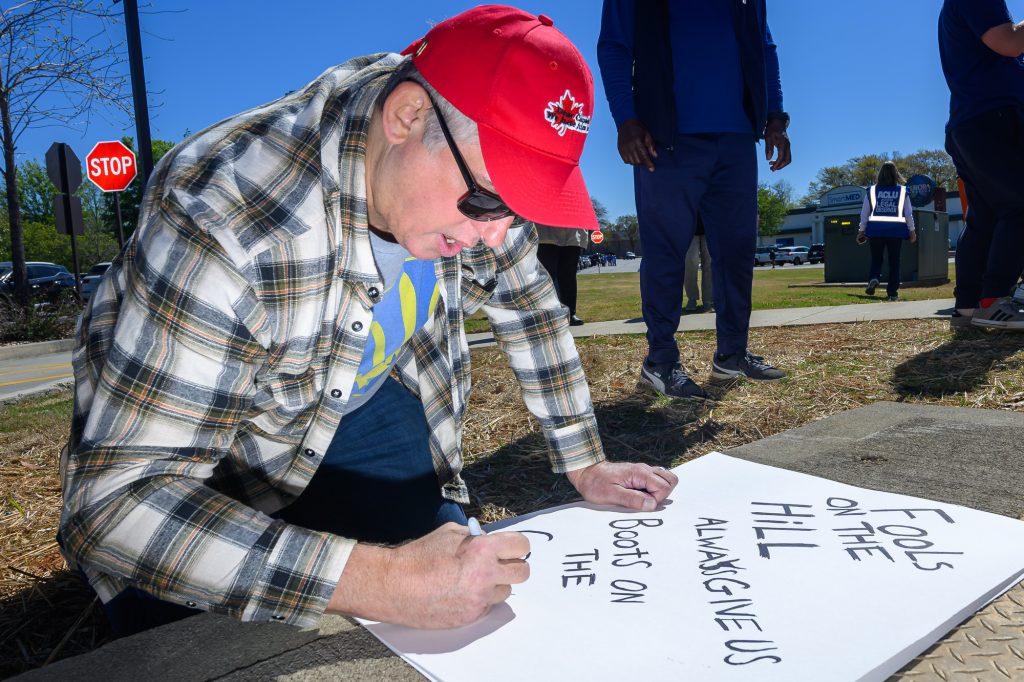
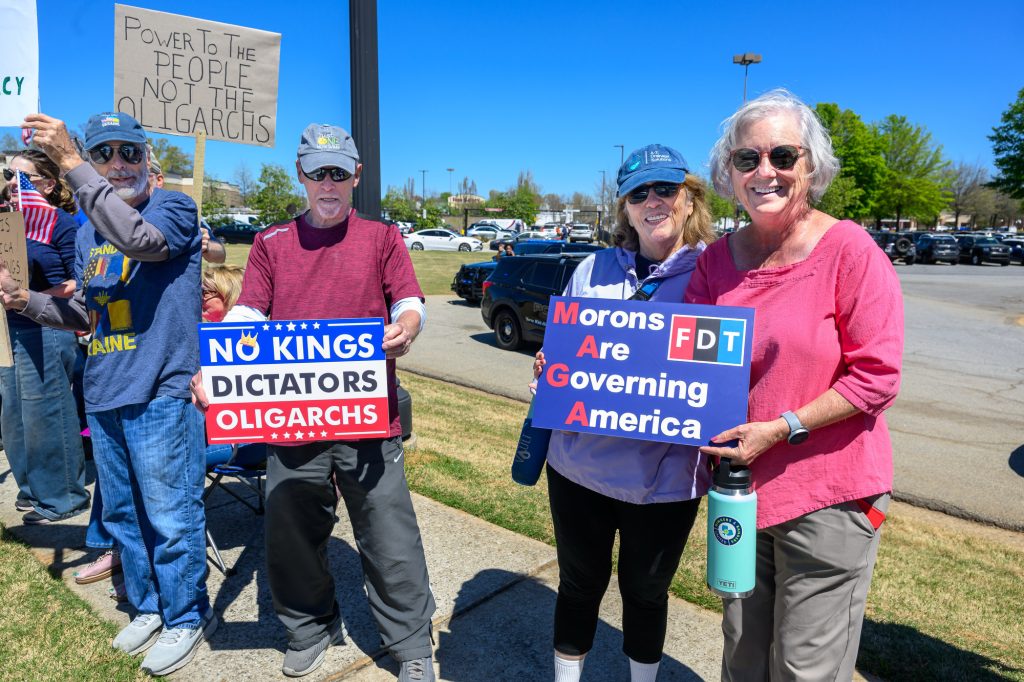
ROYAL RIEDIMGER makes HIS poster
ROYAL RIEDIMGER was seen making HIS poster, carefully constructing a message that would soon join dozens of others carried into the crowd.
TONY WESTERFIELD, a volunteer for the event
TONY WESTERFIELD, volunteering at the event, moved through the gathering carrying HIS poster, part of the flow of people supporting and participating in the day.
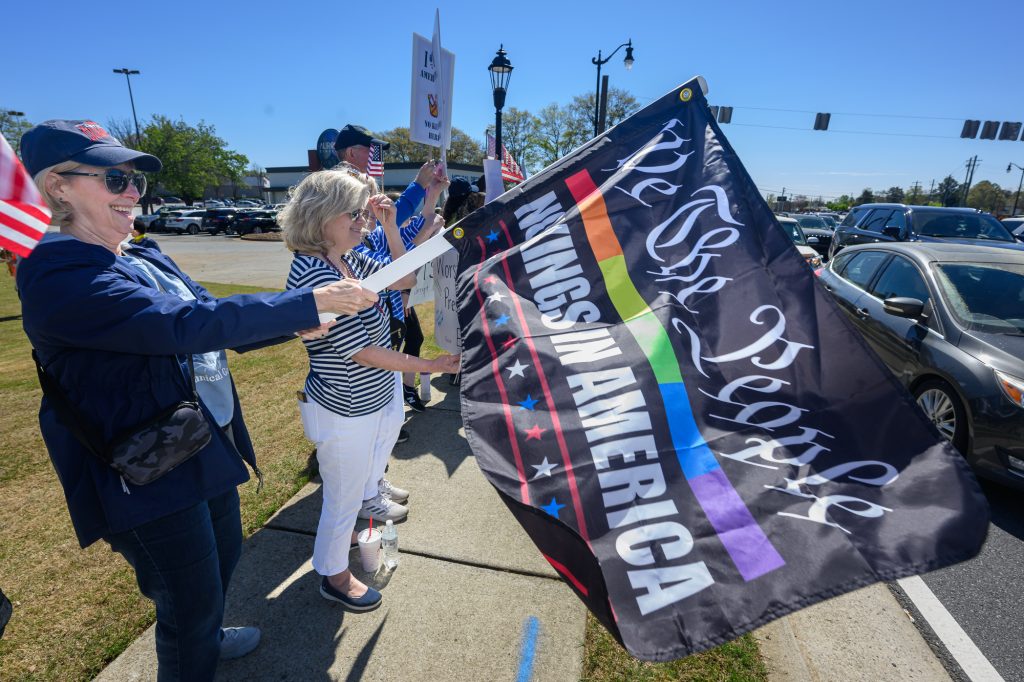
RITA DOWNING holds HER “We the People” flag
RITA DOWNING stood holding HER “We the People” flag—simple words that carried weight in the context of the gathering around HER.
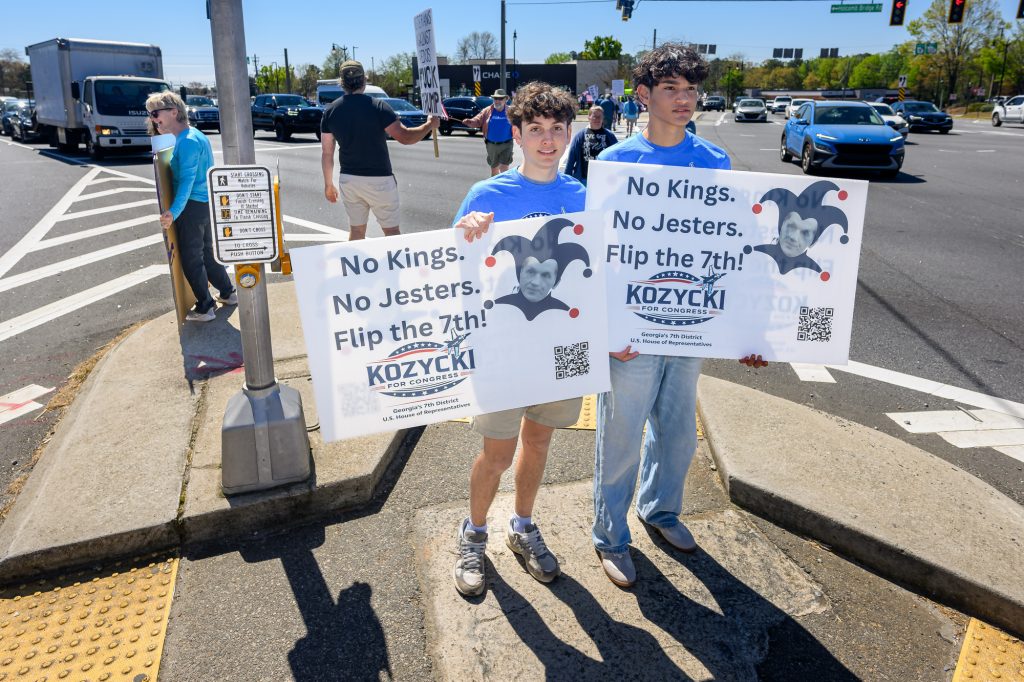
Friends GRAHAM ANTIN and NIKHIO GULLEY carry THEIR posters
Friends GRAHAM ANTIN and NIKHIO GULLEY crossed Holcomb Bridge Road together, each carrying THEIR own posters, moving through traffic and into the larger stream of demonstrators.
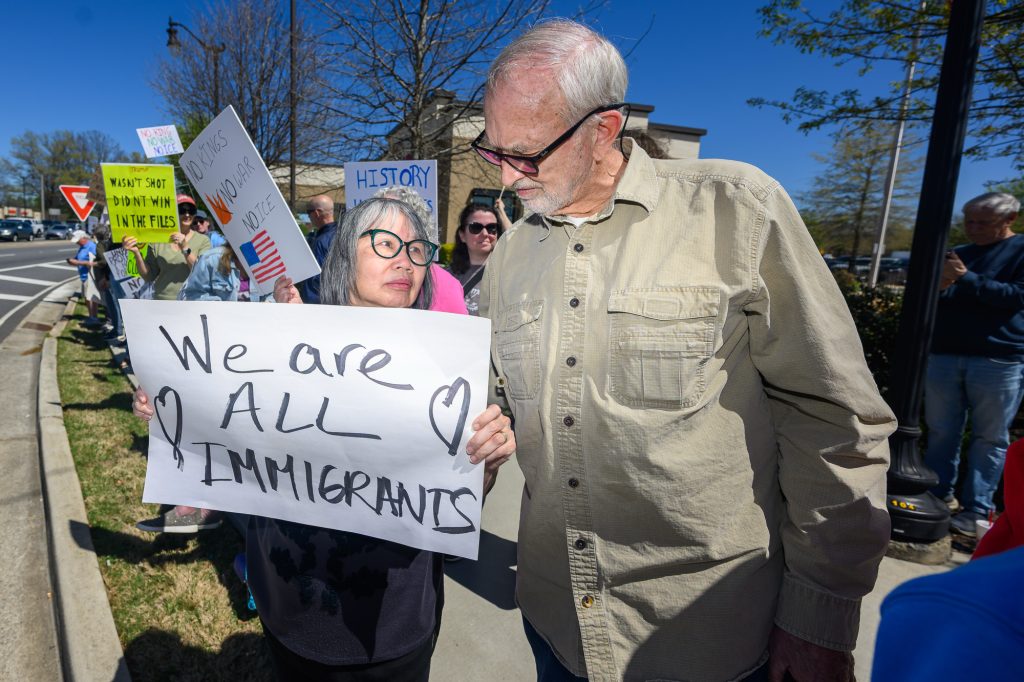
AGNES RUST and DAVID RUST
AGNES RUST and DAVID RUST stood side by side holding a sign that read “We Are All Immigrants,” a message that turned their presence into part of the visual conversation happening across the intersection.
JOAN ROBERSON holds a “No Kings Since 1776”
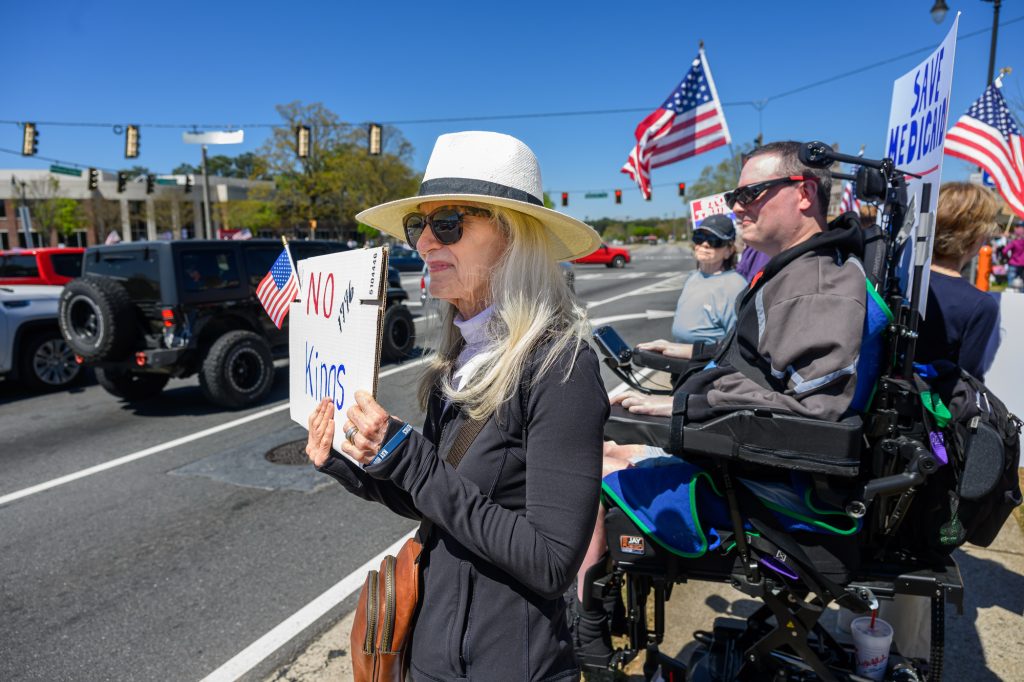
JOAN ROBERSON held a “No Kings Since 1776” sign while, just behind HER, BRETT CHANCE sat in a wheelchair with a “Save Medicare” sign attached—two messages occupying the same frame, each adding another layer to the day’s expression.
From a wider view on the ground, CHRIS BARLEY, GEORGE COPPENHAVER, DARYA ABERBACK, and ROBBIE COPPENHAVER stood together holding THEIR signs, part of the steady rhythm of people arriving, pausing, and joining in.
The View That Connects It All
The drone image pulled everything together again.
Demonstrators gathered Saturday at the Corner of Holcomb Bridge & Alpharetta Hwy in front of Chick-Fil-A, Holcomb Bridge Road & Alpharetta Highway, Roswell, GA for a No Kings rally aimed at protesting perceived executive-overreach.
What looked like individual statements from the ground became, from above, a collective presence. Not uniform. Not scripted. But shared space is occupied by people choosing to show up and be seen.
That contrast—between aerial scale and human detail—is where the story lives.
From above, it was about volume and turnout.
From the ground, it was about voices.
And somewhere between the two, it became a reminder of what public expression looks like when people step into a shared space and speak in their own way.
Most people only see the final performance. What they don’t see is the moment where everything either comes together—or falls apart.
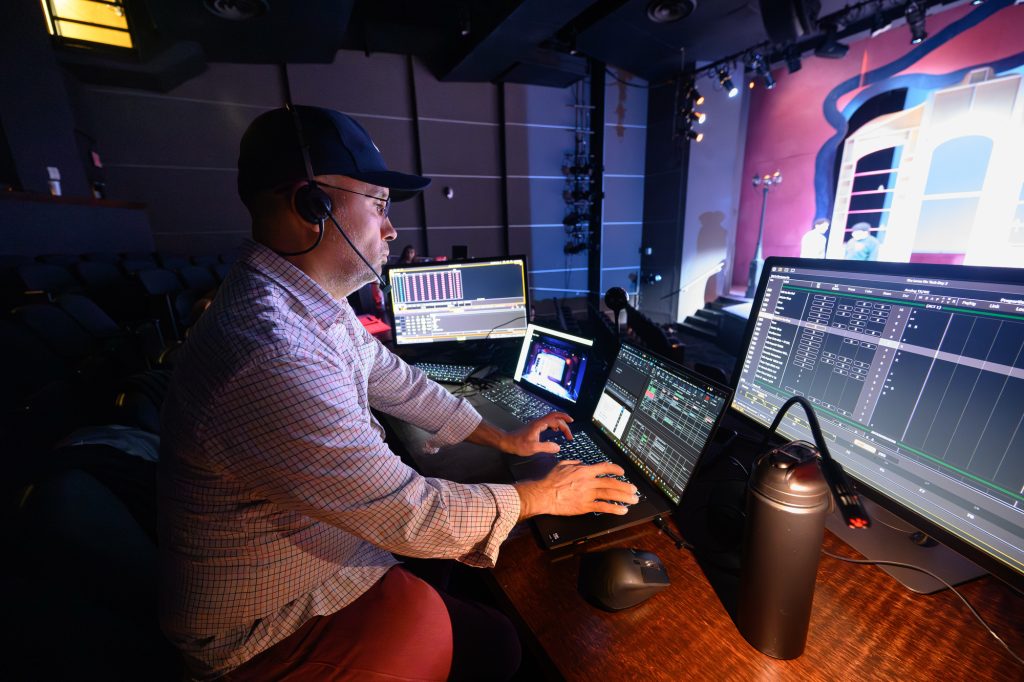
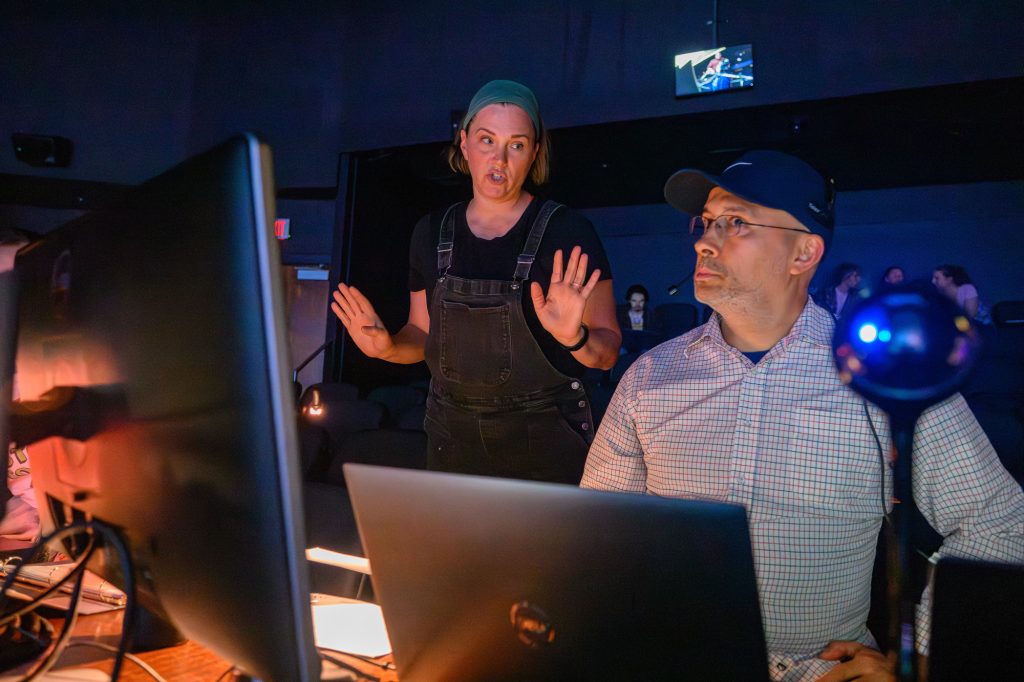
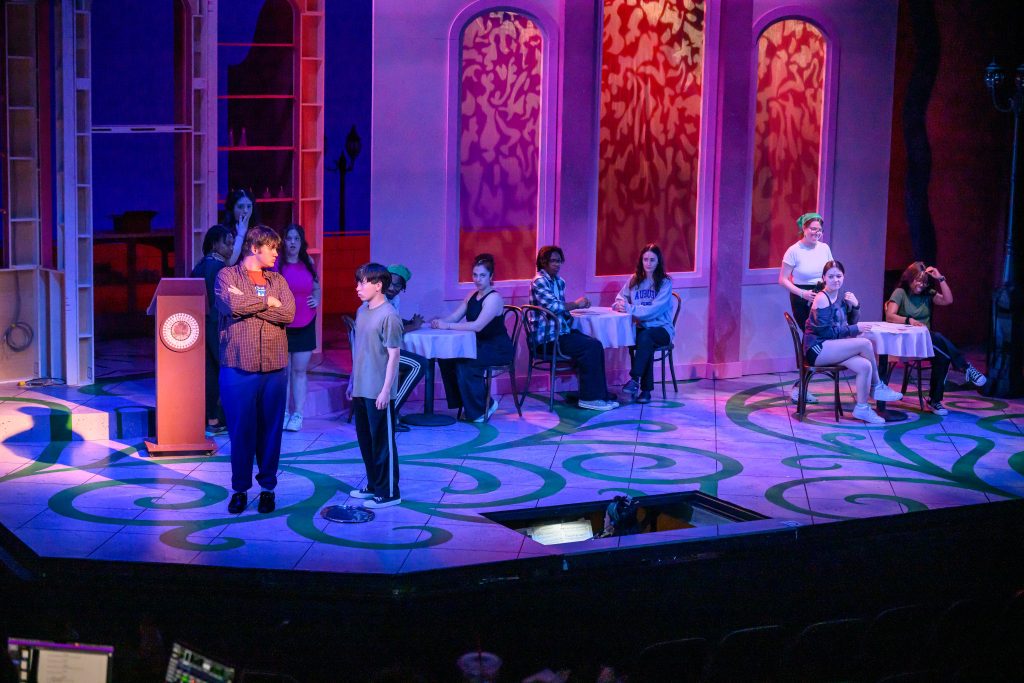
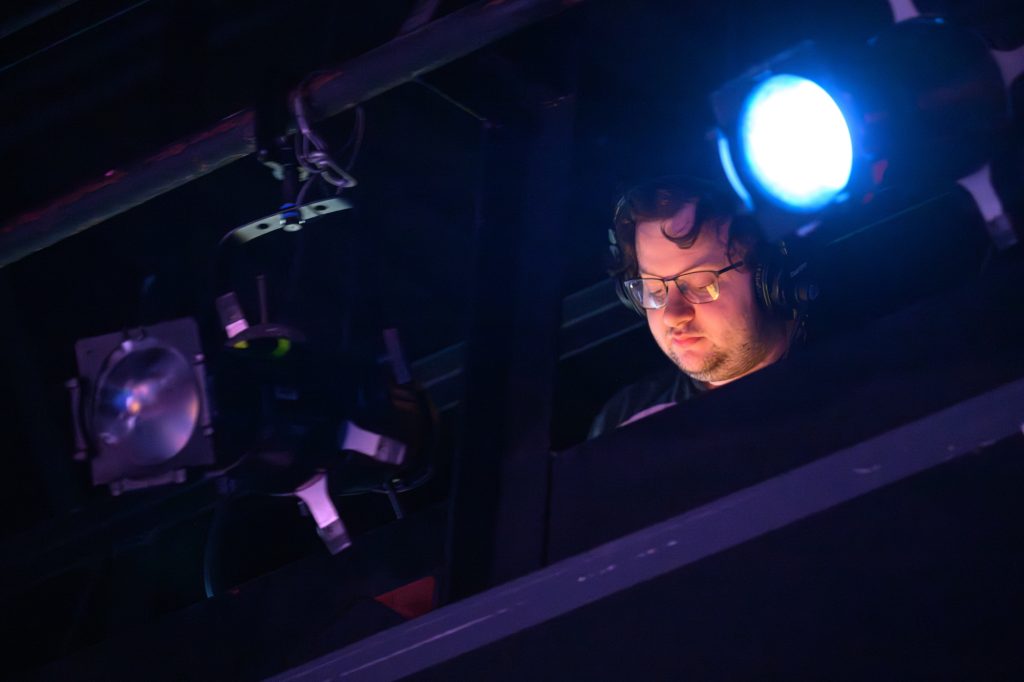
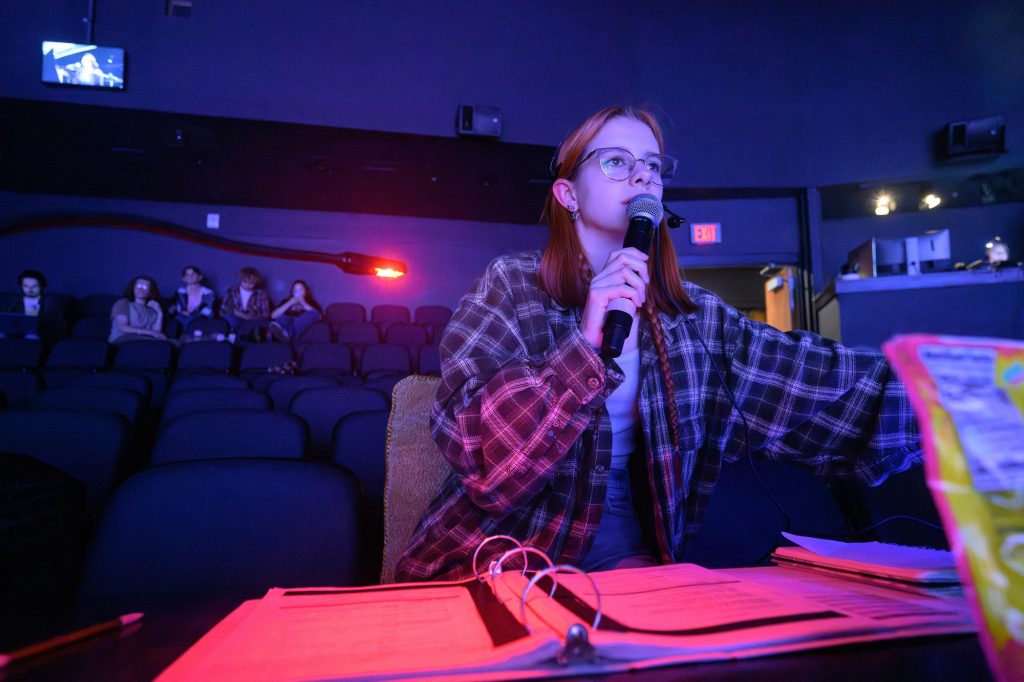
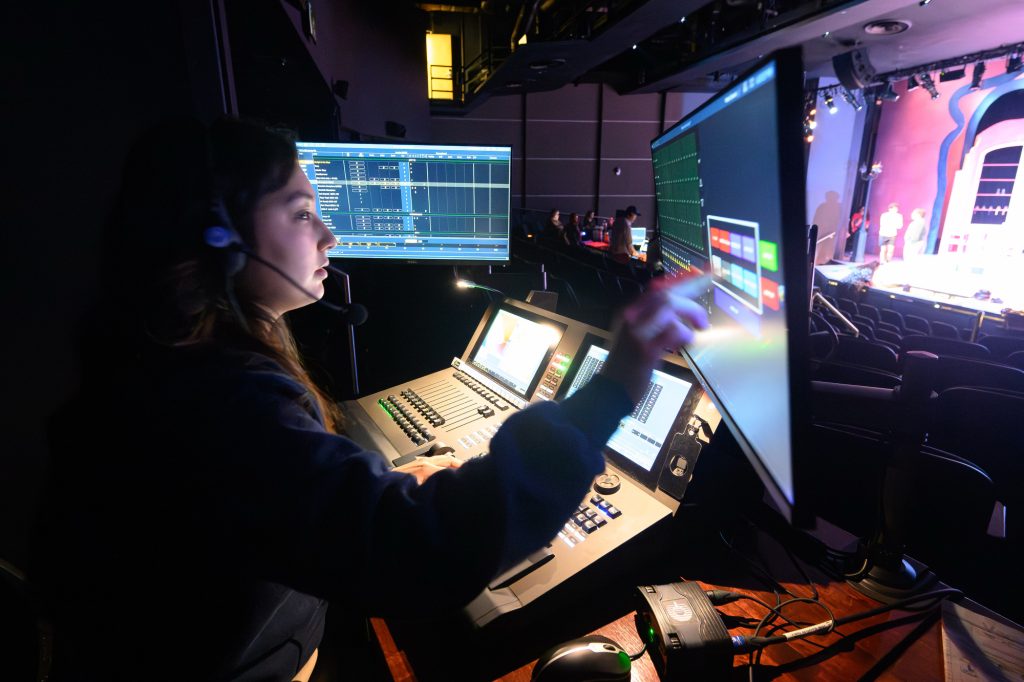
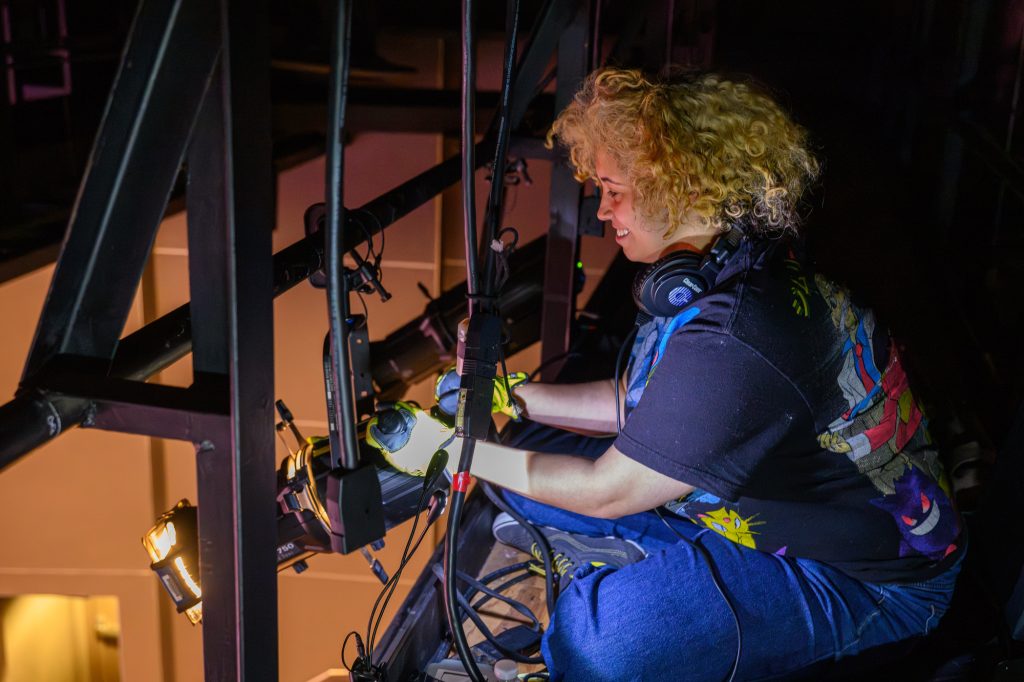
I recently photographed a cue rehearsal for the musical She Loves Me at Kennesaw State University’s Robert S. Geer Family College of the Arts, and it reminded me of something every organization needs to understand about storytelling.
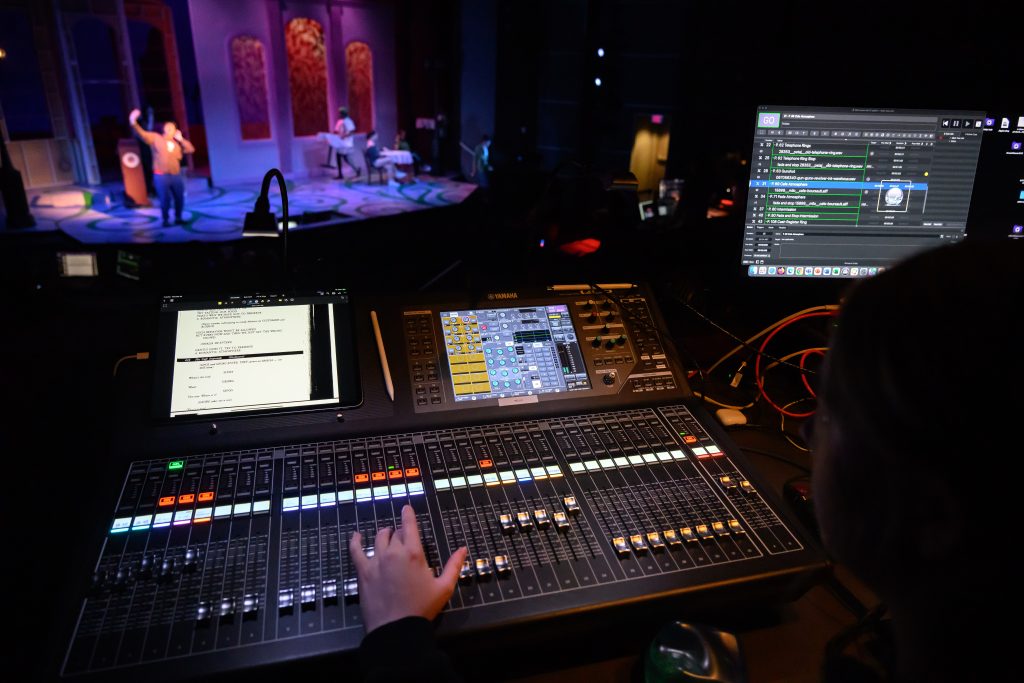
A cue rehearsal—often called a cue-to-cue—isn’t about running the full show. It’s where the production jumps from one technical moment to the next: lighting changes, sound cues, scene transitions. Every detail is tested and timed so the story flows seamlessly for the audience.
In many ways, this is exactly what most organizations skip.
Too often, teams jump straight to the “performance”—the final video, the photos, the campaign—without ever working through the cues:
Who is the story really about?
What moment carries the emotional weight?
Where does the audience feel something shift?
Without those cues, the story may exist… but it won’t connect.
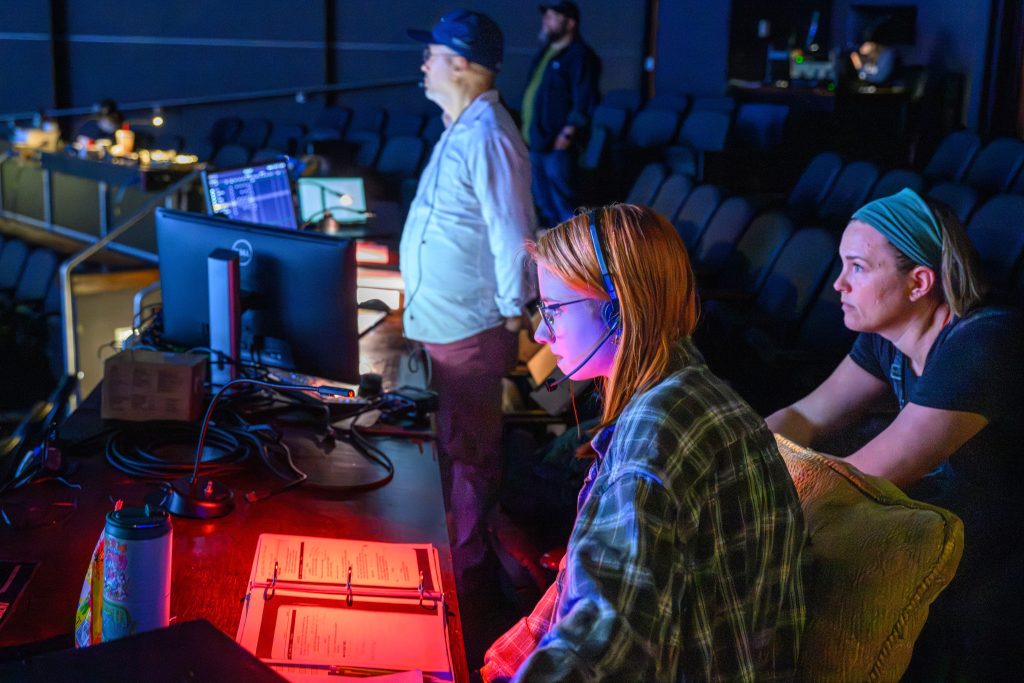
What I love about photographing a rehearsal like this is that it reveals the full team behind the story.
You see the stage manager calling cues and holding everything together. You see lighting and sound designers shaping the emotional tone. You see crew members moving pieces in near darkness. You see actors stepping in and out, helping mark the exact moments that trigger everything else.
This is where storytelling becomes synchronized.
And this is why I photograph it.
I’m not just documenting performers—I’m capturing the system that makes storytelling work. Because great storytelling is never just about the person on stage. It’s about everything supporting that moment.
If you want stronger storytelling in your organization, don’t start with the final product.
Start with your cues.
What is the turning point in the story?
Who carries the emotional weight?
What details help the audience feel it?
When those are clear, everything else falls into place.
She Loves Me
Stillwell Theater
Rehearsal
Watching She Loves Me move from cue rehearsal to performance is a reminder of what happens when every detail is aligned.
If you’re in the area, it’s worth seeing how all of this comes together on stage.
If you look closely at the theater world, the people behind the scenes are often the ones who build the most consistent, long-term careers.
Actors are incredibly talented, but their work is often project-based—moving from audition to audition, role to role, with very little security. In fact, many actors work other jobs between performances because steady roles are hard to maintain.
But behind the scenes, it’s different.
Stage managers, lighting designers, sound engineers, and crew members are the ones productions depend on over and over again. These are the people who make the show run—and because of that, they’re often the ones who continue working season after season, sometimes for their entire careers.
A stage manager, for example, isn’t just part of one performance—they carry the show from rehearsal through the entire run, calling every cue and maintaining the production night after night.
And the broader crew—stagehands, technicians, designers—are the skilled professionals who build, operate, and sustain the production itself.
If you love theater, it’s worth remembering this:
Not everyone is meant to stand in the spotlight.
Some of the most meaningful—and lasting—careers in the arts happen just out of view, where the story is quietly being held together.
Most people don’t realize how scattered their photos have become until they go looking for something specific—and can’t find it.
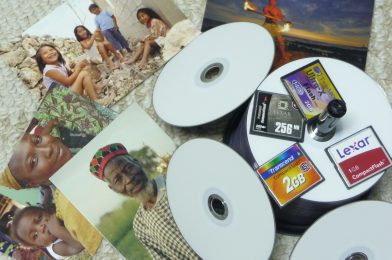
Maybe it’s a family moment buried on an old CD. A trip stored on a thumb drive in a drawer. A hard drive sitting on a shelf. Or images floating in a cloud account you haven’t touched in years.
Over time, photos end up duplicated across multiple formats and locations. That creates confusion, slows down your workflow, and increases the risk of losing access to important memories.
A more intentional system doesn’t just make things easier—it gives you confidence that your images are both preserved and accessible.
Why Organization Matters
Photos are more than files. They represent people, stories, milestones, and history.
Without a clear system:
You waste time searching across devices
You risk losing access to older storage formats
You may forget where your “best” or final versions live
You end up duplicating effort instead of building on what already exists
The goal isn’t perfection. The goal is findability and preservation.
The Approach I Use
Over time, I’ve built a system that balances accessibility, redundancy, and practicality. It’s not about chasing the newest tool—it’s about using a combination of platforms that serve different roles.
1. Centralizing Select Images in the Cloud
I’ve moved organized photo collections from CDs, DVDs, thumb drives, and older hard drives into an online platform like PhotoShelter.
This becomes a searchable, accessible library for finalized JPEG images—photos that already include embedded metadata such as captions, keywords, and other identifying information.
This step is about making your images easy to find and share, without digging through physical storage.
2. Maintaining a Local Archive on a NAS
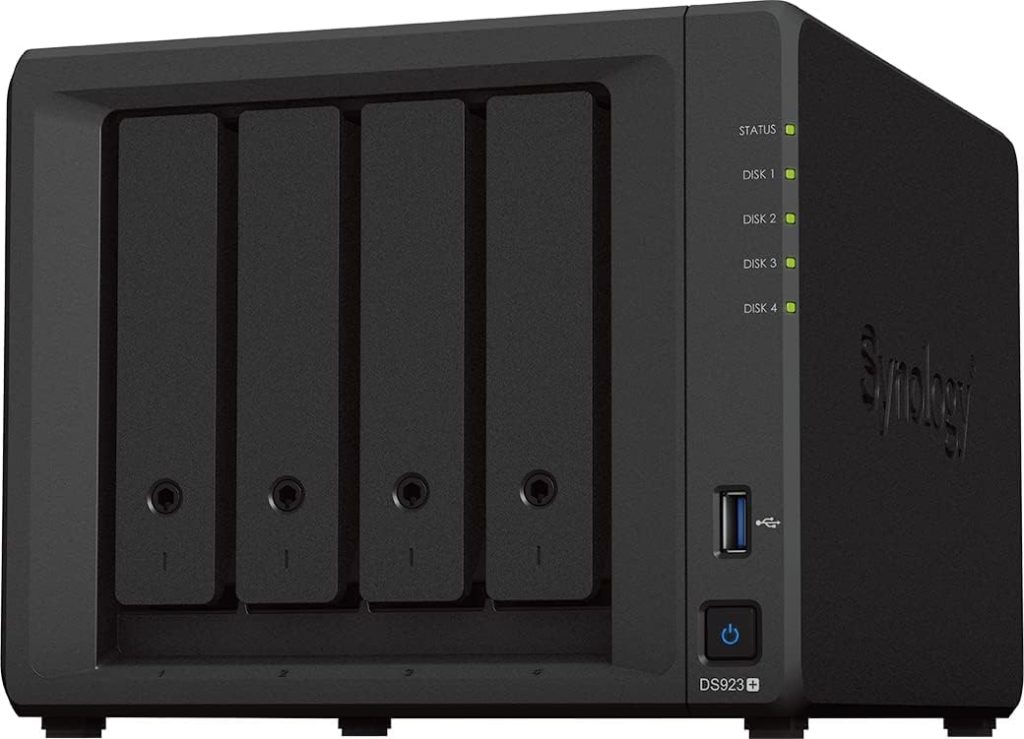
At the same time, I keep a Network Attached Storage (NAS) system as my primary archive.
This serves as my long-term, structured storage for:
RAW files
Master image files
Complete photo libraries
A NAS allows for centralized access across devices while also supporting redundancy and backup strategies. It becomes the backbone of your personal or professional archive.
3. Using a Cataloging Tool for Search and Retrieval
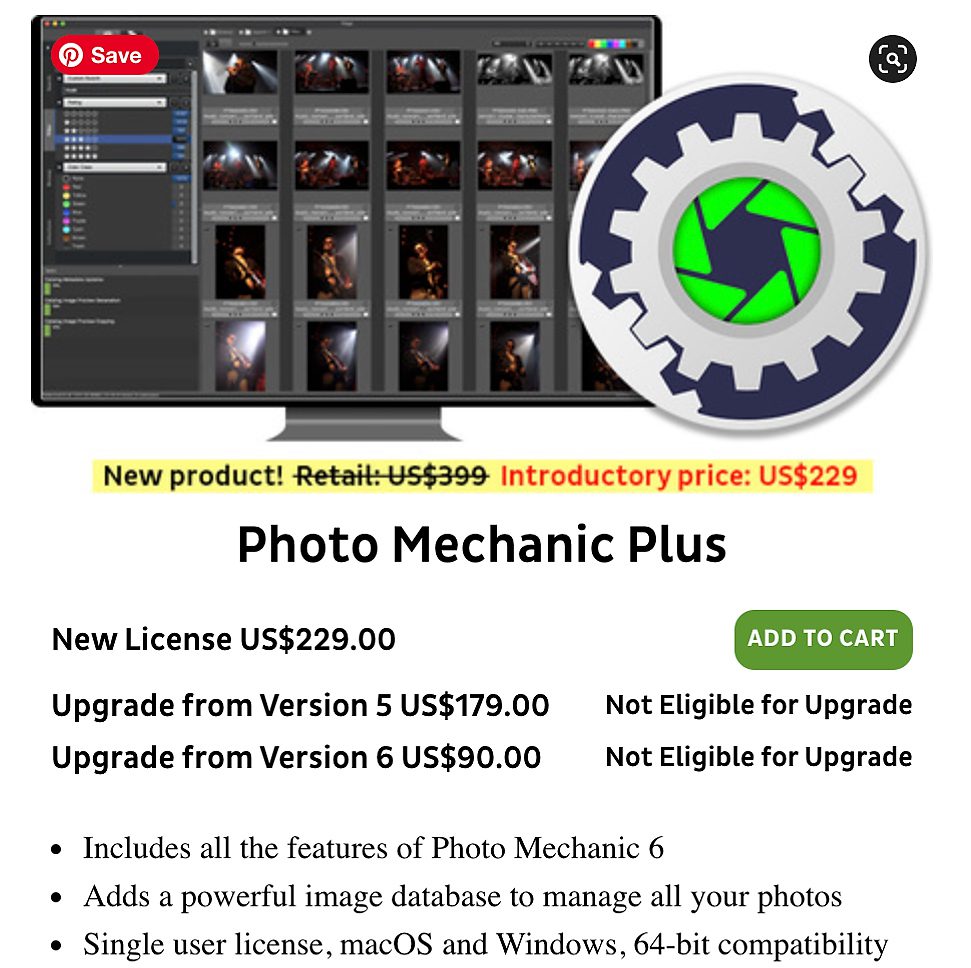
To make sense of everything on the NAS, I rely on Photo Mechanic Plus as a cataloging and search tool.
Instead of relying on folder browsing alone, the catalog allows me to:
Search by metadata
Locate images quickly across large archives
Work efficiently without moving files around unnecessarily
Think of it as an index that connects you to your storage, rather than replacing it.
4. Keeping Original Physical Media
Even after migration, I still keep my original CDs, DVDs, SSDs, and hard drives.
They serve as:
A backup reference
A safeguard against corruption or accidental loss
A historical record of how files were originally stored
While I don’t rely on them for daily access, they remain part of the overall safety net.
5. Revisiting Lightroom Archives When Needed
I occasionally return to older Lightroom catalogs to access RAW files or revisit earlier work.
This adds another layer of flexibility—especially for projects where the RAW file or earlier edits may be needed again.
How This Applies to You
Whether you’re organizing family photos, managing a hobby archive, or working professionally, the principles are the same:
Consolidate what matters most
Keep a structured master archive
Use tools that make searching easy
Maintain backups across multiple formats
Preserve originals, even if they’re not your daily access point
You don’t need to adopt every tool I use. What matters is building a system that fits your scale and needs while following the same core idea: separate storage from access, and make both intentional.
A Simple Way to Start
If your photos feel overwhelming, begin here:
Identify where your images currently live
Choose one primary location to centralize your best and most important images
Move or copy files into that structure in batches
Add or preserve metadata so files remain searchable
Set up at least one backup system for redundancy
Gradually bring order to older archives instead of trying to fix everything at once
Progress matters more than perfection.
Final Thought
A well-organized photo archive isn’t just about efficiency—it’s about stewardship.
When your images are easy to find, properly stored, and thoughtfully maintained, you’re better equipped to revisit moments, tell stories, and pass them on.
That’s when a collection of files becomes something more meaningful: a living archive of stories that can still be used, shared, and remembered.
One of the biggest differences between someone who gets the shot and someone who misses it has very little to do with creativity—and everything to do with preparation.
Moments don’t wait for you.
If you’re still fiddling with settings when the peak action, emotion, or expression happens… It’s gone. That’s why the most important part of photography often happens before you ever raise the camera to your eye.
Be Ready Before You Walk Out the Door
Before you even leave, take a few minutes to set your camera up for the kind of work you expect to do.
I’m always thinking through scenarios ahead of time because the settings for each situation can be dramatically different. The last thing you want is to walk into a fast-paced environment with your camera still set for studio strobes—or vice versa.
I shoot everything in RAW. That gives me the most flexibility later. But when a client needs something immediately, I use Nikon SnapBridge to send an image straight to my phone. It automatically converts RAW to JPEG, and I can email it on the spot.
That way, I’m covered both for quality and speed.
Always Take Test Shots
Once you’ve dialed in your settings, don’t assume everything is perfect.
Take a few test frames.
Check exposure. Look at your focus. Zoom in on details. Make sure nothing unexpected is happening—like flicker, color shifts, or missed focus.
This simple step has saved me more times than I can count.
My Go-To Camera Setups
Over the years, I’ve developed a few “starting point” setups depending on the situation. These aren’t rigid rules—but they get me ready fast.
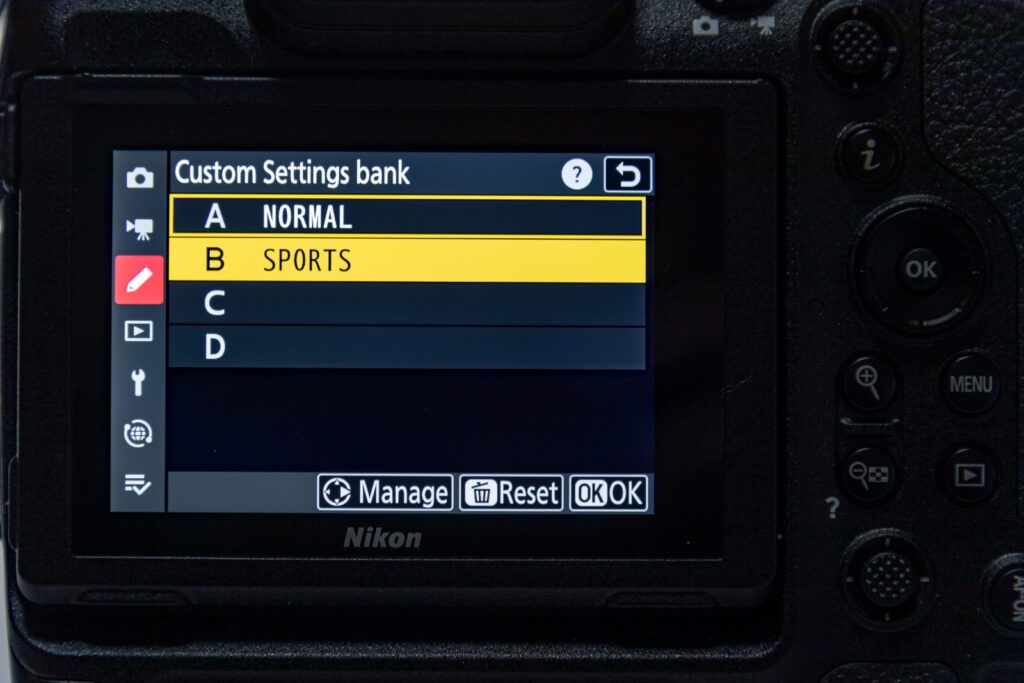
One of the features I really appreciate on the Nikon Z9 is the ability to save your setups so you don’t have to rebuild them from scratch. You can store up to four custom shooting banks in the Photo Shooting Menu (A–D) and another four in the Custom Settings Menu (also A–D—the little pencil icon).
Nikon D5 Sports Settings
What that means in real life is simple: you can have one bank dialed in for everyday storytelling, another for sports, one for studio, and one for tricky lighting situations. Then, instead of digging through menus, you just switch banks, and you’re instantly ready for that environment. It’s one of those small workflow decisions that makes a big difference when the moment is unfolding in front of you.
1) Everyday / General Shooting
This is my default when I’m walking into most environments.
Auto ISO: 64–25600
Minimum shutter speed: 1/250
Focus: AF-C with 3D Tracking or Auto-Area AF
Motor drive: Single shot
I also programmed a function button so I can quickly switch between 3D Tracking and Auto-Area AF depending on what’s happening in front of me.
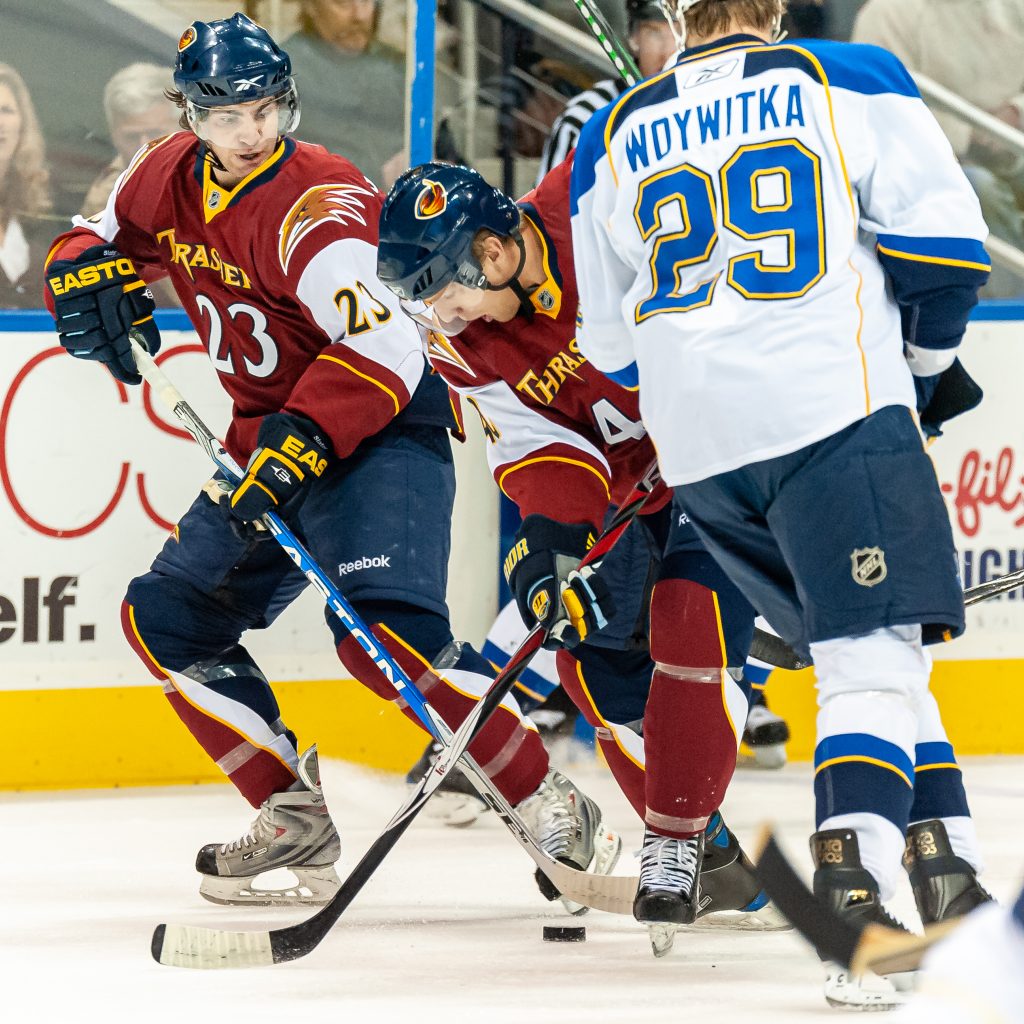
NHL hockey game
2) Sports & Fast Action
When everything is moving fast, your settings have to keep up.
Auto ISO: 64–25600
Shutter speed: 1/4000
Focus: AF-C with 3D Tracking or Wide-Area AF (C1/C2)
Subject Detection: People or Vehicles
AF setup: Back-button focus (AF-ON only)
Blocked Shot AF Response: 3 or 4
Motor drive: 20 fps
This setup is all about tracking and capturing peak moments without hesitation.
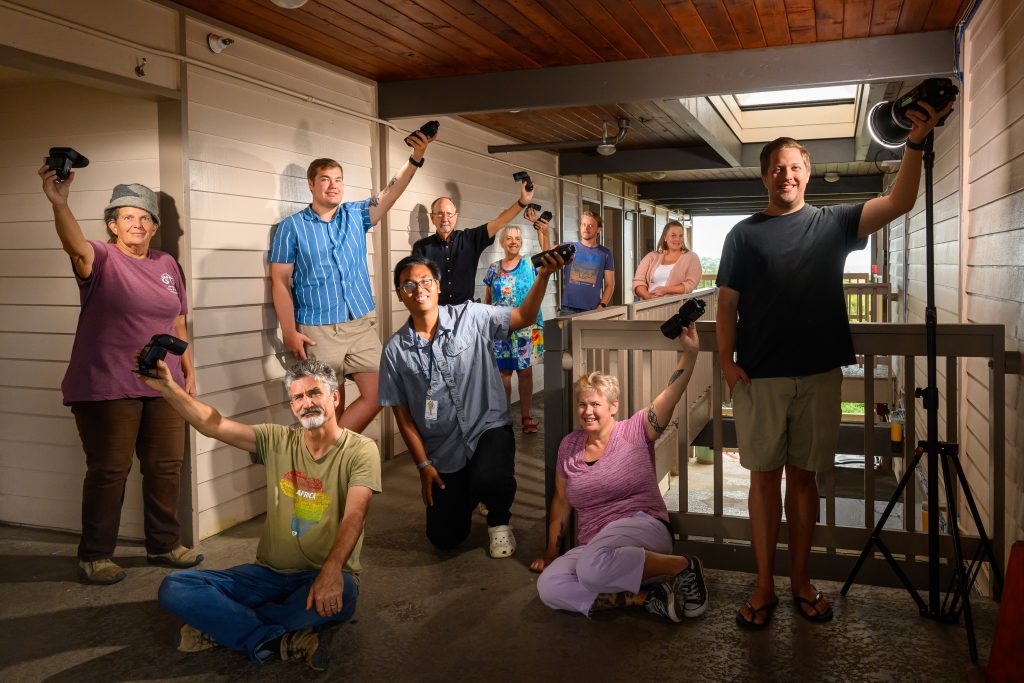
Group Photo [NIKON Z 9, NIKKOR Z 24-120mm f/4 S, Mode = Manual, ISO 1250, 1/400, ƒ/7.1, (35mm = 24)]
3) Studio Flash
Studio work is controlled—but that means your settings need to be precise.
Mode: Manual
ISO: 64 or 100
Shutter speed: 1/125–1/250 (sync speed)
Silent Mode: OFF
“Apply Settings to Live View”: ON
Motor drive: Single
Here, consistency is everything. You’re building the light, so your camera needs to stay locked in.
4) Fluorescent Lighting (The Problem Child)
Fluorescent lighting can create flicker and color issues if you’re not careful.
Auto ISO: 64–25600
Shutter speed: 1/60–1/125
Enable High-Frequency Flicker Reduction
Fine-tune shutter speed if needed
Use custom white balance when necessary
If you’re seeing banding or strange color shifts, this is where you slow down and dial things in.
Why I Rely on Auto ISO
Auto ISO is one of the most powerful tools in modern cameras—and I use it almost all the time.
It lets me lock in the creative decisions (aperture and shutter speed) while the camera adjusts ISO to maintain proper exposure. That means I can stay focused on storytelling instead of chasing exposure.
The only time I typically avoid Auto ISO is in controlled environments—like studio flash—where I want absolute consistency from frame to frame.
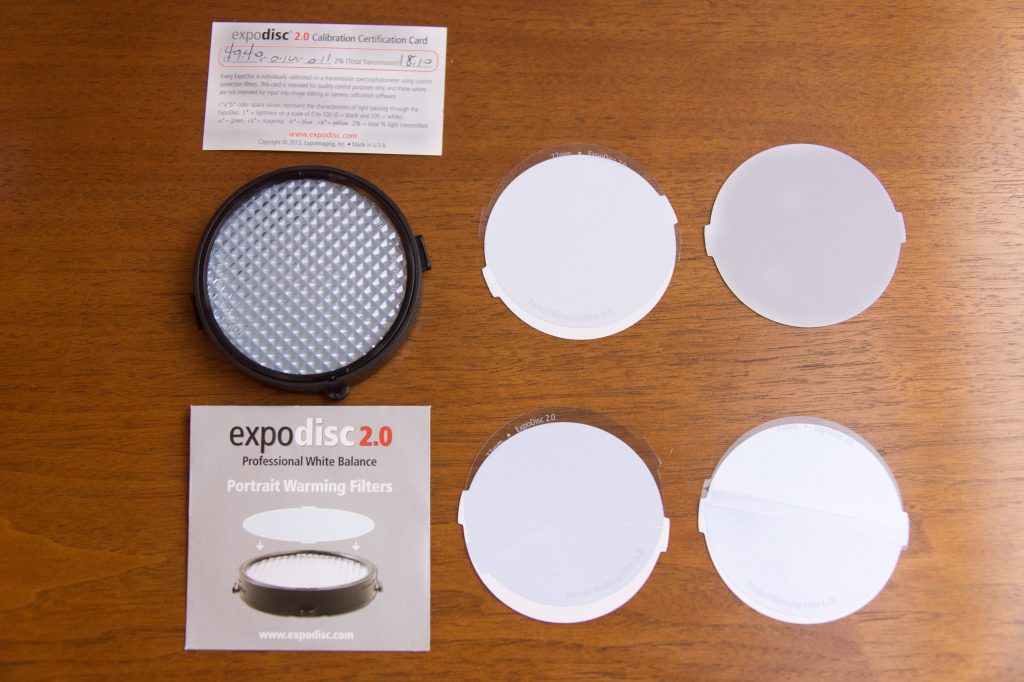
ExpoDisc
Getting Color Right Before You Edit
Today’s cameras do a pretty impressive job with Auto White Balance.
But “pretty close” isn’t the same as accurate—especially when it comes to skin tones.
You might not notice the shift at first, but once you start editing, those small inconsistencies become apparent. Skin can look slightly too warm, too cool, or just a little off—and now you’re spending time fixing something that could have been handled in-camera.
That’s why I still use an ExpoDisc.
By creating a custom white balance using a neutral 18% gray reference, I can get accurate color in the moment. The result?
Better skin tones
Consistent color across images
Less time correcting in post
It’s a simple step that pays off in a big way later.
Preparation Is What Frees You to Be Creative
All of this might sound technical—and it is—but the goal isn’t to get lost in settings.
The goal is to eliminate distractions.
When your camera is ready… When your exposure is dialed in… When your focus system is set…
You’re free to do what really matters:
Pay attention. Watch for emotion. Anticipate the moment.
Because in the end, great photography isn’t about your settings.
It’s about being ready when the story unfolds—and not missing it.
Cookie Consent
We use cookies to improve your experience on our site. By using our site, you consent to cookies.