Over the past few weeks, I’ve been attending the Citizens’ Fire Academy with the Roswell Fire Department here in Roswell.
I originally signed up simply because I was curious. Like many people, I see fire trucks rushing past and know that somewhere a team of professionals is responding to an emergency. But I realized I didn’t really understand what happens behind the scenes.
What I didn’t expect was how many stories I would discover.
As a storyteller and photographer, my instincts kicked in immediately. Every session has moments worth capturing—people demonstrating life-saving skills, firefighters explaining how they make decisions under pressure, or technology that feels like it came straight out of science fiction.
So I started doing what I naturally do: I brought my camera, took photos, and began sharing what I was learning on social media.
And something interesting happened.
Those small posts began to become little stories about the people who protect our community.
A Front Row Seat to the Stories
One evening, we met the command staff and learned how the department operates behind the scenes. I shared this on social media:
Tonight at Fire Citizens’ Academy, we got to meet Roswell’s command staff and dive into how the department protects our community — from reducing homeowners’ insurance risks to keeping us safer in our own businesses and neighborhoods. The crew walked us through their roles, answered every question our class asked, and even delivered a classic long PowerPoint with plenty of humor and real-life stories.
As a bonus, at the end of the night, we saw a demo of the cutting-edge Qwake technology they’re testing — a next-gen helmet system that combines AI, augmented reality, and thermal imaging to help firefighters see through smoke and navigate zero-visibility environments safely. It overlays thermal and edge-detection views directly in the firefighter’s line of sight, helps them locate exits and victims faster, and can stream real-time information back to the incident commander—even to headquarters—improving situational awareness for everyone.
This isn’t futuristic fantasy — departments across the country are already testing this gear as part of early rollout programs. What an incredible glimpse into the future of public safety right here in Roswell!
That night alone could have been an entire article. Instead, it became a short story shared online—one that helped people see their fire department in a new light.
The Human Side of First Responders
Another week focused on emergency medical response. What struck me most wasn’t just the equipment or procedures—it was the depth of training and teamwork required when someone’s life is on the line.
Here’s what I shared afterward:
Over the past two weeks, the Roswell Fire Department Citizens’ Fire Academy has given me a deeper appreciation for the people who show up when someone’s life is on the line.
One evening focused on lifesaving basics. Captain Bryan Thomas, Battalion Chief Danny Dwyer, and Battalion Chief & Fire Marshal Chris Archer walked us through CPR, AED use, and airway-clearance techniques. It was practical, hands-on learning that reminded me how important it is for everyday citizens to know what to do before first responders arrive.
The following week shifted to EMS, and what happens when the professionals take over.
Battalion Chief DeWayne Campbell led the evening with help from the team at Station 22, including Captain Anthony Witchousky, Firefighter Kyle Phillips, Roswell City Nurse Virginia Hames, Captain Bryan Thomas, and others. We also heard from the department’s Medical Director, Dr. E. Malcolm III, who explained the critical role a medical director plays in EMS systems.
They walked us through the different levels of EMT training and the paramedic level, showed us the tools and medications they use in the field, and demonstrated how they are used during real emergencies. Then we got to try some of it ourselves.
Citizen’s Academy Week #4 EMS
Combat Application Tourniquet (C-A-T)
Citizen’s Academy Week #4 EMS
The LUCAS 3, v3.1 Chest Compression System is a mechanical CPR device used by emergency responders and hospitals to perform automatic chest compressions on someone in cardiac arrest. It essentially does CPR for the rescuers.
The night ended with a realistic scenario. A person was unconscious, and someone from our class had to take charge—directing one person to call 911, another to retrieve the AED, and starting CPR. As we rotated through roles, the fire engine arrived, and the EMS team took over. Watching them move from assessment to treatment with the equipment we had just learned about was incredibly impressive.
What struck me most was the depth of knowledge and experience these professionals possess. The more questions we asked, the more it became clear how deep their training really goes.
I left feeling grateful—and honestly lucky—to live in Roswell, Georgia, where the first responders are this well-trained and this committed to saving lives.
Why This Matters for Storytelling
This experience has reminded me of something I often teach:
Stories are everywhere—you just have to be paying attention.
The Citizens’ Fire Academy isn’t a marketing campaign. It’s simply a program designed to help residents understand their fire department.
But within every class are:
real people
real expertise
real moments of learning
real examples of service
Those are the ingredients of powerful storytelling.
By photographing and sharing these moments, I’m doing two things at once.
1. Helping the Fire Department Tell Their Story
Most organizations—especially public service agencies—are incredibly busy doing their work. Telling their story often falls to the bottom of the list.
By sharing what I’m seeing and learning, I’m helping shine a light on:
The training firefighters go through
The technology they are testing
The professionalism of the team
The importance of community preparedness
It’s a small way of giving back to the department that serves our city.
2. Demonstrating My Own Storytelling Skills
At the same time, these posts are quietly doing something else.
They’re showing how I work as a storyteller.
Instead of simply saying, “I’m a storyteller,” people are seeing it in action:
Identifying meaningful moments
Capturing photos that show what’s happening
Turning information into human stories
Sharing those stories in ways people want to read
In other words, the best marketing for storytelling is often telling stories.
Marketing Without Feeling Like Marketing
One of the challenges many photographers and communicators face is how to promote their work without constantly talking about themselves.
This experience has been a great reminder that the best marketing often focuses on someone else’s story.
When you highlight meaningful work happening around you:
The audience learns something valuable
The organization receives positive exposure
And your storytelling ability becomes visible in a natural way
It’s authentic, helpful, and far more engaging than simply posting, “Look at what I can do.”
A Grateful Student
I’m only partway through the Citizens’ Fire Academy, and already it has deepened my respect for the men and women who serve our community through the Roswell Fire Department.
It has also reminded me that great stories are often hiding in plain sight—in classrooms, training sessions, community programs, and everyday moments where people are serving others.
Sometimes all it takes is paying attention, picking up a camera, and sharing what you see.
Life has a way of throwing challenges at us that we never expected. My friend Gibbs Frazeur knows this all too well. As a lifelong photojournalist, he built a career on capturing moments that mattered. But a small tick changed everything when it gave him Lyme disease.
The diagnosis didn’t come quickly, and even after, the symptoms were unpredictable. Some days, Gibbs would feel fine. Other days, the pain would be so severe that it robbed him of his ability to work or even participate fully in family life. His wife—who had retired from pharmacy to raise their four boys—returned to work to help financially. Even with treatment, diet changes, and exercise, Lyme disease still took its toll.
Thankfully, Gibbs has now been in remission for the past 8 months to a year. While there are still occasional tough days, he has experienced a new level of health and freedom that allows him to be more present for his family and himself.
In the middle of his health battle, Gibbs found something that brought him joy and gave him a sense of purpose. During the early part of the pandemic, he bought a Nikon 200-500mm lens for his Nikon D750 and started photographing birds in his backyard. At first, the technical frustrations of his older camera slowed him down—but the spark was there. We had many conversations about upgrading, and eventually, he and his wife decided to invest in a new Nikon Z6iii, later adding the Z 180-600mm lens and the Z 1.4 converter.
That decision wasn’t just about gear. It was about creating space for peace, joy, and restoration. Today, Gibbs’s wildlife photography is more than a hobby—it’s a sanctuary. It gives him a break from the weight of everyday responsibilities and allows him to focus on beauty, patience, and wonder.
I recently filmed Gibbs out at Providence Park in Milton, Georgia, with his new setup. I intentionally didn’t cut the video short. Wildlife photography isn’t about rushing; it’s about slowing down, waiting, and immersing yourself in nature.
Here’s the video of Gibbs on his journey:
We all need something like this—a hobby, activity, or practice that gives us joy and purpose no matter what life brings. It doesn’t have to be photography. Maybe it’s gardening, playing music, hiking, painting, or just walking each morning with coffee.
The question I want to leave you with is this:
What brings you peace, the way Gibbs has found in his photography?
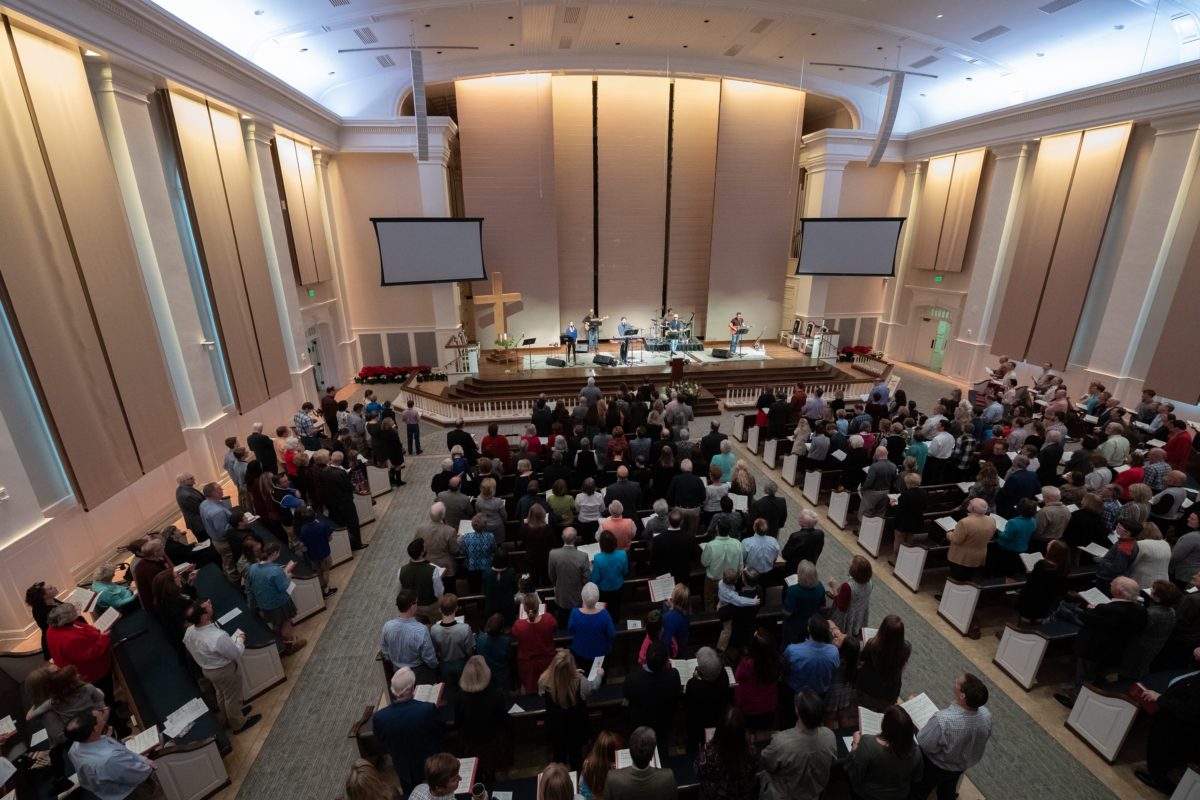
Look carefully at these first two photographs. What is similar, and what is different?
[NIKON D5, 14.0-24.0 mm f/2.8, ISO 7200, ƒ/7.1, 1/250]
They are in the same church on the same day. The difference is that the church has two types of worship services.
8:45 a.m. Contemporary Service 8:45 a.m. Dunwoody United Methodist Church [NIKON Z 6, 24.0-105.0 mm f/4.0, ISO 2000, ƒ/5.6, 1/100]
The very first photo is from 8:45 a.m. Contemporary Worship Service and the second is from the 11:05 a.m. Traditional Worship Service. They went to great lengths to transform their large sanctuary from a traditional church to a contemporary space. They have fabric that covers all the walls to keep the Rock Style band music from bouncing around too much in the space to allowing the traditional Choir to reverberate during the traditional service.
11:05 a.m. Traditional Service Dunwoody United Methodist Church [NIKON Z 6, 24.0-105.0 mm f/4.0, ISO 1400, ƒ/5.6, 1/100]
The senior pastor speaks at both services.
Senior Pastor Dan Brown, Contemporary Service Dunwoody United Methodist Church [NIKON D5, 28.0-300.0 mm f/3.5-5.6, ISO 5600, ƒ/5.6, 1/100]
There is little difference between the two other than just his dress code.
Senior Pastor Dan Brown, Traditional Service Dunwoody United Methodist Church [NIKON D5, 28.0-300.0 mm f/3.5-5.6, ISO 4000, ƒ/5.6, 1/250]
Just six years ago, the church added a contemporary service that met in its gym. It is now the best-attended service and needs more space. This is why they converted their most significant space to accommodate the group.
Andy Stanley, pastor of North Point Community Church
One of the largest churches in America, North Point Community Church, is nearby. Many churches lost members to this church because of its worship style and sermons.
When Andy Stanley started the church in November of 1995, they intentionally created a new format and wanted to be different than all the churches in the area. Andy said, “Atlanta does not need another church. Atlanta needs a safe environment where the unchurched can come and hear the life-changing truth that Jesus Christ cares for them and dies for their sins.” So began North Point Community Church.
Andy understood the audience better than most in Atlanta in 1995.
WHY CHURCHES ARE DYING AND DECLINING FASTER TODAY
Slow response to change as change accelerates all around us. Many churches are incredibly slow to change. For most of our American history, the pace of cultural and technological change was sufficiently paced for churches to lag only five to ten years. Now, churches are lagging 20 to 30 years as the pace of change increases dramatically. To many attendees and members, the church thus seems increasingly irrelevant. To be clear, I am speaking about issues of style, methodology, and awareness, not changing doctrine or biblical truths. A recently interviewed church guest said it clearly: “I stuck with my parents’ church as long as I could. But I had had enough when we had a big blow-up over projection screens in the worship center. I wanted to go to a church where matters of minutia were not issues to fight over.”
I believe that the church isn’t the only organization that has to do a better job of understanding its audience. Journalism has suffered dramatically because they have lost touch with its audience.
Like the growing churches, the content should not change; instead, the issues of style, methodology, and awareness need to change.
Today, communicators need to do a better job of getting to know their audience. While you must master the subject to communicate it, you must also pay as much attention to the audience’s understanding.
One of the most significant problems people face with anything they create is the fear that others will discover it. Well, the smart ones know you have to advertise and appeal to the needs of that audience to engage them.
I know that some of the most successful organizations are those that have created a fictitious family/customer. This family represents the median of the bell curve of that community.
I have listened to writers and editors arguing over why Sam and Sally [fictitious couple] would be interested in a story.
If you cannot tell me why a story you are working on is necessary for your audience to see, the odds of anyone reading it are not good.
You have to tell people how this information can impact their lives. Surprisingly, I have been shocked when people show me their work in journalism, and I ask why they did a story, and they cannot tell me why the audience needs to know about it.
If you know your audience and your subject, you will not have to worry about a Plan “B.”
I met Naomi Harward a couple of years ago at our Storytellers Abroad Workshop in Nicaragua. Naomi is one of the quietest people I have ever met.
Naomi working with James Dockery on her project. [Canon EOS 5D Mark IV, EF24-105mm f/4L IS USM, ISO 1600, ƒ/4, 1/60]
Naomi said many times that video isn’t something she likes. She prefers writing. We continued to push her out of her comfort zone.
Pat Davison looks at Naomi’s project. [Canon EOS 5D Mark IV, EF70-200mm f/2.8L IS USM, ISO 1600, ƒ/5.6, 1/60]
Each one of the instructors is direct when advising students. We do not beat around the bush. They give their strong opinions because they want the best story possible for the subject and audience.
Naomi is the only workshop participant who did her story in English and then had it translated into Spanish for subtitles.
Listen to Sara Lu tell her story and see how Naomi captured it for you here:
If you want to learn how to have an experience like Naomi in a storytelling workshop, please consider joining us this June in Romania with Storytellers Abroad.
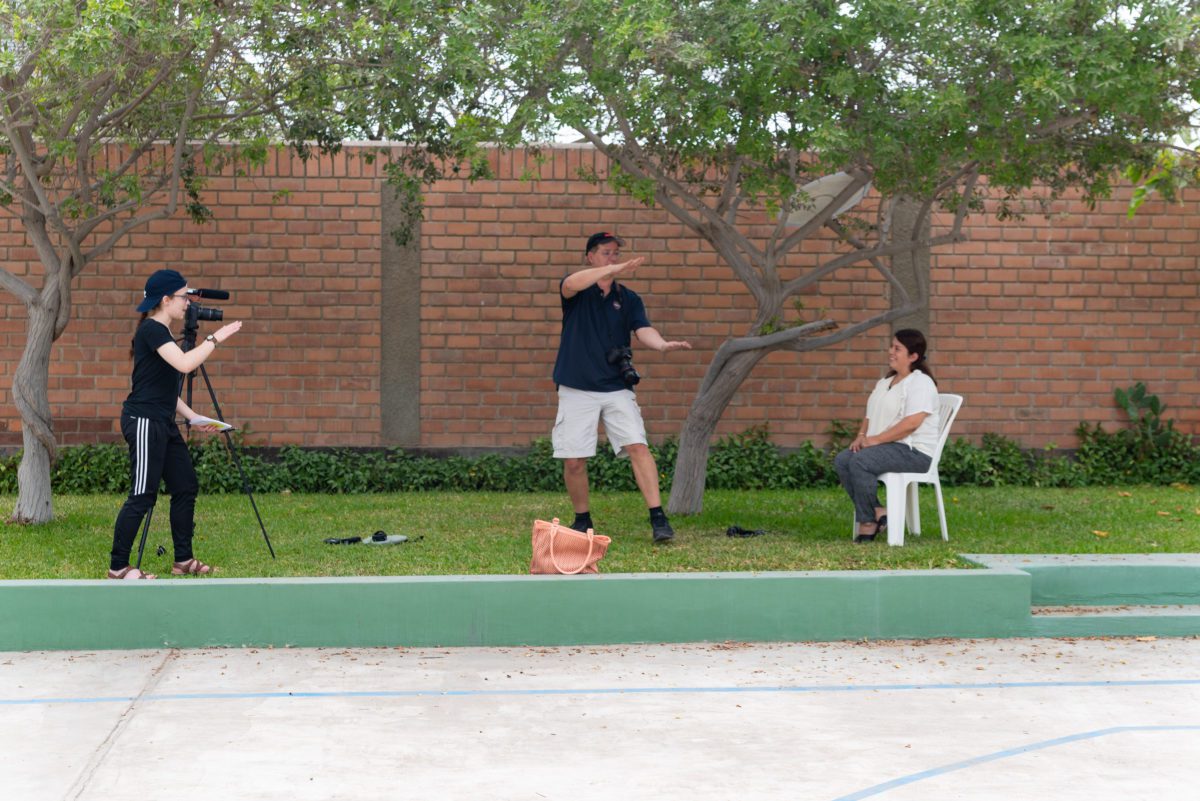
Jay York is working on his story for the Storytellers Abroad Workshop in Lima, Peru [NIKON Z 6, 24.0-105.0 mm f/4.0, ISO 32000, ƒ/6.3, 1/200, Focal Length = 24]
I have known Jay York for years. We met at the Southwestern Photojournalism Seminar in Fort Worth, Texas. Jay was using his vacations to photograph for the ABWE.
Storytellers Abroad Workshop in Lima, Peru [NIKON Z 6, 24.0-105.0 mm f/4.0, ISO 100, ƒ/4, 1/800, Focal Length = 35]
Many years ago, photographers volunteered their time to help ABWE missionaries by taking photos of work worldwide that went into a database. During the film years, missionaries would have to go to Harrisburg, PA offices, look through all the 35mm slides, and get copies to use in their slide shows that they showed to churches and supporters on leave.
Jay York and translator Andrea Carhuachîn. Storytellers Abroad Workshop in Lima, Peru [NIKON Z 6, 24.0-105.0 mm f/4.0, ISO 51200, ƒ/4, 1/200, Focal Length = 62]
During our week in Lima, Peru, Jay worked on a story about Elvira Cuevas Bolívar. Here is the package that Jay produced.
Jay worked methodically in ensuring he understood Elvira’s story, which is much bigger than told in this package, and worked with three instructors, Pat Davison, James Dockery, and me.
Jay York’s Story on Elvira Cuevas with Andrea Carhuachîn serving as translator. Storytellers Abroad Workshop in Lima, Peru [NIKON Z 6, 24.0-105.0 mm f/4.0, ISO 2200, ƒ/4, 1/200, Focal Length = 24]
Jay wanted to understand every aspect of the storytelling process.
Elvira Cuevas – Storytellers Abroad Workshop in Lima, Peru [NIKON Z 6, 24.0-105.0 mm f/4.0, ISO 4500, ƒ/4.5, 1/200, Focal Length = 68]
A couple of months before the trip, Jay switched camera systems to the Fuji mirrorless. Jay shot most of this project on the Fuji X-T3.
Jay York with Elvira Cuevas and her son Chris. [NIKON Z 6, 24.0-105.0 mm f/4.0, ISO 100, ƒ/4.5, 1/200, Focal Length = 68]
If you want to learn how to tell a mission story like Jay, check out the opportunity with Storytellers Abroad.