|
Getting your Trinity Audio player ready...
|
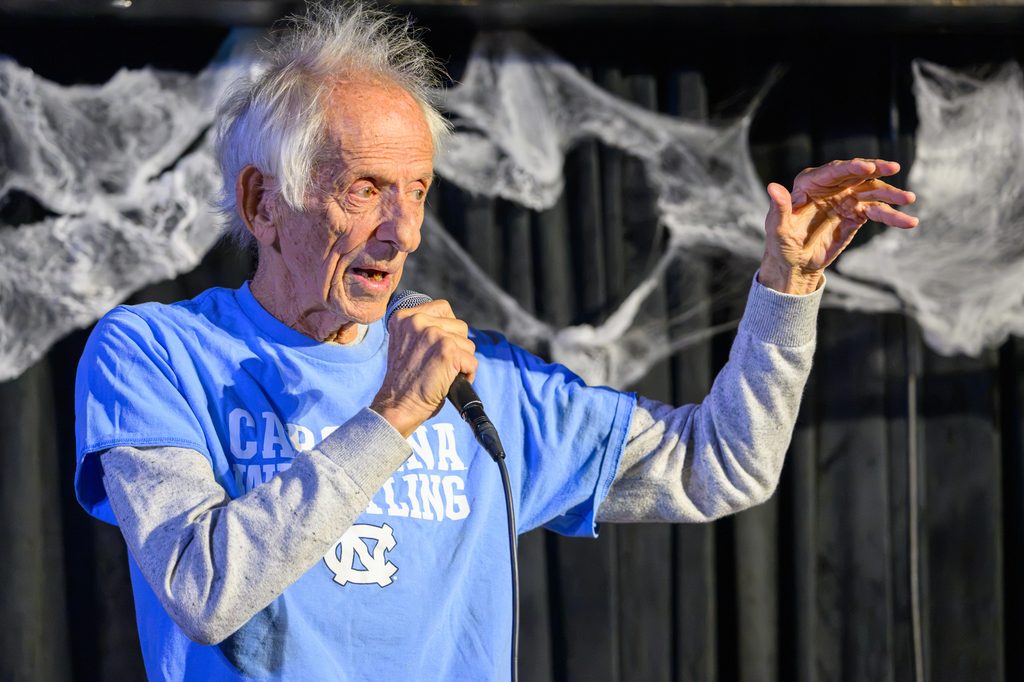
Photographing “A Celebration of Jeff Justice” at The Punchline in Atlanta tonight reminded me how much comedians share with photographers, writers, teachers, and other communicators.
We pay attention to everyday life. Something catches our interest, and we want to share it. The challenge is helping someone else see what we see—and giving them a reason to care.
Mark Evans emceed the evening, with Jerry Farber, Kay Dodd, Carlos Rodriguez, and Jamie Bendall performing stand-up before Jeff spoke at the end. Watching through my camera, I kept thinking about the work behind what happens at the microphone.
A comedian walks onto a stage with words, timing, expressions, and a particular way of seeing the world. From those ingredients, they have to build a connection with a room full of people.
That is an art.

The Material Is All Around Us
Much of a comedian’s material comes from experiences the rest of us recognize: family conversations, awkward encounters, work, aging, or the little frustrations of getting through a day.
The comedian notices something we may have experienced without stopping to examine it. Then they find a way to bring that observation into focus.
Sometimes the laugh comes from recognition: “I’ve done that.”
Sometimes it comes from surprise: “I never thought about it that way.”
That movement between recognition and discovery is familiar to me as a photographer. A photograph can draw someone in through a recognizable experience, then reveal a detail or relationship they might otherwise have missed.
The subject may be ordinary. The attention we give it makes the difference.
A Point of View Gives the Work Its Voice

Two comedians can talk about the same subject and produce very different material. Their experiences, personalities, and assumptions shape what they notice and how they tell it.
The same is true of photographers.
Put several photographers in the same room, and each will find different pictures. One notices gestures. Another sees patterns of light. Someone else watches the relationships unfolding at the edges of the room.
Our point of view develops through paying attention to what moves us, puzzles us, or makes us curious.
For a comedian, the question might be, “Why does this strike me as funny?”
For me, it is often, “Why does this moment matter?”
Both questions push us beyond simply recording what happened. They help us discover what we have to say.

Knowing the Audience Shapes the Delivery
An observation that makes sense to us may need some explanation before it connects with someone else.
A comedian has to give the audience enough information to enter the story. Who is involved? What is the situation? What expectation is being established?
Too little context, and people get lost. Too much, and the energy disappears before the payoff.
I face that same challenge in visual storytelling. I may understand a photograph’s significance because I was there. The viewer needs the right image, sequence, or caption to understand it too.
Teachers face it when introducing an unfamiliar idea. Businesses face it when explaining their services. Journalists face it when reporting a complicated story.
Knowing our audience helps us decide where to begin, what needs explaining, and which details matter.
It also requires humility. If people are struggling to follow us, we need to examine how we are communicating.
Timing Gives People Room to Respond
Watching stand-up reminds me that the spaces between words are part of the performance.
A pause can build anticipation. A look can let an idea settle. Moving too quickly can bury a moment before the audience has time to respond.
As a photographer, I am always watching for those brief changes in expression and gesture. A raised eyebrow, a hand held in place, or a reaction after a line can carry as much meaning as the words.
As a teacher, I also need to remember that people require time to process an idea. Finishing a sentence does not mean everyone has finished understanding it.
Good communication has a rhythm that makes room for the audience.

The Work Is in the Revision
What sounds conversational onstage can take considerable work to shape.
An everyday experience has to become a story an audience can follow. Details need selecting. Wording needs tightening. The speaker has to discover where the surprise belongs.
That process feels familiar when I edit photographs or write a blog post. I have to choose what serves the story and let go of material that distracts from it—even when I like it.
The audience experiences the finished work. The communicator has to do the sorting.
Helping Others Find Their Voice

Jeff’s years of teaching add another dimension to that artistry. Helping someone develop as a communicator means paying attention to the person as well as the material.
What do they notice? What experiences can they draw from? How can they express an idea in a way that sounds like them?
Those questions matter in photography education too. I want students to develop the skills and confidence to recognize their own stories and tell them well.
Tonight was a celebration of laughter, but it also gave me a reason to appreciate the observation, craft, and courage behind it.
Whether I am holding a camera, teaching a class, or writing, I can learn from the comedian at the microphone: pay attention to everyday life, understand the people in front of you, and keep working until what you see becomes something they can see too.