|
Getting your Trinity Audio player ready...
|
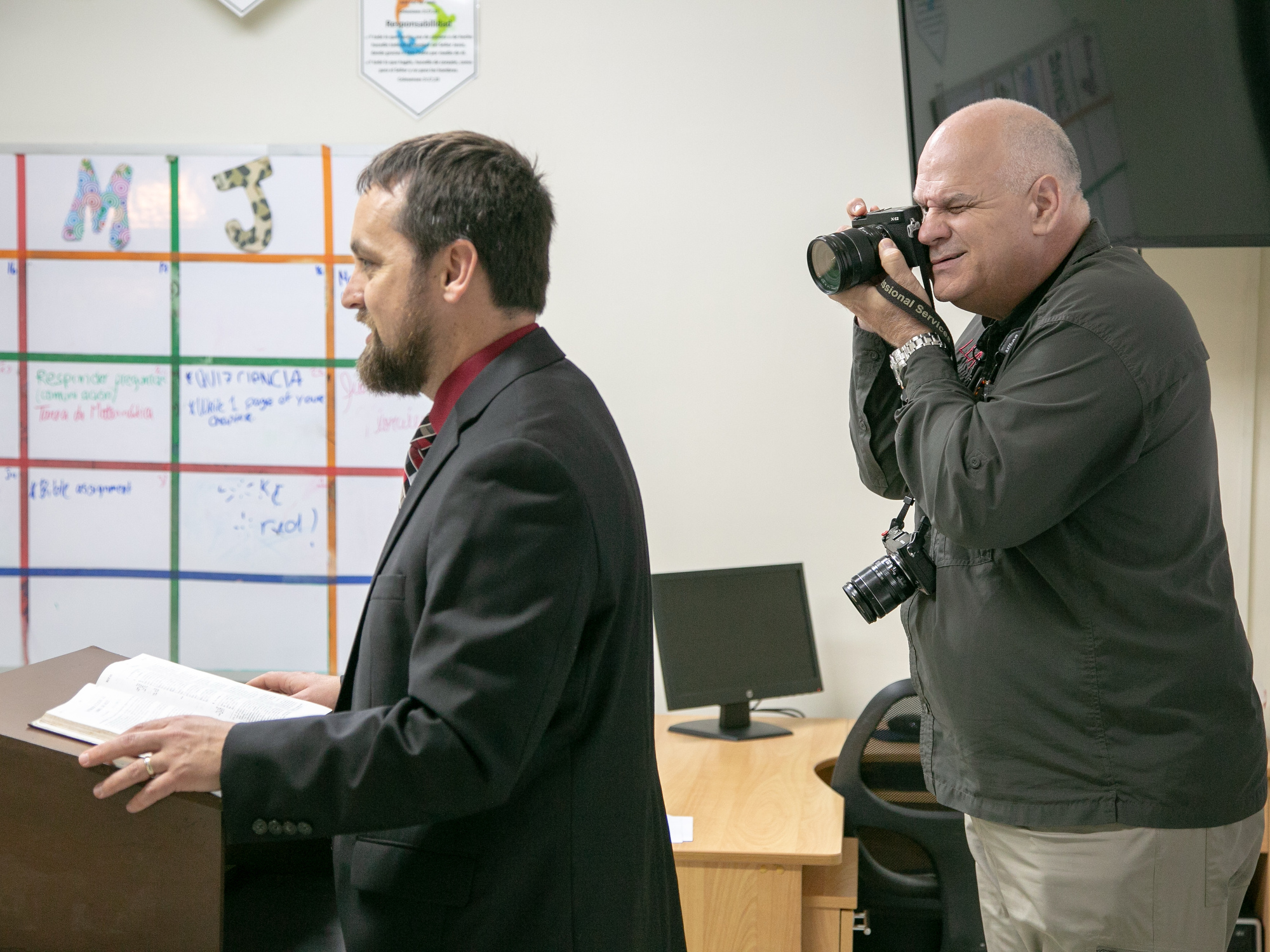
Stanley photographing professor Jon Stone‘s seminary class in Lima, Peru. Photo by Jeff Raymond
What Arthur Brooks helped me understand about career changes, unexpected detours, and following a calling.
Looking back on my career, I see something that probably makes little sense to someone reading my résumé.
I’ve been a newspaper photojournalist, a missionary organization photographer, a computer salesman, a door-to-door meat salesman, a Glamour Shots photographer, a one-hour photo lab employee, a university staff photographer, a freelancer, and a corporate communications consultant.
Some of those jobs were wonderful opportunities. Others were simply ways to pay the bills.
Some changes were my decisions. Others were made for me.
Yet through all those experiences, I was trying to do one thing: follow what I believed was God’s calling on my life.
Recently, I listened to behavioral scientist and Harvard professor Arthur C. Brooks discuss four different career paths. His explanation helped me see my own journey differently.
Maybe my career wasn’t as scattered as it appeared.
Maybe I had been following a calling all along, even when the jobs changed.
The First Major Change Came Before I Graduated
During my senior year of college, I had a plan.
I was going to graduate and go straight to seminary.
I believed God was calling me into ministry, and seminary seemed like the logical next step.
But something changed during that final year.
Instead of going directly to seminary, I became a newspaper photojournalist.
I loved photography. I loved telling stories. I loved meeting people and learning about their lives.
Photojournalism let me enter people’s worlds, listen to their experiences, and share their stories with others.
At the time, I might have thought I was postponing my calling to ministry.
Looking back, I wonder whether I was actually discovering another way to live it out.
About a year and a half later, I joined the International Mission Board and worked as one of the photographers for The Commission magazine.
Now my photography and my desire to serve in missions had come together.
I was using visual storytelling to help people understand what God was doing around the world.
It felt like the perfect match for my skills and calling.
But it didn’t last.
When the Job Disappears, Does the Calling Disappear Too?
I was laid off from the International Mission Board.
That was not part of my plan.
Losing a job is difficult enough. Losing a job that feels connected to your calling raises a whole different set of questions.
If God called me to do this, why did the opportunity disappear?
Had I misunderstood my calling?
Was I supposed to do something else?
I moved to Long Island, New York, and began seminary seven months later.
During that transition, I sold computers for Tandy.
Selling computers certainly wasn’t what I had envisioned when I first thought about ministry or photojournalism.
But I needed to work.
And that became a recurring theme during my seminary years.
I sold meat door to door.
I worked at Glamour Shots.
I became an assistant manager at an Eckerd one-hour photo lab.
Eventually, I became a manager at Flash Photo, where I was working when I graduated from seminary.
These weren’t jobs I had dreamed of.
They helped pay the bills while I pursued my education.
But I learned something important.
A job doesn’t have to be your calling to have value.
Looking back, I can see how those experiences taught me things that would become useful later.
Selling taught me how to approach people, listen, communicate value, and handle rejection.
Working in retail taught me about customers, expectations, service, and management.
Working in photo labs kept me connected to photography while helping me understand the business side of an industry I loved.
I didn’t always recognize the value of those lessons as I learned them.
Sometimes I was trying to make enough money to keep going.
Atlanta, Georgia Tech, and Another Change
After graduating from seminary, I moved to Atlanta to become a staff photographer at Georgia Tech.
For nine years, I worked in a university environment, photographing people, events, research, education, and the stories that helped communicate the institution’s mission.
It was another opportunity to combine photography with communication and storytelling.
I wasn’t working for a missionary organization anymore.
But I was still helping people tell stories that mattered.
Nine years later, I went full-time as a freelance photographer.
That was another major transition.
I went from having an employer to having clients.
Instead of simply making photographs, I was now responsible for finding work, negotiating contracts, managing finances, serving customers, and keeping the business alive.
Six years into freelancing, Chick-fil-A put me on retainer for eight days a month.
My responsibilities included consulting, photography, and video production.
That relationship continued on retainer for 12 years.
Today, I continue working with Chick-fil-A on a project-by-project contract basis.
Once again, my job structure changed.
But the central work of helping people communicate through storytelling remained.
Arthur Brooks and the Spiral Career
In a recent episode of his Office Hours program, Arthur Brooks discussed research by psychologist Michael Driver and colleagues that identified four career patterns.
Brooks describes them as:
- Linear: Moving upward through positions with increasing responsibility, prestige, or compensation.
- Expert: Remaining in a relatively stable profession, developing expertise, and valuing security.
- Transitory: Moving between different jobs, often prioritizing life outside work rather than career advancement.
- Spiral: Moving through distinct career chapters, with each experience contributing to the next.
Brooks explains that people with spiral careers often make major changes roughly every seven to twelve years.
From the outside, their careers may appear disconnected.
But to the person living that life, the chapters often connect.
Brooks himself describes moving from professional musician to economist, nonprofit executive, and eventually professor and writer focused on happiness.
He discovered that the knowledge and experiences from one career helped shape the next.
Hearing him describe this made me think about my own life.
My career certainly hasn’t followed a traditional ladder.
But I also don’t fit neatly into the spiral model.
Some of my changes happened because I wanted a new opportunity.
Others happened because I lost a job or needed to earn money.
Unlike someone changing careers because of boredom, I often found myself trying to keep pursuing the same underlying purpose through very different circumstances.
That distinction matters.
I wasn’t always looking for a new calling. Sometimes I was looking for another way to live out the calling I already believed I had.
Being Pushed Versus Being Pulled
One of Brooks’ most helpful observations concerns why people change jobs.
He distinguishes between being pulled toward a new opportunity and being pushed out of an existing position.
Being pulled means you see something you want to pursue.
Being pushed means circumstances force the decision.
I’ve experienced both.
Choosing newspaper photography over immediately attending seminary was a pull.
Moving into freelance photography was another major decision.
But being laid off from the International Mission Board was a push.
I didn’t get to choose the timing.
I had to figure out what came next.
Brooks points out that involuntary changes are often harder because they remove our sense of control.
That certainly resonates with my experience.
It is much easier to talk about following your calling when you have a paycheck and a clear plan.
It gets harder when you have bills to pay and no obvious next opportunity.
Yet I don’t believe those difficult transitions necessarily mean we have wandered outside our calling.
Sometimes they mean the circumstances in which we pursue that calling have changed.
Your Calling Is Bigger Than Your Job Title
One of the biggest mistakes I think we can make is confusing our calling with our employer.
When I worked for the International Mission Board, I could easily connect my work to ministry.
I photographed missionary work and helped communicate the Gospel.
But what about selling computers?
What about selling meat door to door?
What about managing a photo lab?
Were those years outside God’s calling?
I don’t think so.
They were part of my life, and they shaped the person I became.
I believe calling has more to do with who we are becoming, the gifts we are developing, and how we use those gifts to serve others than with the name on our business card.
For me, photography has been one of the most consistent tools.
But photography itself may not be the deepest part of my calling.
Storytelling, teaching, helping people communicate, building relationships, and serving others have remained important throughout my life.
The camera is one way I do that.
It isn’t the only way.
That is why I have increasingly found myself interested in teaching, consulting, writing, and helping others develop their own storytelling skills.
These activities may look different from newspaper photojournalism, but I see a connection.
The Importance of Serving Something Bigger Than Yourself
Brooks also argues that people who approach their careers with an organization-centered perspective often experience greater long-term satisfaction than those who focus primarily on what the job provides them personally.
He isn’t saying we should ignore our needs.
It is that belonging to a team, contributing to a mission, and helping others succeed can make work more meaningful.
That idea resonates deeply with my experience.
Some of my most satisfying work has come when I understood why the organization needed the photographs.
At the International Mission Board, the photographs helped communicate missionary work.
At Georgia Tech, they helped tell stories about education, research, and the people behind those efforts.
At Chick-fil-A, my work has helped people communicate, celebrate, train, and connect.
In my teaching, I want students to become better storytellers so they can make a difference in others’ lives.
The common denominator isn’t the camera.
It is serving people through communication.
That’s one reason I’ve kept finding meaning in photography after so many years.
The purpose has always been bigger than simply making another photograph.
What About the Jobs That Pay the Bills?
I think this is especially important for young people to understand.
Not every job will be your dream job.
Not every job will feel like a calling.
Sometimes you need employment because rent is due, groceries cost money, and your family depends on you.
There is dignity in that work.
During seminary, I wasn’t selling meat door to door because I believed it was my ultimate professional destination.
I was doing what I needed to do to continue moving forward.
But I also had opportunities to develop skills, interact with people, and learn things I might never have learned in a classroom.
We often don’t recognize the importance of those experiences until much later.
A detour is not necessarily wasted time.
A temporary job isn’t necessarily a failure.
Sometimes the work that keeps us financially afloat also prepares us for responsibilities we cannot yet imagine.
Four Lessons From Brooks That I Am Still Learning
Toward the end of his discussion, Brooks offers four recommendations for navigating career changes.
I think each one is worth considering through the lens of calling.
Manage your expectations.
A new job will not solve every problem in your life.
I’ve learned that every opportunity comes with challenges. Even jobs that seem perfectly aligned with your interests involve difficult days.
Following a calling doesn’t guarantee an easy road.
Build a meaningful life outside work.
Brooks emphasizes that our satisfaction with life influences our satisfaction with work.
I would add that family, faith, friendships, and service help keep our careers in perspective.
If our identity depends entirely on our employment, losing a job can feel like losing ourselves.
Pay attention to when change may be necessary.
Brooks recommends recognizing warning signs and exploring opportunities before circumstances force a decision.
That isn’t always possible.
My layoff taught me that sometimes someone else decides for you.
But it is wise to continue learning, developing relationships, and preparing for possibilities beyond your current position.
Don’t let fear prevent you from moving forward.
This may be the hardest lesson.
Change involves uncertainty.
Sometimes we have to move forward without knowing exactly where the road will lead.
For me, that is where faith becomes particularly important.
Faith does not mean I know what will happen next.
It means I can continue trying to be faithful with the opportunities and responsibilities in front of me.
Looking Back, I See Preparation Where I Once Saw Detours
When I was younger, I tended to think of calling as a destination.
Find the right profession.
Get the right job.
Serve in the right organization.
Stay there and fulfill your purpose.
But my life didn’t work that way.
I went from preparing for seminary to working as a newspaper photojournalist.
From the newspaper to missionary photography.
From a layoff to selling computers.
From seminary and retail jobs to Georgia Tech.
From a university staff position to freelancing.
From freelancing to a long-term corporate consulting relationship.
And today, I continue working, writing, teaching, photographing, and exploring how my experiences can help others.
There have been wonderful seasons.
There have also been painful ones.
I wouldn’t pretend I wanted every change or understood its purpose at the time.
But looking backward, I can see connections I couldn’t see while living through those moments.
I can see how selling taught me communication.
How managing taught me responsibility.
How photojournalism taught me curiosity and listening.
How missionary photography connected storytelling with service.
How university photography expanded my understanding of institutional communication.
How freelancing taught me business and relationships.
And how consulting and teaching have allowed me to share what I’ve learned.
Brooks calls this kind of career progression a spiral.
I understand why.
But when I look at my own journey, I see something else running through those spirals.
A thread.
A desire to use my abilities to help people, communicate meaningful stories, and serve a purpose beyond myself.
That thread has remained even when the jobs changed.
Maybe We Need to Rethink What It Means to Follow a Calling
We often ask young people, “What do you want to be when you grow up?”
Maybe we should spend more time asking different questions.
What problems do you care about?
Who do you want to serve?
What gifts and abilities are you developing?
What experiences are helping you grow?
And how might those gifts be used in ways you cannot yet imagine?
I still believe God calls people.
But I no longer think that calling must always be expressed through one employer, one profession, or one uninterrupted career path.
Sometimes the calling takes us through unexpected opportunities.
Sometimes it leads us through jobs we never would have chosen.
And sometimes the path forward becomes clear only when we look backward.
I don’t know exactly what the next chapter of my career will look like.
But I do know that my calling has never depended entirely on a job title.
My career has changed many times. My understanding of my calling has grown through those changes.
And perhaps that is the lesson I most want to share.
Don’t confuse losing a job with losing your purpose.
Don’t assume an unexpected detour means you’ve failed.
And don’t overlook what you may be learning in a season that seems disconnected from where you want to go.
You may discover years later that those experiences were preparing you for opportunities you couldn’t have imagined.
Your career may not be a straight line.
That doesn’t mean your life lacks direction.
I was inspired by Arthur C. Brooks’ discussion of the four career patterns and navigating job changes on his Office Hours program. Brooks draws on career research associated with psychologist Michael Driver and colleagues. His ideas provided a framework for reflecting on my own career and calling.