|
Getting your Trinity Audio player ready...
|
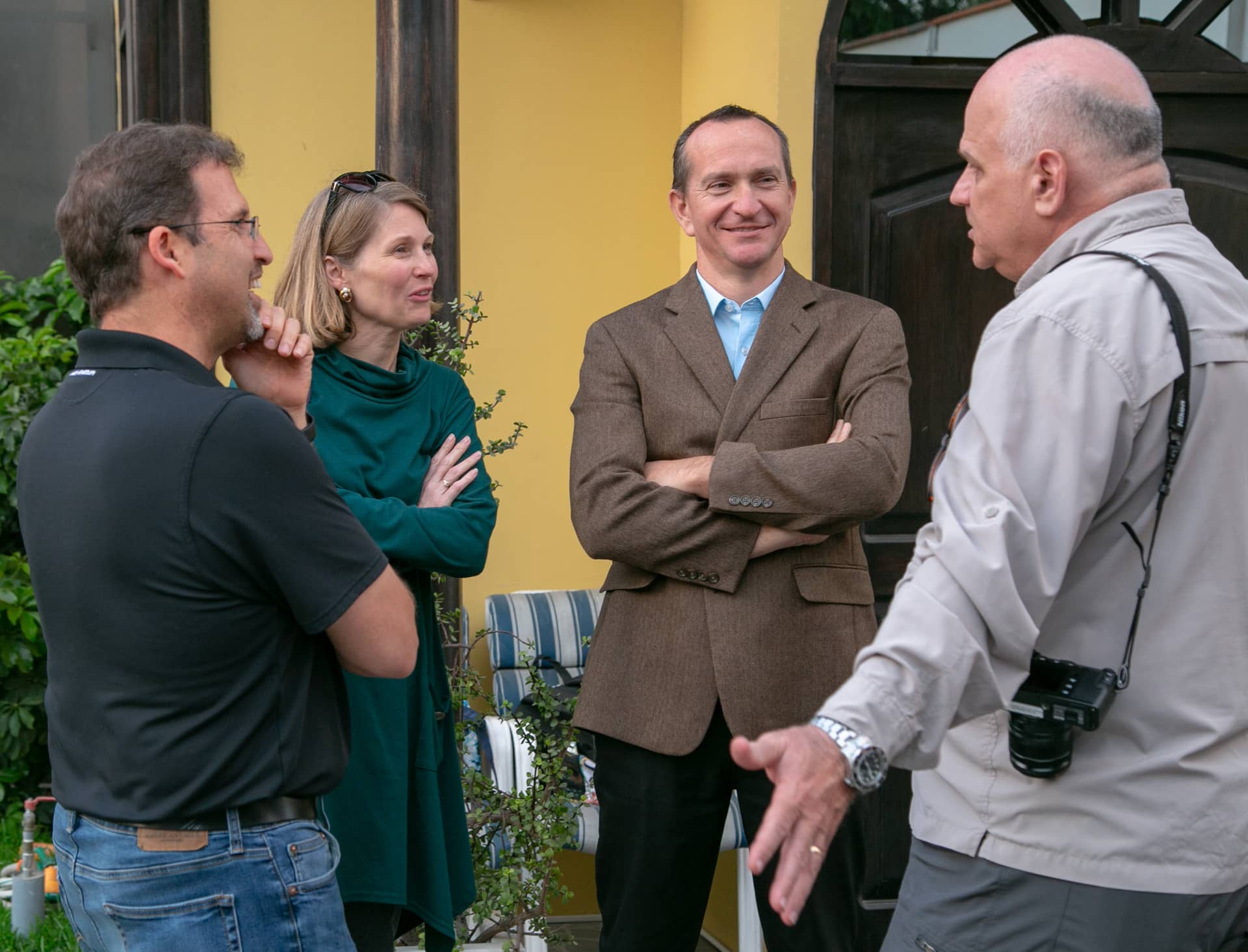
ABWE missionaries Steve Frerichs, Stephanie Pace, and Andy Pace talk with photographer Stanley Leary outside a home in Peru. Leary was there with Jeff Raymond to plan the Storytellers Abroad Workshop. Photo by: Jeff Raymond
My friend and fellow photojournalist Gibbs Frazeur recently sent me a video that described my job better than most things I’ve read about my own profession.
In it, Lance Ford, speaking on the Restore Report (I watched it on The Roys Report’s YouTube channel), argues that many churches have become very good at producing an experience while losing track of what the experience is for. The lights, music, and transitions work. But he asks whether people are being formed into disciples. His point is that you can manufacture a moment, but not the thing the moment is supposed to produce.
Gibbs and I have both lived in newsrooms, and I’m grateful he thought of me when he saw it. It did stick with me.
Organizations drift
Almost every organization I’ve worked with began with a clear purpose. Then the machinery grew: the website, the campaigns, the dashboard, the annual gala. All of it is useful, but it slowly starts to feel like the point.
Ford noticed that churches celebrate attendance, giving, and streaming numbers because those are easy to count. The harder questions are about what kind of people the church is producing. Nonprofits and brands have the same habit. We report impressions, followers, and views because they fit on a slide. Whether the people we serve are better off doesn’t fit on a slide.
The storyteller’s duty
I’ve spent more than 40 years as a photojournalist, and I’ve come to see that the same duty follows me whether I’m covering my community or working for an organization: protecting the audience’s trust. Whoever is paying, the audience can’t see what I saw, so they rely on me to get it right. That duty has three parts.
1. Vet what you pass along. An audience can’t verify your story. They trust that someone checked. Years in photojournalism taught me that the work starts before the camera comes out, with curiosity and listening. It means asking the people who live the story, not just the people who commissioned it. In my own work, I think of this as looking below the brief, at the people closest to the story, and above it, at what the image is supposed to accomplish.
2. Tell the truth even when it costs you. Sometimes the most valuable thing I can tell a client is that the assignment isn’t the real problem.
I was once asked to help a church communications team create videos to boost engagement and giving. I kept asking two questions: who watches your videos now, and how will they reach the people you need? The staff was so deep inside their bubble that they were making polished videos for people who already agreed with them. A perfect video that nobody outside the walls sees doesn’t serve the mission. And asking people to share a mediocre video won’t fix it either. First make something worth sharing, then equip your people to share it with their own networks. That isn’t what a client wants to hear in the first meeting, but it’s why they invited me to their planning meeting.
3. Measure success by the audience’s flourishing, not their attention. Attention is easy to buy. Understanding, trust, and a changed life are harder to earn and harder to count. I try to ask whether the story helped someone understand something they would have missed, or helped an organization’s supporters see their part in the work.
Journalists, pastors, and storytellers
It’s telling that Ford’s message reached me through a journalism outlet. Investigative reporters and good pastors are held to a similar standard: check the claims, tell the truth even when it costs you, and measure success by whether people are better off.
I carry that standard into every kind of work I do. When I cover my community as a journalist, my loyalty is to the public. When an organization hires me to tell its story, the setup is different, because the client is paying and has a stake in the outcome. But the ethics don’t change. I still verify what I pass along, tell the client when the story they want isn’t the true one, and ask whether the audience is better off. The trust I’m handling is the same, and so is the way it gets lost.
Story as multiplier, not substitute
None of this means story and production are the enemy. Ford says plainly that he isn’t against excellence, music, or technology. The problem comes when production replaces substance.
I wrote about how Mother Teresa’s story spread after Malcolm Muggeridge’s 1969 BBC documentary. The documentary didn’t feed anyone. The work was already happening in Calcutta. But the story multiplied the work. The order matters: the substance comes first and the storytelling carries it further. When the story gets ahead of the substance, you have a brand without a mission. When the substance never gets told, good work stays small.
Make the story about the audience, not the storyteller
Ford argues that a leader’s job is to equip people, not to become the star. He warns that a church depending on one charismatic personality is fragile. I think good storytellers hold the same standard. An organization whose story depends on one flashy campaign, or one storyteller, is fragile too.
When I work with a mission-driven group, I want to leave them more capable than I found them. That means their own people can recognize a story, tell it honestly, and keep returning to what the organization exists to do. A story isn’t finished until it reaches the person it’s for, which is why I translate the same true story differently for different audiences without changing the facts.
A question to keep asking
Ford closes with a question for churches: What is your church producing? I think every organization should ask it, and a storyteller’s job is to keep asking it when everyone else is busy with the deadline.
Is the work making people better off? Does the story we’re telling match what we actually do? Would the people we serve recognize themselves in it?
If the answers are yes, the story gets out of the way, and the mission shows. If they’re not, no amount of polish will fix it.
Thanks, Gibbs, for sending the video my way.