
|
Getting your Trinity Audio player ready...
|
Dave Black spoke at a seminar about using his Nikon Speedlight SB900 flashes instead of his Studio heads to light a basketball court and an ice rink.
I was on the edge of my seat, absorbing what he was talking about. I didn’t go out and buy more SB900 flashes and use them instead of my strobes for one reason: clients were not paying for sports coverage as in years past.
But what I was listening to was some of the reasons it was working for Dave Black.
First, by having his strobes just a little over the ambient light level, he was able to get better color and avoid the problem with sodium vapor lights. The dynamic range under flash is the greatest light spectrum. Dave Black was shooting his flash just enough over the ambient to affect the color and help shift it to the 5000º Kelvin range.
Sodium vapor lights flicker, and when you shoot above 1/100 shutter speed, you can get color shifts throughout a photo, or just a band.
Another advantage of shooting with the Nikon Speedlights is that you can use just about any shutter speed. For example, Dave could freeze the puck in ice hockey by shooting at 1/200. His basketball shots were also sharper.
 |
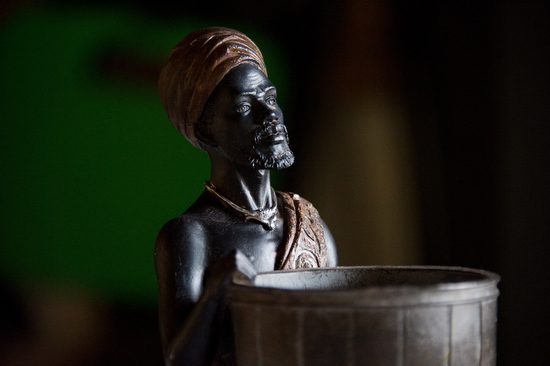
| Available Light only (Nikon D3S, ISO 12,800, f/5.6, 1/40, 28-300mm) |
I began experimenting with using strobes with high ISO, and found some benefits other than just for sports.
I shot the same photo here three different ways. I lit the statue with window light, and I shot it with nothing but the window light; any bounce backfill is just from the room. I shot it at ISO 12,800.
As you can see, the highlights look good, and you will notice more noise in the shadows.
 |
| Fill Flash set -3.0 (Nikon D3S, ISO 12,800, f/5.6, 1/30, 28-300mm) |

I got a slightly different result by putting my SB900 with the dome on the camera and bounce flash ng. By adjusting the setting on the back of the flash, I underexposed the flash by -3 stops.
As you can see, the shadows are now not black as in the first photo.
Then I shot one more photo with the flash at a normal setting, which gave me a lot more light. This completely wiped out the shadow detail. However, since I was using it in rear sync mode, it was still complementing the window light and not overpowering it.
 |
| Fill Flash normal setting (Nikon D3S, ISO 12,800, f/5.6, 1/20, 28-300mm) |
You need to zoom in to see some of the noise issues with each photo. The noise shows up the most in the green background. You’ll see a lot of noise the more it is in the shadow.
 |
| Available Light only (Nikon D3S, ISO 12,800, f/5.6, 1/40, 28-300mm) |
 |
| Fill Flash set -3.0 (Nikon D3S, ISO 12,800, f/5.6, 1/30, 28-300mm) |
As you add more fill light (-3 stops), the noise diminishes greatly.
 |
| Fill Flash normal setting (Nikon D3S, ISO 12,800, f/5.6, 1/20, 28-300mm) |
I noticed that noise diminishes when you add Nikon Speedlights to high-ISO photos like these, shot at 12,800 ISO.
Less Flash output at High ISO
When you raise the ISO setting on your camera, every stop you raise it, the flash only needs to put out half as much light as it did. If you leave a Nikon D3S on auto ISO and the lowest ISO is 200, then the minute you put on your flash and turn it on, the ISO will drop to 200.
You must manually set your ISO to the high ISO you desire. Here, choose ISO 12,800.
The light the flash needs to put out at this setting is 7 stops less than at 100. This also means your flash can increase its throw distance by 7 times. If your flash only works at 10 feet at f/4 and ISO 200, you can now get f/4 at 640 feet away at ISO 12,800.
Color Temperature affects noise.
From my experience, I have found that whenever you shoot with flash, you have the greatest dynamic range. Also, the noise is less with flash than with incandescent, fluorescent, or sodium vapor light.
Slow and Rear Shutter setting
On the Nikon system, when the flash balances with the existing light, the flash only needs to do a little work because it complements the light, not being the primary light.
Why do I shoot with Nikon?
The Canon Speedlight system is similar to the Nikon TTL Speedlight system. You use Slow and Rear Shutter settings, but the higher the shutter speed, the darker and less consistent the flash becomes than in the Nikon system.
My point is that if you want to shoot with shutter speeds of 1/8000 with your speed lights, you better have a Nikon.


Regarding the Canon flash, from a Canon user. Totally true! The Nikon system is consistant, -2/3 is – 2/3 every time. With Canon, if I want consistant fill flash, I've pretty much given up on ttl fill flash. I find it is easier to just tweak the + or – in the manual setting till I like it, and then click away.
Regarding the Canon flash, from a Canon user. Totally true! The Nikon system is consistant, -2/3 is – 2/3 every time. With Canon, if I want consistant fill flash, I've pretty much given up on ttl fill flash. I find it is easier to just tweak the + or – in the manual setting till I like it, and then click away.