Fuji X-E2, FUJINON XF 55-200mm, ISO 4000, ƒ/4.8, 1/500
Do you feel like a little kid all excited about a subject you get to photograph? I know I do, and lately, since we have an excellent bird feeder and a variety of birds at the feeder.
Here we have the male purple finch and the Red Headed Woodpecker on our feeder. Again, this is something that connects me to the past. My grandparents loved their feeders, and I remember them talking about the birds as they visited.
Fuji X-E2, FUJINON XF 55-200mm, ISO 5000, ƒ/4.8, 1/500
I was surprised the woodpecker stayed for so long on the feeder, just chilling. It was lightly raining, and I guess just like we enjoyed a shower to relax, maybe the bird was relaxing from all the rain.
Nikon D4, Sigma 120-300mm ƒ/2.8 DG OS HSM | S, Sigma 2x EX DG APO Autofocus Teleconverter, ISO 25600, ƒ/5.6, 1/2000
Another thing I get excited about is sports photography. As I went through my college negatives the other day, I noticed how much more I shot at a typical game than a specific assignment. Getting a good action shot is much more challenging than getting an environmental portrait.
Nikon D4, Sigma 120-300mm ƒ/2.8 DG OS HSM | S, Sigma 2x EX DG APO Autofocus Teleconverter, ISO 25600, ƒ/5.6, 1/1600
Please note it when you find yourself absorbed and lost in something. This absorption is most likely where your strengths lie. This feeling is something you need to nurture.
Nikon D4, Sigma 120-300mm ƒ/2.8 DG OS HSM | S, Sigma 2x EX DG APO Autofocus Teleconverter, ISO 14368, ƒ/5.6, 1/2000
Sometimes as I have found, you don’t have to go any further than your backyard.
This is based on my experience, and others may have other suggestions that might contradict my comments.
I recommend a few settings when shooting a video on your Nikon D4. When this becomes critical, you decide to shoot multiple cameras and need everything to match when you get into post-production.
I think editing RAW images in Adobe Lightroom and getting ideas to match from different cameras is much easier and more accurate than using the video editing software of Adobe Premiere or Final Cut Pro X.
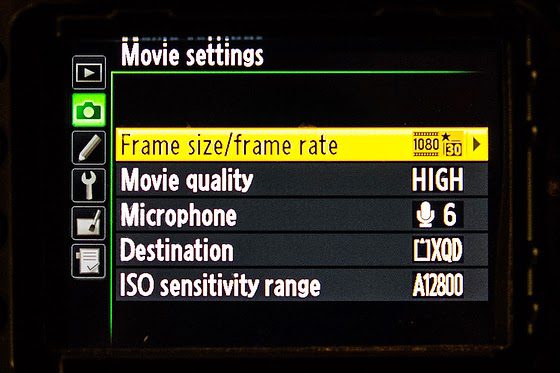
Before you go to the Movie settings on the camera, I recommend creating a menu bank for Video, as I have done here. This way, once you have made all the settings, they are saved.
In the movie Settings, choose your Frame Size/Frame Rate. The standard Frame Rate for movie theaters and TV is 24 fps.
When you pan or right to left, you will see Frame Rate affect the look and feel of the image. The public is so used to 24 fps that this is the best default. Some use 30 fps.
People often shoot higher Frame rates to make a slow motion by slowing it down to 24 fps.
Your shutter speed on the camera should be set to twice the Frame Rate for the movie settings. If you shoot 24 frames, you will be at 1/60 since this is the closest. If you hit 60 fps, then 1/125 should be your setting.
I usually shoot on 1080/30fps and set it for high quality.
Most of the time, the microphone setting must be set manually, and the sound levels must be used to adjust the recording volume. I highly recommend using headphones and looking at the audio meter on the viewfinder. Be careful because the recording level and the headphone volumes are set separately.
I have my color space set on Adobe RGB. You also want to set the Picture Control, then.
Some of this is personal preference, but the key is if using more than one camera, all the settings are set the same, or you will have trouble matching the Video, and color can look off switching between the cameras.
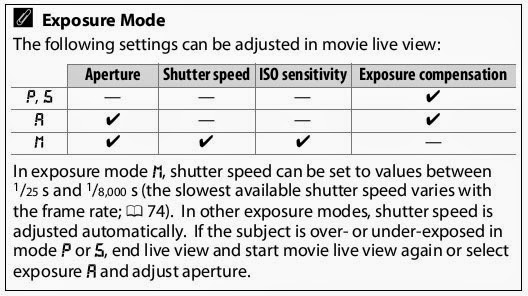
You can adjust your microphone levels and exposure when you go to Live View in movie mode. To prevent light entering via the viewfinder from interfering with exposure, close the viewfinder eyepiece shutter.
It would help if you went to manual mode to have the most control over the settings. A subject’s movement can change the exposure even when the light stays the same. Use manual mode.
As you can see from this chart, you can control more in manual mode.
Regarding focus, I use autofocus when I have a subject framed and then go to the manual guide.
The motor for the lens tends to make a noise I don’t want to pick up.
Microphone
I recommend using a Lavalier microphone for interviews, and for natural sound and quick-moving situations, I recommend a shotgun microphone.
Here is an earlier blog post I did to help you with the audio recording.
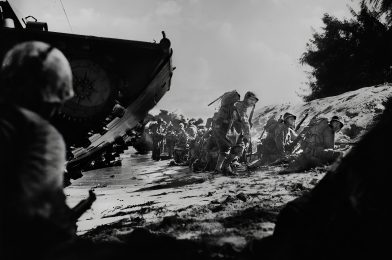
ON THE BEACH: The first wave of Marines takes cover behind the sand dunes on Saipan beach, during the World War II invasion of Marianas Islands. The soldier kneeling in the sand at far right is Carl Matthews of Texas; second from right is Wendal Nightingale of Skowhegan, Maine; standing is Lt. James Stanley Leary of North Carolina. Neither Nightingale nor Leary made it home from Saipan; both are still listed as missing in action. Time Life photo by U.S. Marine Sgt. James Burns
The oldest of my father’s siblings was James Stanley Leary who was named after his father and my grandfather. He died July 14, 1944 during battle with the Japanese on Saipan. 120 Marines died there.
I too was named after my grandfather, so we shared the same name.
Good chance that the famous Life photographer W. Eugene Smith was there with him. This is where he took the famous photograph of the little baby being pulled out by the soldier. Here is link to that photo.
Today is about remembering those who gave the ultimate sacrifice for our freedom.
Nikon D4, AF-S NIKKOR 28-300mm f/3.5-5.6G ED VR, ISO 100, ƒ/8, 1/250
I drove up to Canton, Georgia to the National Cemetery there to just remember. While there I saw family members in tears missing their loved ones.
Nikon D4, AF-S NIKKOR 28-300mm f/3.5-5.6G ED VR, ISO 100, ƒ/8, 1/250
I saw what looked like parents at their child’s grave.
Nikon D4, AF-S NIKKOR 28-300mm f/3.5-5.6G ED VR, ISO 100, ƒ/8, 1/200
I saw service members remembering their friends. This marine left this for his friend.
I had waited till he had paid his respects to get the close-up of the Symbol of the Corps The Eagle, Globe and Anchor emblem has been part of the uniform since 1868 and became the official emblem of the Marine Corps in 1955.
The eagle with spread wings represents our proud nation. The globe points to worldwide presence. The anchor stands for naval tradition. Together, they represent a dedication to service in the air, on land and at sea.
Today this tomb stones are visual reminders to us the living of the dead who sacrificed. Remember your photos will help generations to come to be able to remember. Take pictures with the attitude of service.
Nikon D4, Nikon 85mm ƒ/1.8G, ISO 100, ƒ/2.2, 1/3200
John 15:13 Contemporary English Version (CEV)
13 The greatest way to show love for friends is to die for them.
Nikon D4, Nikon 85mm ƒ/1.8G, ISO 100, ƒ/1.8, 1/400
Have you ever noticed that using a technique that a famous photographer perfected and maybe even taught you doesn’t produce the same results?
Maybe you have realized that you are implementing all these techniques correctly in your photos, and you continue not to win any competitions you are entering.
A wonderful moment in Remember the Titans is about how “… attitude reflects leadership.” Here, listen to the clip:
Where is your heart?
It wasn’t what I did that made a difference–it was how I thought. I started asking myself why specific techniques worked and others didn’t. I soon noticed that when a strategy was wildly successful, it had more to do with the fact that I honored a principle than the strategy itself. When a strategy was less successful, that, too, could be directly related to a code I violated.
A principle differs from a strategy; it is about understanding the why, not the what or how. Your ability to be flexible is because you are more relaxed. Understanding these principles is important because you “GET IT,” and because you do, you can listen more and look for ways to implement them. Natural creativity can take place if you understand the principles.
The principle of the technique frees you up, whereas the method alone will freeze you up.
Kalyn Wood [Nikon D4, AF NIKKOR 85mm f/1.4D, ISO 800, ƒ/1.4, 1/160]
I remember this photo shoot I was doing to help a young actress with her headshots. I could see what I wanted to capture right before me, but it wasn’t working. I was shooting with soft boxes using strobes, and the depth of the field was too big.
I wanted to shoot at ƒ/1.4. So, always using my strobes in the studio was a technique. But unfortunately, I was letting that technology get in the way of the principle of soft lighting.
These lights are just too much, and then I relaxed and realized the modeling lights might be just enough to make it work. So I turned off the radio remote, opened the 85mm lens to ƒ/1.4, cranked the ISO to 800, and started shooting.
That is only a tiny part of why I love this photo. You see, there is another part of the creative process. I had been noticing the model’s looks and the mood they were creating. So I told her how her particular looks reminded me of some famous actresses in Hollywood.
Kalyn Wood [Nikon D4, AF NIKKOR 85mm f/1.4D, ISO 200, ƒ/8, 1/200]
She looked like Evil Queen/Regina Mills (Played by Lana Parrilla) on Once Upon a Time. She loved that actress and was pleased I saw her in that way.
Kalyn Wood [Nikon D4, AF NIKKOR 85mm f/1.4D, ISO 200, ƒ/1.4, 1/80]
In this photo, I told her how she reminded me of Anna May Bates (played by Joanne Froggatt) in Downton Abbey. Her mom was there and said I was mentioning all her favorites. We were connecting.
The principle of lighting and its WHY drove the creative process, not just putting the light here and looking here.
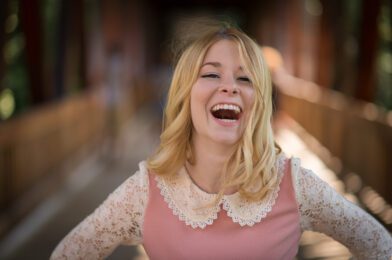
Jane Yandel [Nikon D4, Nikon 85mm ƒ/1.8G, ISO 50, ƒ/2.8, 1/60]
I was trying to capture her personality for the photos of the beautiful blonde. She is such a ham and loves to have fun. Not too serious at all. After a while, I connected with her like the humble kid next door.
Then, as we changed locations, I started to see how specific areas would bring out different parts of her personality. They would compliment her and create a mood. The last photo is what I think of when I think of the famous Dove Girl ads.
You see, we have been talking about the principles of portraits and not so much technique.
If you love photography because of playing with all the gear, then be ready to accept mediocrity. However, if inspiring imagery motivates you, then learn to get in touch with your heart and what moves you, and then you will create great images.
Nikon D750, AF-S NIKKOR 28-300mm f/3.5-5.6G ED VR, ISO 5000, ƒ/5.6, 1/100–Off camera flash Neewer TT850 triggered by the Neewer 433MHz Wireless 16 Channel radio remote set to 1/128th power and with gels and grid
I love it when you can get super close because people forget about you. Here this boy is deep into his computer software, and the teacher is helping him.
Getting close to people takes time.
Nikon D750, AF-S NIKKOR 28-300mm f/3.5-5.6G ED VR, ISO 6400, ƒ/5.6, 1/100–Off camera flash Neewer TT850 triggered by the Neewer 433MHz Wireless 16 Channel radio remote set to 1/128th power and with gels and grid
If I did this just once, you might think it is luck, but trust me, once you let people feel comfortable with you and you are non-threatening, you can get close and get better photos.
Photographed with a 14-24mm, I am shooting zoomed as wide as it will go at 14mm. So in all of the images in this blog, I can take my hand and reach and touch the main subject’s face.
Being close is the key to your photos looking better–Get more intimate with your feet. You should be able to touch your subject because you are too close most of the time.
Nikon D750, AF-S NIKKOR 28-300mm f/3.5-5.6G ED VR, ISO 1600, ƒ/5.6, 1/100
Notice the difference when you work this close from the 14mm to this photo at 28mm. It starts to look like a telephoto lens.
You get a sense of place by getting close and using ultra wide-angle lenses. You can see the other students and how they are working. I try to put the audience in the room with me.
Nikon D750, AF-S NIKKOR 28-300mm f/3.5-5.6G ED VR, ISO 1600, ƒ/5.6, 1/100
Here I stepped just a little back and zoomed in to 42mm. Notice how distant you are in comparison?
If you want your photos to look better, use your feet and get close enough to touch your subject.
There are a few exceptions, and wildlife is one of those exceptions. I use long lenses like 500mm or 600mm, so I live to have another day.
When covering sports, you want to communicate the athleticism and the competition. Here I went low for a good reason.
When you get below eye level of your subject, you give them power. When you get low as I did here, you start to make the athletes look like the “Roman gods.” We even name many of our sports teams after Greek names like Spartans.
Now I am standing in the same position, but the camera is at my standing eye level. The thing that makes this photo work is the aspect of “competition.” You can see all the racers tightly packed and looking for an opportunity to move ahead in the pack.
Nikon D4, AF-S NIKKOR 28-300mm f/3.5-5.6G ED VR, ISO 800, ƒ/6.3, 1/2000
Depending on the caption, this photo of the three riders can make this photo more or less critical. If these were the leaders [first place, second place, and third place], this could be a good photo in the story. However, the guy in the middle’s facial expression doesn’t communicate effort. Instead, he looks like he is enjoying a leisurely Sunday afternoon bike ride.
Nikon D4, Sigma 70-200mm f/2.8 EX DG APO OS HSM, ISO 2800, ƒ/5.6, 1/2000
In contrast, the earlier photo of this one is shot a lot tighter to emphasize facial expressions, and I think these riders all look a lot more competitive in their facial expressions.
Tips:
Shoot a variety of angles
Shoot with a variety of lenses
Look for body language to help communicate
Look for facial expressions
Be sure you show more than one athlete to display competition
We haven’t played tourist in Atlanta for a long time, and we decided to take in a couple of attractions this weekend. After doing this, I would recommend this for a Mother’s Day present.
I checked online about pricing for SkyView Atlanta. Here are the prices, and you can click on the link to take you to their web page.
We drove down from Roswell and parked right next to SkyView. I walked right up and got on with no wait time at all.
Nikon D4, AF-S NIKKOR 28-300mm f/3.5-5.6G ED VR, ISO 100, ƒ/5.3, 1/250
Here are some of the sights from up inside the gondola. Unfortunately, due to shooting through the glass of the gondola, sometimes there were flairs that I couldn’t avoid.
Nikon D4, AF-S NIKKOR 28-300mm f/3.5-5.6G ED VR, ISO 100, ƒ/5.3, 1/250
You can see most of the major attractions from SkyView in downtown Atlanta. Here you can see the Olympic Rings in Centennial Park.
Nikon D4, AF-S NIKKOR 28-300mm f/3.5-5.6G ED VR, ISO 100, ƒ/5.6, 1/320
Here is the World of Coke, and you can also see the Georgia Aquarium, The College Football Hall of Fame, CNN, and the new Civil Rights Museum.
Riding slowly without a top that you would have in a car makes you look at the city differently. But, slowing down and enjoying the scenery was worth the ride.
Nikon D750, AF-S NIKKOR 28-300mm f/3.5-5.6G ED VR, ISO 220, ƒ/14, 1/30
Today I decided to go and have some fun covering The Roswell Criterium for a beautiful Sunday sunny day after a lot of rain in our town.
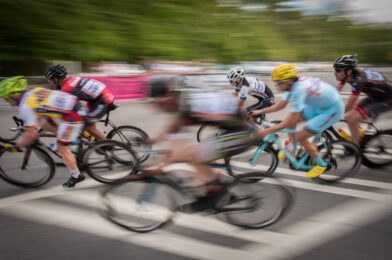
I thought I would play with panning, and let me say it is hard to play with panning. That is hard to get a good photo with bicyclists blazing by about 45 mph.
Nikon D750, AF-S NIKKOR 28-300mm f/3.5-5.6G ED VR, ISO 280, ƒ/14, 1/30
I tried with the 14-24mm but felt that I needed to be closer, and the Nikon 28-300mm at 28mm on the curve was just perfect.
Nikon D4, AF-S NIKKOR 28-300mm f/3.5-5.6G ED VR, ISO 800, ƒ/5.6, 1/2000
The pack of bicyclists would come by at such a clip that you had a hard to unless you had decided before they came into view your next course of action. Will you pan or shoot tight? Who will you focus on? Will it be the leader or someone else in the pack?
Technical choices like panning require you to shoot at a slow shutter speed and freeze the action as I did of the pack was shot at 1/2000.
Nikon D4, AF-S NIKKOR 28-300mm f/3.5-5.6G ED VR, ISO 900, ƒ/6.3, 1/2000
I preferred shooting at a greater depth-of-field since I hadn’t shot much bicycling and wanted at least a few in-focus photos. Also, this gave the camera a little room front to back to play with focus sharpness.
Here you can see I used my ultra wide-angle lens, the Nikon 14-24mm @ 14mm. Unless you shoot this wide, you might not realize how close I was to the action, but the rider came by me less than a foot from me.
[NIKON D4, 14.0-24.0 mm f/2.8, Mode = Aperture Priority, ISO 1600, 1/2000, ƒ/13, (35mm = 14)]
I didn’t like the power lines in the background, but I couldn’t move to an angle and get rid of them for this type of photo.
Nikon D4, Sigma 120-300mm ƒ/2.8 DG OS HSM | S, Sigma TC-2001 2x, ISO 1800, ƒ/8, 1/2000
I did pull out the long glass and shot this photo at 600mm to pull in the start and finish lines.
Nikon Dr, Sigma 120-300mm ƒ/2.8 DG OS HSM | S, Sigma TC-2001 2x, ISO 3200, ƒ/8, 1/2000
When they are coming up a hill, it looks like I am on the ground, but I was standing for this photo to shoot over the fence.
Nikon Dr, Sigma 120-300mm ƒ/2.8 DG OS HSM | S, Sigma TC-2001 2x, ISO 640, ƒ/6.3, 1/2000
For this last photo, I decided to clean up my background and make it “A Classy Clutter” for a background.
We often have bicycle races in Roswell, so look for them in the news and come and shoot it yourself. No press pass was necessary for all access. Here is another group to follow that will tell you about the subsequent events http://www.bikeroswell.com/.
AF Activation – Auto Focus only: use the back focus button on focusing, and shutter release only controls the shutter
Release Mode–Continuous High Speed
Nikon D4, Sigma 120-300mm ƒ/2.8 DG OS HSM | S, Sigma TC-2001 2x, ISO 1000, ƒ/8, 1/2000
I like to stand in the endzone of the goal that the team I am covering is trying to score.
Getting on your knees is even better than standing.
Nikon D4, Sigma 120-300mm ƒ/2.8 DG OS HSM | S, Sigma TC-2001 2x, ISO 1100, ƒ/8, 1/2000
The athletes’ level of play will determine how good photos you will get. The better the game, the more opportunities for great action photos will increase.
Nikon D4, AF NIKKOR 85mm f/1.4D, ISO 200, ƒ/1.4, 1/80
My friends and I were teaching a class, and we had one student that we all were trying to figure out why they were taking the course. He found each of us and wanted to tell us all he knew about photography.
One of us mentioned how it takes 10,000 hours to master something. Malcolm Gladwell talks about this in his book, and I have also written about it on the blog. Here is that link.
The student then went on to say then I am a master then. One is a master when others acknowledge it about you and not the other way around.
My mentor Don Rutledge was trying to form a style and talked about how one guy told him about his style.
Why is it so hard to establish one’s style? I think the hardest thing for most pros is the lack of feedback.
Once you were a hobbyist, your friends would compliment your work and tell you how good you were and you should be a photographer. But, once you become a pro, they no longer give you that feedback. Why? You see, now you are expected to take great photos.
I think professional photographers need to seek out and pay for feedback.
The other day my friend Will Flora experimented with some workers. He is a training director for a company. He got some front-line workers to come to a bowling alley where he paid them to bowl for the day.
There was a catch. Will had covered all the monitors and put up a curtain so they could not see how many pins they took down or see their scores. After a while, the workers wanted to quit and go home.
They were being paid to bowl for the day and wanted to quit.
As they took off their shoes, Will removed the curtain and uncovered the monitors. A guy asked if they could still bowl without the stuff in the way. He said, of course. They then started to bowl and have fun. You see, people enjoy work when they understand their part–especially when they can make a game of it.
Nikon Coolpix P7000, ISO 100, ƒ/7.1, 1/1000
While it is essential that you get paid as a professional photographer and paid a good wage for your creative talents, we still need and want feedback. How are we doing?
Here is a to-do list for you:
Find a Mentor/Coach to help you discover your style
Be sure the style you are pursuing is the core of who you are and want to become
If you like a photo and you know the photographer, tell them that you like it and why. You must be willing to give feedback if you want to receive it.
Fuji X-E2, FUJINON XF 55-200mm, ISO 6400, ƒ/8, 1/400
Don’t be the photographer that is a legend in their mind.
Nikon D750, AF-S NIKKOR 28-300mm f/3.5-5.6G ED VR, ISO 160, ƒ/8, 1/125
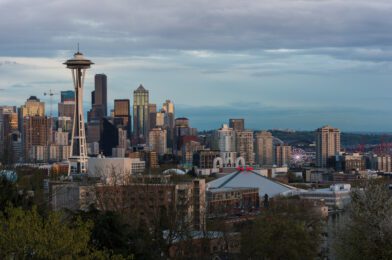
When you go to Seattle, visit Kerry Park [211 W Highland Dr, 98119] at sunset to get some great photos. I arrived early and shot the picture above with my Nikon D750.
You must hang out until about 20 minutes after sunset; it is worth the wait if you do.
Nikon D750, AF-S NIKKOR 28-300mm f/3.5-5.6G ED VR, ISO 100, ƒ/8, 2.5 sec
I recommend bringing a tripod and a lens around the 100 – 150mm range. The 70-200mm works excellently; I used it and the 28-300mm lens.
The clouds covered Mount Rainier this night, but the city looked marvelous.
Nikon D4, Sigma 70-200mm f/2.8 EX DG APO OS HSM, ISO 100, ƒ/8, 1/4
Here are some photos shot with the Nikon D4 and the Sigma 70-200mm f/2.8 EX DG APO OS HSM.
Nikon D4, Sigma 70-200mm f/2.8 EX DG APO OS HSM, ISO 100, ƒ/8, 1/1.2
I also shot some with the AF-S NIKKOR 28-300mm f/3.5-5.6G ED VR on the Nikon D4.
Nikon D4, Sigma 70-200mm f/2.8 EX DG APO OS HSM, ISO 100, ƒ/8, 2.5 sec
You may have a better night than I when you shoot the Seattle Skyline. Perhaps you will see Mount Rainier.
Nikon D4, Sigma TC-2001 2x, Sigma 120-300mm ƒ/2.8 DG OS HSM | S, ISO 12800, ƒ/5.6, 1/800
Ever since I heard about the new Sigma TC-2001 2x, I have been interested in getting one for my Sigma 120-300mm ƒ/2.8 DG OS HSM | S.
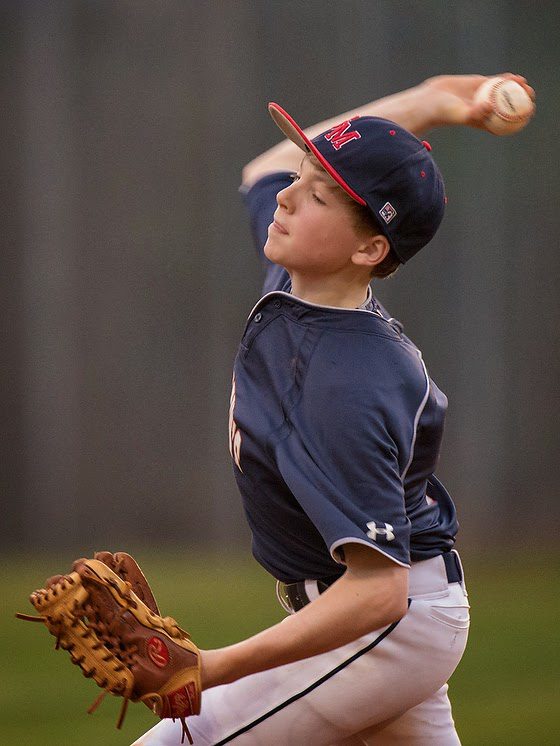
Last night at 6:30 pm, UPS delivered the lens to my door, and by 6:45 pm, I was off to photograph a middle school baseball game that started at 7:30 pm.
Optimized for Nikon F-mount lenses in the Global Vision line, the TC-2001 2x Teleconverter from Sigma will offer an additional focal length of 2 times for select Global Vision lenses. In addition, this model offers full communication between the lens and camera and will allow autofocus to operate at up to f/8. The teleconverter also features two Special Low Dispersion elements for reducing the appearance of chromatic aberrations and maintaining quality. Additionally, for protection, the TC-2001 is both dust and splashproof. When attached, the 2x conversion results in a light loss of approximately two stops.
Nikon D4, Sigma TC-2001 2x, Sigma 120-300mm ƒ/2.8 DG OS HSM | S, ISO 10000, ƒ/5.6, 1/2000
The second photo above I took while the players were warming up at 7:15 pm so that I could shoot at a lower ISO and higher shutter speed–It still had sunlight. Shooting with more light and then less makes this test a little skewed. The sharpness of the photos just 20 minutes later cost me almost 2-stops. I went from ISO 10000, ƒ/5.6 @ 1/2000 to ISO 12800, ƒ/5.6 @ 1/800.
You can see the ball in the second photo frozen in the air, but in the first photo, the player’s arms are blurred.
Nikon D4, Sigma TC-2001 2x, Sigma 120-300mm ƒ/2.8 DG OS HSM | S, ISO 12800, ƒ/5.6, 1/800
I can tell you that I noticed more responsiveness with the lens focusing. That alone would be a great reason to upgrade from the older Sigma 2X.
I also believe there is better contrast and colors with this converter over the older one. Again this would be enough to upgrade.
I also noticed less chromatic aberration compared to the older Sigma 2X.
Nikon D4, Sigma TC-2001 2x, Sigma 120-300mm ƒ/2.8 DG OS HSM | S, ISO 12800, ƒ/5.6, 1/500
Years ago, a young photographer asked an older photographer, “How many millimeters does your lens resolve?” The response was priceless. “About $5,000 worth.” The younger guy looked all puzzled, and then the photographer explained. “How the hell do I know how many millimeters is resolves, but I know I am selling my largest 40″ x 60″ prints with it for $5,000 regularly.”
I posted the photos for the client to download last night after the game. This morning I got this note from the client:
Thank you so much! Photos are great! I already put one on our home page. I’ll touch base with you before the soccer game.
I uploaded 198 images, and about halfway through the game, I needed to take the 2X off because the shutter speed was dropping too low. So there were only 79 images of the 198 shot with the Sigma 2X. Of all the photos, the client picked one this morning to post on their website. So I shot it with the Sigma 2X. While I would have chosen a different photo [everything is subjective], here is their pick. I think because you can read the team name, they picked it over some of the others.
Nikon D4, Sigma TC-2001 2x, Sigma 120-300mm ƒ/2.8 DG OS HSM | S, ISO 12800, ƒ/5.6, 1/800
Cookie Consent
We use cookies to improve your experience on our site. By using our site, you consent to cookies.