|
Getting your Trinity Audio player ready...
|
I have been making pictures and telling stories for more than forty years, and I have had to reinvent how I do it more than once. Recently I listened to a podcast that gave a name to something I had lived but never quite explained.
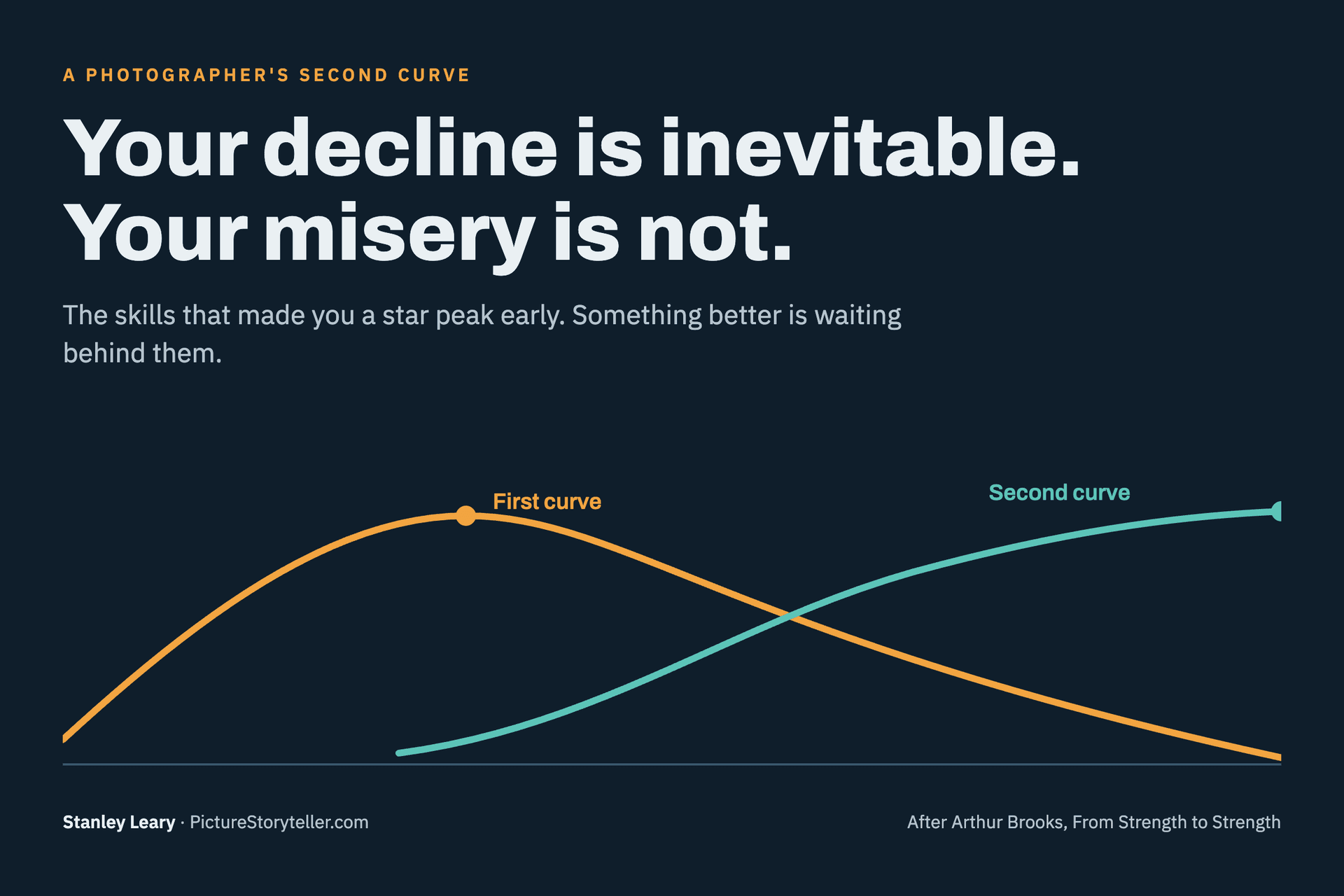
The episode is from Arthur Brooks, the Harvard professor who writes about happiness, and it builds on his book From Strength to Strength. His point is simple and a little uncomfortable. The abilities that make us stars early in a career, like speed, quick problem-solving, and raw mental horsepower, tend to peak sooner than we expect, often around age 40. He calls this fluid intelligence. Then they start to slide.
But a second kind of intelligence comes up behind it. Brooks calls it crystallized intelligence: the library of experience you have built, your pattern recognition, your ability to explain, connect, and teach. It keeps growing for decades. His line stuck with me: “Your decline is inevitable. Your misery is not.”
The unhappiest people, he says, are the ones who keep trying to force the first curve back up—the happiest jump to the second.
He tells two stories.
Darwin made his great discovery in his twenties and became famous almost overnight. In his fifties, younger scientists with better math and more languages passed him by. He kept writing, but he felt like a fraud and spent his later years discouraged.
Bach hit a similar wall when musical tastes moved on, and he could not write in the new style. He did not fight it. He became a teacher, a mentor, and a church musician; he earned less, was less famous, and died surrounded by family and students, working on a textbook for the next generation.
Same kind of wall. Different response.
My own curve
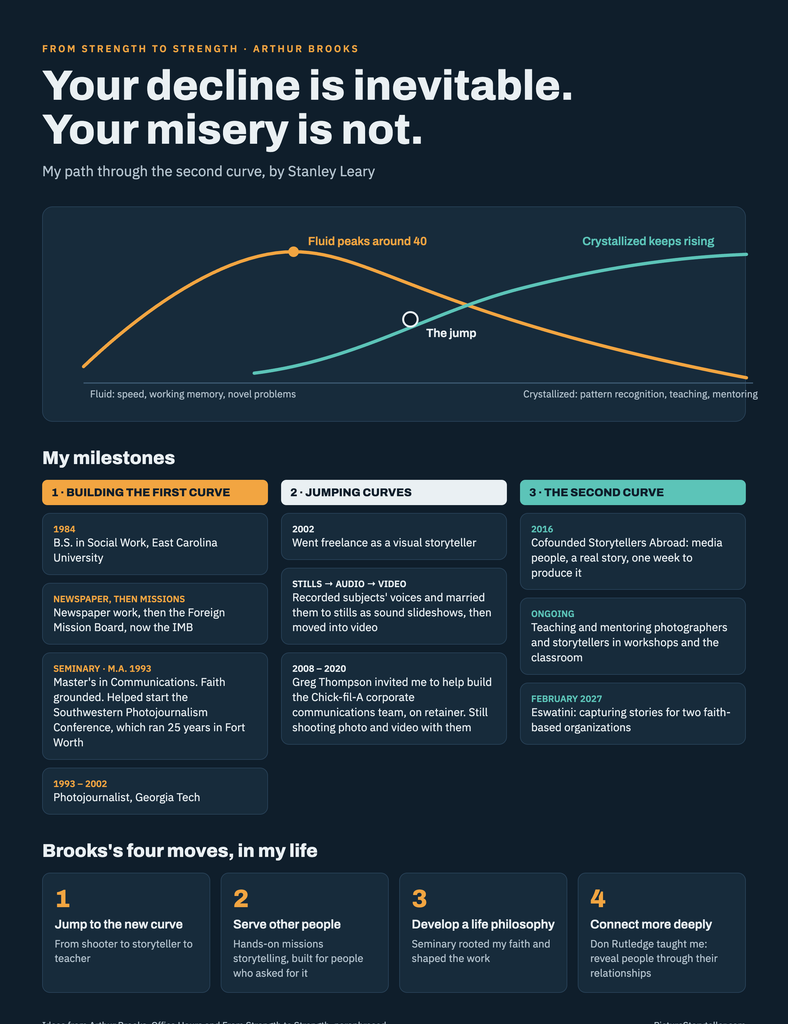
When I look at my own path, I see that I have been jumping curves for a long time, usually without a name for it.
I started with a degree in social work. Then I worked at a newspaper, and my camera became a way to get close to people’s lives. From there, I worked with the Foreign Mission Board, now the IMB, and that is where I first saw how much stories matter in missions. That led me to seminary, where my faith grew deeper, and I finished a master’s in communications. I didn’t know it yet, but I was already moving toward the second curve: the desire to help people understand, not just take pictures.
While I was at Southwestern, I helped start the Southwestern Photojournalism Conference in Fort Worth. It ran for 25 years. Then came more than nine years as a photojournalist at Georgia Tech, and in 2002 I went out on my own as a freelancer.
I could feel the difference when I became responsible for more than just the photographs. When I started recording my subjects’ voices and pairing that audio with the still images, the parts of the story a picture alone can’t carry came alive. For the first time, I felt like a storyteller, not just a photographer. And I helped the people I photographed tell their own stories more effectively.
In those freelance years, I stopped thinking of a still frame as the whole story. I began recording the people I photographed and marrying their voices to the images, which became the sound slideshow, and then I moved into video. Each step meant learning something new while leaning on everything I already knew. That is the second curve at work: the speed of the shutter matters less, and the judgment about what is worth telling matters more.
In 2008, Greg Thompson found me and asked me to help build a corporate communications team at Chick-fil-A. I did that on retainer until 2020, and I still shoot photography and video projects with them today. That work was never about my pictures alone. It was about helping a team see better.
The gap, and Storytellers Abroad
What pulled me forward most was a gap I kept noticing. People who wanted to tell mission stories wanted more than a lecture. They wanted hands-on help. So in 2016, I helped co-found Storytellers Abroad. We take media people to the mission field, give them a real story, and help them produce it in one week.
I have rarely felt more useful than when watching someone get their first story right in a place far from home, with a mentor beside them. It is the same thing I learned from Don Rutledge, who taught me to reveal people through their relationships and their surroundings, not in isolation. He modeled “us, not me” long before I had heard of crystallized intelligence.
What Brooks says to do, and how it looks in a photographer’s life
Brooks gives four moves. Here is how each one shows up for those of us who work with a camera.
- Jump to the new curve. You do not have to quit your craft. Shift from reaction speed to judgment, context, and teaching. Younger shooters may beat you to the frame. They cannot yet beat you to the meaning.
- Serve other people. Look for the strengths in others instead of mourning what you used to do easily. Mentoring is not a consolation prize. For many of us it becomes the work we love most.
- Develop your life philosophy. Brooks notes that crystallized intelligence pairs well with deeper questions and worship. For me, seminary and my faith are what grounded the work.
- Connect more deeply with others. The Harvard study of adult development he cites found that close relationships predict happiness better than anything else.
What is next
In February, I am going to Eswatini to help capture stories for two faith-based organizations. I am not going there to prove I can still keep up with the best shooters in my field. I am going to listen, to see people clearly, and to help their stories reach the people who need to hear them.
If you have hit a hinge in your own work, where the thing you were best at feels harder, and you do not know why, here is what I would say. It may not mean you are done. It may be a handoff.
Brooks’s episode is from the Office Hours podcast. These are my own paraphrases of his ideas, and I encourage you to listen to the full conversation or read From Strength to Strength.