|
Getting your Trinity Audio player ready...
|
KSU Tellers Spring Performance
There’s a moment most of us miss entirely.
The first time we’re given a seat at the adult table.
At first, you mostly listen. You laugh when others laugh. You absorb the rhythm of conversation — the timing of a punchline, the pause that makes a story land. You’re surrounded by people who seem to hold attention effortlessly: the natural storytellers in your family, your circle, your life.
Then one day, you try telling your own story.
It’s a little rough. You leave things out. People ask questions. They help you fill in the gaps. And slowly, over time, you begin to understand something: storytelling isn’t just talking. It’s crafting. It’s shaping an experience so others can step inside it with you.
That’s exactly what I witnessed at the KSU Tellers Spring Performance.

A class about becoming a storyteller
The KSU Tellers is more than a performance group — it’s a process.
Under the direction of Charles Parrott, students gather every Friday morning from 9 a.m. to noon. But this isn’t a lecture. It’s a workshop in becoming vulnerable, observant, and intentional with your voice.
The journey, from what I saw, begins with learning to open up — and that’s no small thing. Most people don’t walk into a room ready to share something real. But through Parrott’s approach, something shifts. Students start to recognize a truth they hadn’t quite believed before:
People want to hear their stories.

Once that realization takes hold, everything changes. The class becomes a collaborative table — each student helping the others discover, shape, and refine the story they’ll eventually bring to the stage.
The performance: early craft, real growth
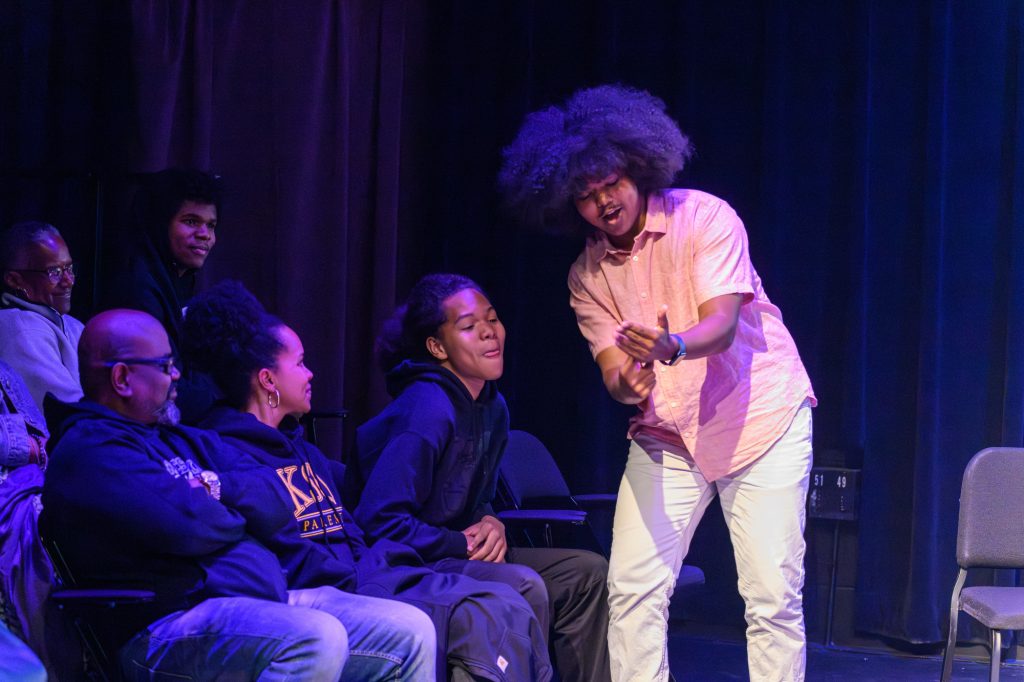
The spring showcase is where those stories meet an audience.
What stood out wasn’t perfection. It was progress.
These are storytellers still early in their journey, and you could see it in the details — in the pacing, the pauses, the moments where a face said everything the words hadn’t quite caught up to yet. Each student brought something different to the stage: their own rhythm, their own perspective, their own way of holding the room.
That’s the beauty of storytelling. There’s no single right way. There’s only an honest one. And every one of them found theirs.



The Quiet Masterclass Happening in Plain Sight
While the students took turns sharing their monologues, they sat together in a row facing the audience. And seated right there with them was their professor.
This is where something subtle—but powerful—was happening.
Parrott wasn’t just watching.
He was feeling every moment.
You could see it in his reactions—the slight shifts in expression, the timing of a smile, the way he leaned into certain moments. He wasn’t performing, but he was modeling what it means to truly engage with a story.
In many ways, he became the emotional meter of the room.
Where others reacted occasionally, he responded continuously—supporting each storyteller without ever taking the spotlight away.
It was a masterclass, not from the stage, but from the chair.
Back to the table
After the performance, the night wasn’t over.

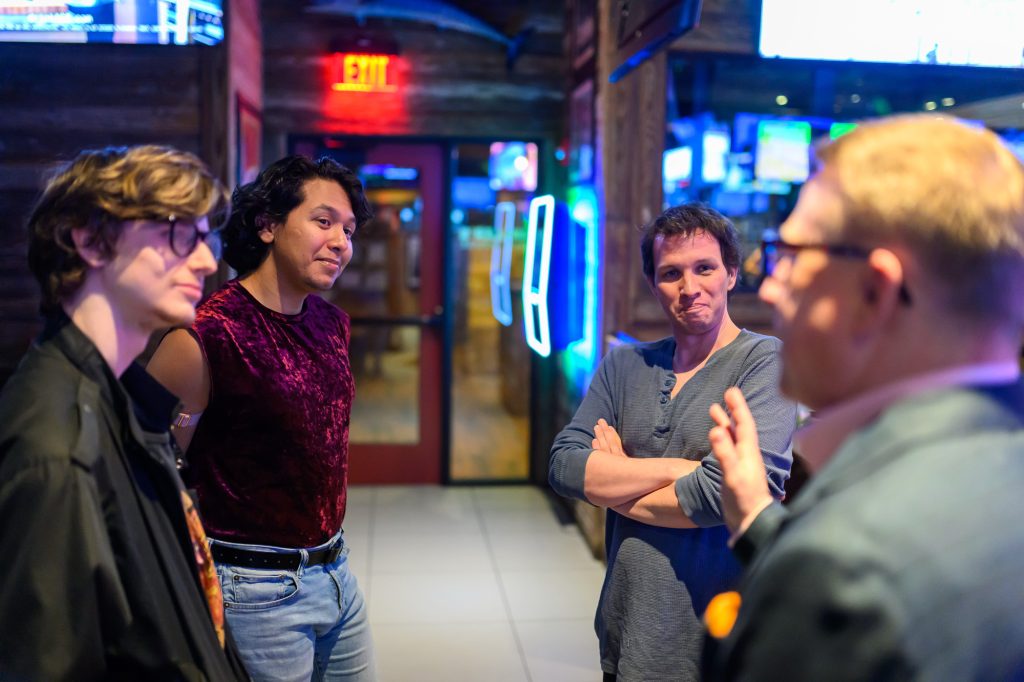
Students, alumni, and friends gathered at Miller’s Ale House near campus. And that’s when it all came full circle — because that gathering, right there, is the culmination of the class.
People sitting around a table, sharing stories. Laughing. Reflecting. Connecting.
Looking around the room, you could see it on their faces: these students aren’t just better performers. They’re better communicators. Better listeners. Better at finding their way into a conversation and making it mean something.

Why this matters
The KSU Tellers is officially a storytelling troupe within KSU’s Department of Theatre & Performance Studies — focused on personal narrative, solo performance, and devised theatre. They perform at festivals, do community outreach, and grow as artists.
But what I witnessed goes deeper than a program description.
This is about learning to take your own life — your moments, your struggles, your humor — and shape it into something that resonates with another person. It’s about learning when to speak, and how to make it matter when you do.
It’s about earning your place at the adult table.
And maybe more importantly, helping someone else feel like they belong there too.