|
Getting your Trinity Audio player ready...
|
Mark Romzick, president of the Upper Chattahoochee Chapter of Trout Unlimited, carries his coat back to the car as the day warms up. Romzick said, “I love fly fishing, and this is a way to preserve streams for future generations.”
When I pulled into Chattahoochee Pointe Park to cover a tree-planting event along the river, I already knew something most people don’t think about when shooting outdoors:
I was going to need flash.
That might sound counterintuitive. It was daytime. Plenty of light. A beautiful setting under a canopy of trees. But experience has taught me that available light and usable storytelling light are not always the same thing.
The Assignment
The story itself was strong—volunteers planting native trees to protect the Chattahoochee watershed. Families, conservationists, and community leaders all working together. It had heart, purpose, and visual potential.

But visually, it also had a challenge:
- People bending over, digging holes
- Faces angled downward
- Tree cover creating uneven light
- Hats casting deep shadows across eyes
If I relied only on available light, I’d come back with technically acceptable images—but not images that truly connect.
And for me, that’s the difference.
Flash Isn’t About “Fixing”—It’s About Revealing
Most people think flash is something you use when there isn’t enough light.
I use it when the light isn’t telling the story well.
Here’s what the on-camera flash helped me do in this situation:
1. Open Up Faces in Harsh Shade

Under tree cover, light becomes patchy. Add a baseball cap, and suddenly the most important part of the photo—the eyes—disappear.
A subtle touch of fill flash brings those faces back:
- Eyes become visible
- Expressions come alive
- Viewers can connect emotionally
Without that, you’re just documenting activity. With it, you’re telling a story about people.

2. Control Contrast in High Dynamic Range Scenes
Outdoor scenes—especially in woods—often have extreme contrast:
- Bright highlights filtering through leaves
- Deep shadows underneath
Cameras struggle with this more than our eyes do.
Fill flash helps compress that range:
- Lifts shadows without blowing highlights
- Keeps detail in both bright and dark areas
- Produces a more natural, readable image
This is especially important for newspapers, where images are often reproduced smaller and need clarity at a glance.
3. Improve Color Accuracy
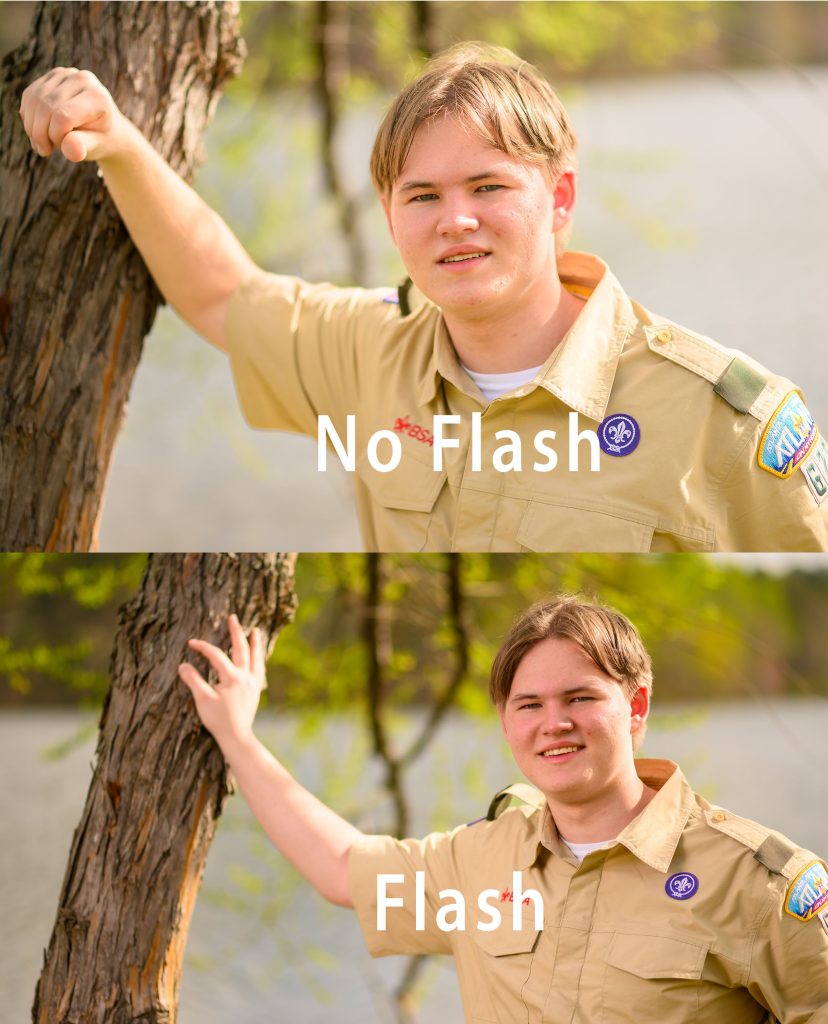
One of the biggest hidden problems in wooded environments is color cast.
All that green? It reflects back onto skin tones.
Without flash:
- Skin can look greenish or muddy
- Colors lose their vibrancy
With flash:
- You introduce a neutral light source (around daylight balance)
- Skin tones look natural again
- Colors pop in a way that feels true to the moment

4. Add Subtle Separation and Depth
Flash—used well—doesn’t look like flash.
It creates just enough separation between subject and background to:
- Give dimension
- Prevent subjects from blending into busy environments
- Guide the viewer’s eye
This is especially helpful in environmental storytelling, where the background matters—but the subject still needs to lead.
5. Freeze Motion Cleanly
Even in daylight, motion can be an issue:
- Shovels moving
- Dirt flying
- Hands in action
Flash adds a crispness to those moments by freezing motion more effectively than ambient light alone.
That means sharper storytelling frames—especially when people are working.
Why This Matters in Today’s Newsrooms
Here’s something I’ve noticed working with newspapers today:
Many staff writers are shooting with phones first—and maybe a camera second.
And almost no one is using flash outdoors.
There’s an assumption:
“If there’s light, you don’t need flash.”
But what I’m seeing—and what my editor is responding to—is that using flash thoughtfully elevates the work.

It’s not about making something look artificial.
It’s about making the story clearer.
- Faces are readable
- Moments feel more immediate
- Images reproduce better in print and online
In a world flooded with images, that difference stands out.
My Approach
I’m not blasting flash on everything.
Before I even step out of the car, I’m asking:
- Will flash improve the story?
- Will it help the viewer connect?
If the answer is yes, I use it.
If not, I leave it off.
That’s the key—intentionality.
The Bigger Picture
For me, this goes back to something I teach all the time:
Great storytelling isn’t about using the latest gear.
It’s about using the right tools on purpose.
On-camera flash outdoors is one of those tools that’s often overlooked—but when used well, it can quietly transform an image from “recording a moment” to “communicating a story.”
And in the end, that’s the job.
Why This Matters Even More for Print


Most people today are judging photos on a backlit screen—a phone, tablet, or computer.
That changes everything.
When you’re looking at an image on a screen:
- Light is coming through the image
- Shadows still have detail because they’re illuminated
- Colors feel more vibrant, and contrast feels stronger
But a newspaper is completely different.
It’s reflected light, not transmitted light.
There’s no backlight behind the image—just ink sitting on paper.
The Reality of Dynamic Range in Print
Dynamic range is the difference between the darkest and brightest parts of an image.
On a modern screen, that range is huge:
- Deep blacks
- Bright highlights
- Lots of detail in between
On newsprint, that range shrinks dramatically.
Here’s what happens when your image goes to print:
- Shadows block up faster (you lose detail in dark areas)
- Highlights flatten out (less separation in bright areas)
- Overall contrast gets compressed
- Colors become more muted due to ink absorption into paper
And newspapers take it a step further:
- The paper is more porous
- Ink spreads slightly (dot gain)
- Fine detail and contrast are reduced even more
So that beautifully subtle shadow detail you saw on your camera or laptop?
It may completely disappear in print.
Why Fill Flash Makes a Bigger Difference Than You Think
This is where using flash outdoors becomes even more important.
By lifting the shadows in-camera, I’m doing something critical:
- Preserving detail before the image ever gets to print
- Keeping faces readable even after contrast is reduced
- Giving the file enough separation to survive the printing process
If I rely only on available light in a shaded scene:
- Faces start out dark
- Print makes them darker
- And suddenly the subject gets lost
But with a touch of fill flash:
- The exposure is more balanced
- The subject holds up in print
- The story remains clear
Shooting for the Final Medium
This is something I think many photographers overlook today.
We’re often shooting for how images look on our screens—not where they’ll actually end up.
For me, I’m always asking:
Where will this photo live?
If it’s going to a newspaper:
- I need stronger midtones
- Cleaner separation
- More intentional light on faces
Because print is far less forgiving than a screen.
The Bottom Line
Using flash outdoors isn’t just about solving a lighting problem in the moment.
It’s about making sure the story survives all the way to the final page.
What looks “good enough” on a phone can fall apart in print.
But when you shape the light intentionally—right there in the field—you give your images the best chance to communicate, whether they’re viewed on a screen or held in someone’s hands over morning coffee.