|
Getting your Trinity Audio player ready...
|
Last night, I took my gear to cover the exhibition game between Georgia Tech and Auburn under the lights, a perfect challenge for storytelling through sports photography. The high-energy atmosphere, athletic motion, fast plays, and the dim, artificial light all came together to test camera settings, gear choices, and technique — and ultimately deliver images that, while plentiful, required severe narrowing to find the ones that truly tell the story.
Here’s a breakdown of how I shot the game, what gear and settings I used — plus why they mattered — and what I learned for future assignments.
Gear & Setup
I brought my trusted Nikon Z9 body with the Nikkor Z 100‑400 mm f/4.5‑5.6 VR S lens. That combination gives me the reach, autofocus speed, and sensor performance I need for a fast-moving, variable-light sport like softball.
The 100-400 zoom range allowed me to nail tight action shots at the plate or in the outfield and broader sideline/mound views without changing lenses. The lens is highly regarded for sports and wildlife uses — it is sharp throughout the zoom range, has excellent handling, and reduces vibration.
I anticipated entering high ISO territory because it was a night game under stadium lights. So, I set up to give myself the best chance of crisp, usable images.
And for white balance, I used my ExpoDisc 2.0 White Balance Filter to nail a reliable custom white balance before the game started. The ExpoDisc is designed to provide a calibrated reference that the camera uses for a custom white balance setting, especially useful in mixed or artificial light, rather than relying solely on auto white balance.
Settings: Auto ISO, Shutter Speed & Pre-Capture
Because the light levels were relatively low (stadium lights at night), I decided to rely on Auto ISO mode to let the camera handle the sensitivity ramping as needed. That freed me to focus on shutter speed and composition.
I set a fast shutter speed to freeze action — typically in the range of 1/1000s-1/2000s, depending on the play and zoom. With the 100-400 lens and distance from the field, I often zoomed toward 300-400 mm, so the combination of reach + action required shutter discipline.
Because of the light challenge, I found ISO settings mostly around ISO 25600 for much of the game. That’s high, but with the Z9 (and modern mirrorless sensors), you can push high ISO further than in older systems and still deliver usable files. Many hobbyists hesitate at 25600, but I found that I could still get strong results with careful exposure and focus.
For instance, the Z9’s reviews show that noise is well-controlled even at elevated ISO settings: “careful noise reduction lowers it near the point of irrelevance” for high ISO. In forums, sports shooters report confidently pushing the Z9 at night.
I wanted to try out one extra setting: the pre-capture (or pre-burst) option. In the Z9, this allows the camera to buffer a few frames before the shutter button is fully depressed, capturing “what happened just before” you pressed the button. I used this to ensure that unexpected, split-second plays (e.g., a dive, tag, throw) weren’t missed because I hit the shutter just after the action started.
White Balance Strategy
Before the game began, I placed the ExpoDisc over the lens (at wide-angle/view), pointed at the illumination in the stadium (ideally a neutral field area but under the lights), and set a custom white balance in the camera. The ExpoDisc gives a neutral reference so the camera calibrates its white balance to the dominant light source.
Using the custom white balance is especially helpful under stadium lighting, which often mixes metal halide, LED, or other artificial sources with sometimes ambient twilight. If I left the camera on AWB (auto white balance), I might have gotten color shifts (greens/off-greens on the field, skin tones under changing light). By doing the ExpoDisc step, I could start from a known baseline and rely on RAW to refine further in post if needed.
After the custom WB was set, I left the camera in RAW and made minor tweaks in post-processing only where required. A consistent neutral color was beneficial on the night’s images, especially when selecting fewer keepers.
Image Counts & Selection
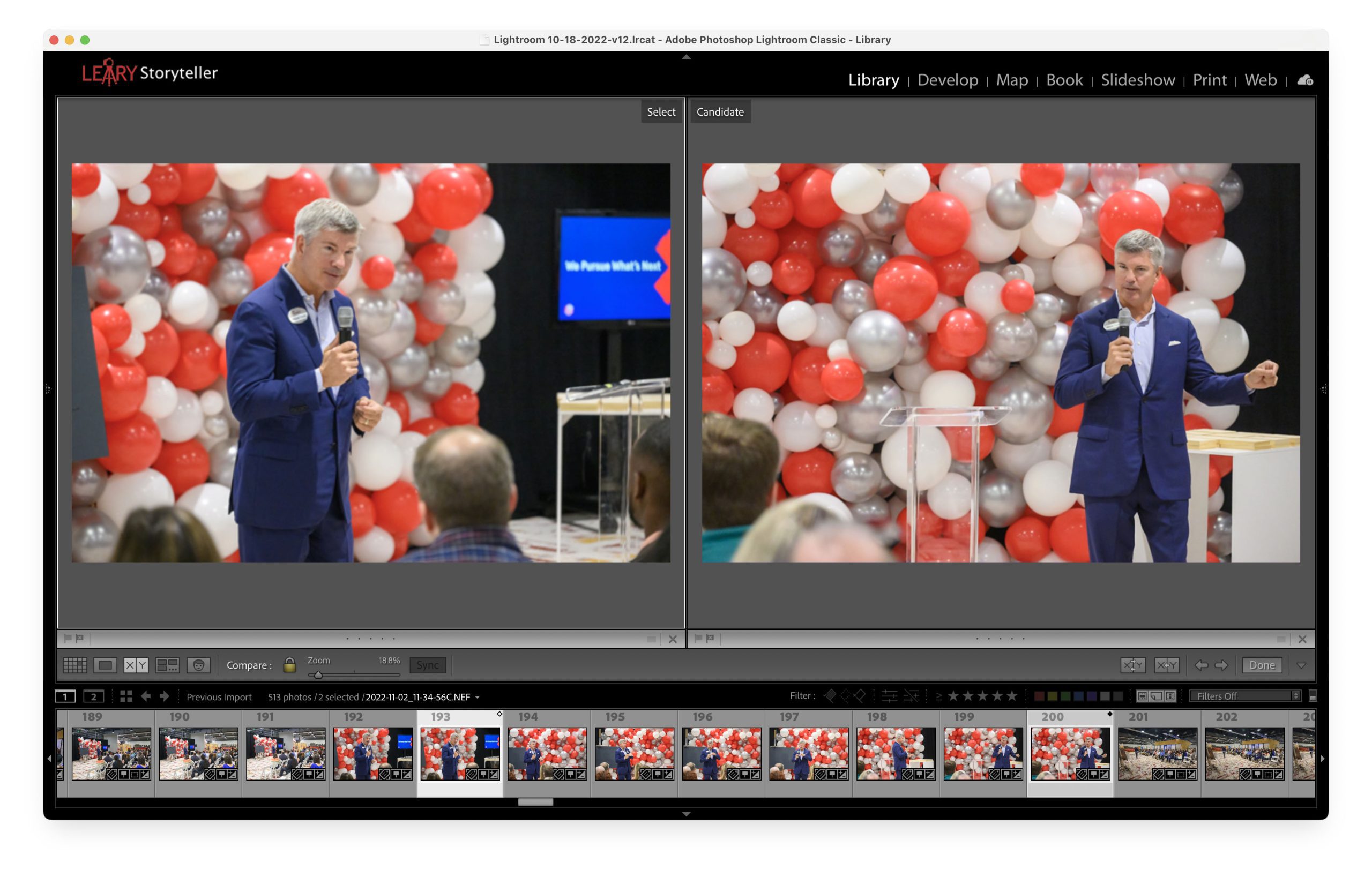
Over the duration of the game, I captured approximately 3,900 images. That works out to lots of frames — but that’s part of shooting action sports: lots of motion, moments, and misses. From those, I narrowed to 436 usable images — images I considered suitable for storytelling, focus, composition, exposure, and color.
From that 436, I judged roughly 20 images to be at the “wire-service submission level”. These would be the ones I would consider sending in if I were providing coverage for a sports news outlet or wire feed: strong play, crisp freeze-action, good light, telling emotion, minimal noise/color issues.
Insights & Tips for Hobbyists
Since many in my audience are advancing their visual-story skills or covering events for nonprofits/businesses, here are some takeaways:
- Don’t fear high ISO: Pushing ISO is often necessary when the light is low. With modern full-frame mirrorless (like the Z9), you can go to ISO 25600 and beyond and still get results you can work with — provided you expose well and manage focus. Underexposure will make noise worse.
- Auto ISO is your friend in variable light. Using Auto ISO (with caps or limits) allows you to maintain a consistent shutter (and aperture) while letting the camera compensate for light changes. This is efficient for sports under lights.
- Custom white balance saves time: Especially with artificial or mixed lighting, using a tool like the ExpoDisc to set a custom WB before you shoot gives you a color baseline. It reduces surprises in post and frees up more time for narrative, composition, and storytelling.
- Pre-capture/buffer functions are valuable: When shooting live action, the difference between hitting the shutter a split-second too late and missing a key moment can be a missed key moment. Using pre-capture (or high-frame-rate burst) functions helps you catch those decisive moments.
- Lens choice matters: A zoom like the 100-400 gives flexibility of reach and framing. The specific lens I used is praised for sharpness, handling, and VR (vibration reduction), which are all important in a low-light sports scenario. And when you’re pretty far from the field, reach communicates the story better.
- Be ruthless in selection: Shooting nearly 4,000 images and extracting fewer than 500 usable images shows the behind-the-scenes work. As storytellers, we’re not just aiming for images —for those few that tell the story, evoke emotion, show context, and freeze a key moment.
Final Thoughts
Covering the Georgia Tech vs. Auburn exhibition game reminded me why I love sports photography for nonprofits and brand-story contexts: the human emotion (win, loss, effort), the motion, the environment under the lights, and the texture of the moment. With the proper gear setup (Z9 + 100–400mm), settings (Auto ISO + pre-capture), white balance control (ExpoDisc), and an intentional selection process, I was able to generate a gallery of images that don’t just show activity — they tell the story.
If you’re heading out to shoot a night game or event under challenging light, I encourage you to test your gear, consider custom white balance, set smart Auto ISO parameters, be ready to shoot lots, and then pick smartly. The hard work in the gallery is in the editing as much as in the image capture.
Thanks for reading. If you like, I can share a short “behind-the-scenes” video clip or slideshow of highlight frames from this game (with commentary on settings per frame). Would that be useful for your workshop or blog audience?