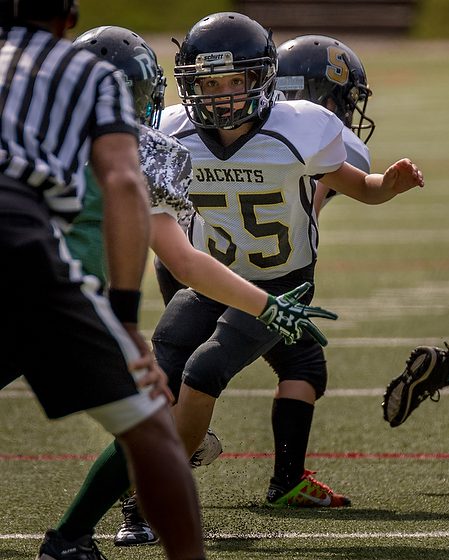
Why youth football is so much fun to photograph

Reading Time: 3 minutes

Nikon D5, Sigma TC-2001 2x, Sigma 120-300mm ƒ/2.8 DG OS HSM | S, ISO 1800, ƒ/5.6, 1/4000

Youth football is a dream come true for most sports photographers. The games are played mainly during the sunlight, and the access to the action is the best you can get compared to shooting high school varsity football which is usually played on a Friday night under poor lighting conditions and limited access.

You do not have to own the most expensive lenses to get great photos. You can get a great telephoto lens for anywhere from $500 to $2,000 to cover your kid’s games.

Sigma makes a 150-600mm lens for about $989. I shoot with the Sigma 120-300mm with a 2x teleconverter most of the time for football.

During the daytime, there is enough light to shoot at most shutter speeds and apertures of your choosing. On a Friday Night football game, you are shooting 1/500 and wide open aperture under those lights to get an image.

Nikon D5, Sigma TC-2001 2x, Sigma 120-300mm ƒ/2.8 DG OS HSM | S, ISO 1100, ƒ/5.6, 1/4000

Here are my tips for those wanting to start shooting your kid’s youth sports activities.

  • Use a lens of at least 300mm – For the money, I recommend a zoom like the Sigma 150-600mm
  • Use Auto ISO
    • Set the lowest ISO to 100
    • Set the highest ISO to the one recommended by the camera manufacturer as top of the normal range
    • Set the Shutter Speed to 1/4000 
  • Shoot in Aperture mode since the Auto ISO is taking care of the shutter speed
  • Custom White Balance
  • Use a monopod
  • Shoot close to wide open as possible. If shooting with a ƒ/1.4 lens, this may be too shallow of depth-of-field. ƒ/2.8 to ƒ/5.6 is an excellent range to make the background go blurry
  • Position yourself so that the action is coming towards you and that you are where you can see the athlete’s faces
  • Shoot RAW 
  • Use Adobe Lightroom to process your images
Nikon D5, Sigma TC-2001 2x, Sigma 120-300mm ƒ/2.8 DG OS HSM | S, ISO 1600, ƒ/5.6, 1/4000

Parents are in love with the “environmental portrait.” They love a good photo of their kid in uniform on the playing field. I think of these like the trading card photos you see of your favorite pro players. By the way, today, it is easy to make trading cards of your kid and maybe their team. Here is a link to doing it. 

Nikon D5, Sigma TC-2001 2x, Sigma 120-300mm ƒ/2.8 DG OS HSM | S, ISO 1100, ƒ/5.6, 1/4000

I was in the end-zone in all these photos of the youth football game. Because I am using the 240-600mm lens [because of the 2x converter], I can get some pretty good action shots without running up and down the field. I am just waiting for them to come to me.

Nikon D5, Sigma TC-2001 2x, Sigma 120-300mm ƒ/2.8 DG OS HSM | S, ISO 1800, ƒ/5.6, 1/4000

I shot these for my friend to use as a gift to him. Maybe you know someone with kids who play ball and could use some photos of their kids. 

Why is youth football so great to photograph? As compared to Pro Football, here are some things that are different.

  • You don’t need a press pass
  • You can get closer to the action
  • You can get by with less expensive gear since you are shooting in daylight
  • Parking is an ease
  • No one is expecting your images right away [if you had access to pro sports, you are shooting for someone who has an absolute deadline]

Nikon D5 & Fuji X-E2 Shooting Live Theatre

Reading Time: 3 minutes

Nikon D5, Sigma TC-2001 2x, Sigma 120-300mm ƒ/2.8 DG OS HSM | S, ISO 22800, ƒ/5.6, 1/500

I have a daughter in theatre, and I enjoy using my photography to connect with her through her plays and musicals.

I have been shooting the latest performance using Nikon D5 and Fuji X-E2. Let me start by jumping to the end for you. I wish I could blend the two cameras, and then I would be happy.

What I loved about the Nikon D5 was I could shoot at ISO 45600, which also let me use the shutter speed of 1/500.

Nikon D5, Sigma TC-2001 2x, Sigma 120-300mm ƒ/2.8 DG OS HSM | S, ISO 45600, ƒ/5.6, 1/500

What I loved about the Fuji X-E2 is that because it is a mirrorless camera, it is much quieter.

Fujifilm X-E2, FUJINON XF 55-200mm, ISO 800, ƒ/4.4, 1/60

Now the Fuji lens has image stabilization. As long as the actors were still, I could get excellent images. However, most of the time, ISO 6400 was the top I could get out of the Fuji, which limited the shutter speed to about 1/200. This was only possible when the stage was well lit.

They often dim the lights in theater to where you need a much higher ISO.

Fujifilm X-E2, FUJINON XF 55-200mm, ISO 6400, ƒ/4.8, 1/200

Now I tried shooting with the Nikon D5 in Live View, which lets you shoot silent. It grabbed a screenshot. However, it is only a JPEG, and most of all, the autofocus sucked. Even Nikon tells you as much. This is on page 45 of the manual.

The only reason I wouldn’t say I liked the Nikon D5 was the noise of the shutter as compared to the Fuji. In every other respect, I preferred it.

The Fuji images put side by side with the Nikon D5 were very acceptable. As long as the actors were not running around, then they were excellent.

The main downside of the Fuji is the focus didn’t lock in as fast as the Nikon D5. If it went out of focus, it would hunt.

Then Nikon D5 was extremely quick with focus.

If I could have made the camera as quiet as the Fuji, I would have never shot the Fuji. In live theatre, you don’t want to draw attention to yourself and distract from the performance because of the camera.

I chose to shoot more with the Fuji based on the sound of the camera more than anything else.

Fujifilm X-E2, FUJINON XF 55-200mm, ISO 1600, ƒ/4.8, 1/200

Here are some more photos for you to see, the camera, and the settings.

Get-R-Done is being performance driven

Reading Time: 3 minutes

Nikon D5, Sigma 35mm ƒ/1.4 DG Art, ISO 360, ƒ/1.4, 1/100

Comedian Larry, the Cable Guy, is credited with coining the American phrase Get-R-Done. I will let Larry explain its origin and meaning.

I have watched my daughter and her friends Get-R-Done for the last five weeks with Shakespeare’s play Twelfth Night.

My daughter is right in the first photo with her friend Jessica. They are also the president and vice-president of the high school theatre club.

The highest levels of performance come to people who are centered, intuitive, creative, and reflective – people who know to see a problem as an opportunity.

–– Deepak Chopra
Fujifilm X-E2, FUJINON XF 55-200mm, ISO 2000, ƒ/3.9, 1/60

I watched my daughter as she designed the costumes for the play. Some were made from scratch, and others were bought at the local thrift store and modified for the period. Her shopping all happened just five weeks ago.

By the way, the rest of the cast was just as busy. They made this quite an elaborate set. This project involved much more work than the musical production they did for ten weeks last year.

Fujifilm X-E2, FUJINON XF 55-200mm, ISO 800, ƒ/4.4, 1/60

Now, at the same time, they are memorizing their lines. This is like learning a foreign language if you haven’t read Shakespeare. It takes time to say the words and understand what you are saying.

I recorded the play last night for my parents, who couldn’t attend the performance. Listen to some of it and see all the sets and costumes for yourself.

Fujifilm X-E2, FUJINON XF 55-200mm, ISO 2500, ƒ/4.5, 1/60

I watched the students’ passion rise so much that tears would pour down their faces. They were frustrated when the lines were justified and did not come as quickly as the material they had previously ordered.

I watched the cast struggle with the old English of Shakespeare.

Then, I watched as the students calmed down and took the time to work with each other, helping them understand a scene and how they worked to improve it.

Learning their roles in the play also helps them figure out their societal roles. First, they knew how blocking and purpose were necessary for their part and how they acted even when they had no lines but were on stage.

How about you?

You have a lot on your plate for your work. Do you Get-R-Done? As Larry, the Cable Guy says, this is when you give it your all and give 110%.

Like all these high school students realize, they repeatedly practiced, so the audience understood. They wanted to perform at a level where the storyline made the audience laugh and cry.

Is all the work you are doing today behind closed doors going to WOW the audience? Are you as passionate about your play as these students are?

Don’t lower your expectations to meet your performance. Raise your level of performance to meet your expectations.

Ralph Marston

Lessons learned from Shakespeare, Bill Clinton, and Steve Jobs

Reading Time: 2 minutes

Our house is quite busy this week. My daughter has not only been memorizing lines for her role as Olivia in Shakespeare’s play Twelfth Night, but she has also been making all the costumes for the actors.

When you study Shakespeare, you soon realize how revolutionary he was, and I think creatives today can learn a lot from him.

The English language owes an outstanding debt to Shakespeare. He coined over 1,700 of our common words by changing nouns into verbs, changing verbs into adjectives, combining words never before used together, adding prefixes and suffixes, and devising wholly original words.

In Twelfth Night, here are some of the words he created:

  • Improbable Fiction
  • Laugh yourself into stitches
  • Out of the jaws of death
  • consanguineous
  • control (n.)
  • dexterously
  • hobnob
  • lustrous
  • malignancy
  • to negotiate
  • whirligig

Innovative

I think what creatives today can take away from Shakespeare is the importance of innovation rather than just variations within a style.

Shakespeare created “Advertising”–that is, he made the word. Likewise, photographers use the word “exposure” extensively in their craft.

At the root of his word-creation lies a problem. I believe Shakespeare was solving the problem of how to talk about life when the terms just didn’t exist. He helped the audience understand the storyline by addressing the lack of words to describe certain elements.

The key to our success is our ability to tackle new problems and develop new solutions.

“I feel your pain” – Bill Clinton.

Your business success requires your ability to have genuine empathy for a client and the challenges they are facing. Your ability to communicate that empathy is key to your success. For example, bill Clinton’s huge debate moment was when he could connect with the American people, talk about their problems, and connect with them emotionally.

After the debate, Clinton shortened this into his slogan, “I feel your pain.”

Steve Jobs, like Clinton, articulated the problem that users experience with mobile phones before introducing the iPhone.

“Business School 101 graph of the smart axis and the easy-to-use axis, phones, regular cell phones are kinda right there, they’re not so smart, and they’re – you know – not so easy to use.”

Jobs, like Clinton, then argued that Apple was the right company to tackle the problem because it had done so before.

“We solved it in computers 20 years ago. We solved it with a bit-mapped screen that could display anything we want. Put any user interface up. And a pointing device. We solved it with the mouse. Right?”

Steve Jobs’ rollouts of new products are studied today by marketing experts just like we study Shakespeare in schools.

Just watch Steve Jobs bring up problem after problem and then show how the new iPhone will handle this for you. Although this was an hour-long presentation, the audience was on the edge of their seats because he continued to introduce new problems and their solutions. The iPhone was to revolutionize how you will do life–and it did just that for our culture.

What Problems Are You Solving?

You want to be successful, so solve others’ problems. Those who rise to the top serve others.

Did you know that your problems tend to disappear when you focus on others’ issues and help solve them? The key to your happiness is to serve others and make them happy.

Mr. Robot appeals to the cerebral audience–Especially visually

Reading Time: 3 minutes
 
Fujifilm X-E2, Fuji XF 18-55mm, ISO 400, ƒ/2.8, 1/125

Rami Malek picked up the Emmy Award for Outstanding Lead Actor for his role in “Mr. Robot.” Malek had the perfect Elliot line to deliver: “Please tell me you’re seeing this too.”

“I play a young man who is, like so many of us, profoundly alienated,” Malek said, which lives with social anxiety disorder and clinical depression in the show. “And the unfortunate thing is I’m not sure how many of us would want to hang out with a guy like Elliot.

“But I want to honor the Elliots cause there’s a little bit of Elliot in all of us.” Todd Campbell, the director of photography for Mr. Robot, helps make the show visually cerebral. This approach helps to connect the show to the nerds. For a writer’s concept to truly connect with cinema, a director of photography helps to bring out the writer’s moods and tone through the visual. The cinema-photography is writing with light to compliment the words to bring the audience along with the storylines.

Fujifilm X-E2, Fuji XF 18-55mm, ISO 500, ƒ/3.2, 1/60

Campbell’s use of the negative space helps to make the audience’s eyes wander through the scene. By not using a lot of movement in a shot, the audience has time to ponder the scene.

Fujifilm X-E2, Fuji XF 18-55mm, ISO 800, ƒ/3.6, 1/60


Most movies today have more than 50% of the scenes being close-up shots. This technique makes you wonder what is outside the frame to engage the audience.

Fujifilm X-E2, Fuji XF 18-55mm, ISO 400, ƒ/2.8, 1/60

When you go close, you wonder what is beyond the frame.

Fujifilm X-E2, Fuji XF 18-55mm, ISO 400, ƒ/2.8, 1/60

You see what is going on going much broader, but your eye wonders much more. In this process, you start to write your visual narrative even more. For me, this is a much more cerebral exercise for the audience, and if you pause long enough on your visuals, the audience will start to take it in. Here is the trailer for Mr. Robot.

[youtube https://www.youtube.com/watch?v=Oc-AsN7d1wg]
To appeal to the nerds and deep thinkers, you have to give them the content that allows their brains to engage and process the content. Mr. Robot does this not just with the storyline, but the visuals help genuinely engage the audience in a way rarely done within cinema today.

Maybe the most significant reason Mr. Robot is such a big hit is that it is unconventional. By being different, the show’s creators appear to be revolutionary. For me, it is a style I grew up in magazine photojournalism.

To me, Mr. Robot proves that the audience is not just ready for much deeper storylines but craving them. They are tired of the quick sound bite and the simplistic close-up visuals. Instead, people enjoy thinking to keep up with the storyline.

Understanding Copyright and Cost of doing business isn’t the secret to success

Reading Time: 5 minutes
 
 
Nikon D3S, AF-S NIKKOR 28-300mm f/3.5-5.6G ED VR, 4–Alienbees B1600, ISO 200, ƒ/11, 1/160

For the past 20+ years, the photography community has been pushing for photographers to know their rights. So naturally, copyright is at the top of that list. Right next to it was, you know, the cost of doing business.

I even perpetuated many of these tips that photographers needed to know to be sure they were running a healthy business.

Before 2002 quality images were hard to come by versus today, where almost daily, the amount of well-exposed, in-focus images happens faster than we can calculate. The reason I picked the year 2002 is that is when a 6-megapixel camera went from $25,000 to under $2,000. The price reduction made it very affordable for the masses.


Today there are so many images available that, for the most part, photography is now a commodity.

As photographers were pushing for more from customers and trying to explain why they must get more money, the customer needed them less and less.

Let me start the business lesson we never did for photographers in the past. We need to start running our business based on the customer/audience.

Nikon D100, Sigma 70-200mm f/2.8 EX DG APO OS HSM,, ISO 200, ƒ/22, 1/160

What is the customer’s problem?

The best possible customer for you is the one going through a significant crisis. You can be the superhero and help save their business. You can see their problem and have a solution that will not only fix the problem but also help them be more successful.

The reality is that this is your only kind of customer. Businesses don’t spend money on things that will not help them reach their objective. At least we know they cannot afford to do that very often without going out of business.

Next, you need to figure out how much it costs to provide that solution to the client.

If you don’t know the problems you are solving for a business, you cannot figure out what you need to be doing in the first place.

[Nikon D5, Sigma TC-2001 2x, Sigma 120-300mm ƒ/2.8 DG OS HSM | S, ISO 36000, ƒ/5.6, 1/4000]

Do the math

Now, this math you are going to do has two parts. First, you have ongoing expenses, which you must spread over all your jobs. Your prices are not just what money you need to pay for your home budget but also your business budget. Your business budget includes your gear, costs to find out about customers, and expenses to communicate to them about your solutions. Remember, you have to do all this because they may not hire you, and you still have to pay for it.

It would be best if you spread this cost of doing business over all your jobs throughout the year. Maybe that figure is about $600 per average job you must build into the price.

Next, you must do your math again and add up all the expenses to do the specific job to solve this client’s problem.

You add these together, and this is what you must make to stay in business.

How you arrived at this price or what this figure is should never be discussed with the client. Therefore, your pricing breakdown is for you only.

Now, if you have a client, for example, in a ditch with their car in the middle of nowhere, and you have a tow truck and are there to help them, you are in a great position, especially if they are in a hurry. So this is when you can get a lot more money than had you been in a large city with many more options for the customer to choose from than just you.

Take the time to know your market and what others are charging.

Determine your Target Audience

Now, you have a problem if the going rates are lower than the figure you need to charge. You will need to convince people somehow that you are a better solution. That is possible because an oil change can run from $19.95 to $20,000 for a Bugatti Veyron.

Believe it or not, there is a formula for true luxury, and it is called the Intrinsic Value Dependency Index. Now I am not an expert in this, but in general, a product must be of the best quality and, in the process, creates a space in its own market. This item must be rare as well. True luxury comes with over-the-top service as well.

When you get a $20,000 oil change, they are doing a lot more than you driving into a bay and staying in the car while they change your oil. Instead, they offer your wine, Champaign, or an excellent latte. Good chance they even picked up your vehicle from your home and brought it back to you at your convenience.

Once you know the figures you need to charge, see the marketplace, and decide where you want to be in that market, you not only set your price, you create a marketing plan to execute.

You have a website, portfolio, brochures, business cards, and other materials you will use to help showcase your work, which is a solution to the customer’s problem.

Going back to the side of the road with our customers in distress, you give them your sales pitch. I am here to help you. I can have my limo driver come and pick you up and take you to where you need to be next, and while that is happening, I can get your car out of the ditch and bring this to the repair shop of your choosing. If you don’t have a repair shop, you prefer I have a few that I regularly use that will work with your insurance and get you back up and running.

They love it and ask you how much. You give customers the price, and they gladly pay. Your limo driver picks them up, offers them some beverages, and takes them to their appointment.

Your business is about you solving other people’s problems. The key is more than the cost of doing business, copyright, or having the latest camera gear. Knowing your client first and foremost is the key.

Photography/Video/Multimedia is the tool for solving problems for customers. Those who are the most successful are not waiting by the phone like a plumber getting a call because a toilet overflowed. Instead, the most successful are Steve Jobs creating products to solve problems for clients they didn’t even know they had until they saw the solution.

Summary:

  1. Start with the problem of the client
  2. Come up with a solution to that problem
  3. Know all the costs involved in providing that solution
  4. Create the sales pitch that addresses their problem with your solution and how the outcome will look if they use your services.
  5. Create a price that will cover your costs and help position your services within the marketplace. Hopefully, one that is a luxury and not a commodity.

The secret to a successful business is focusing on solving clients’ problems.

Mr. Robot conjures up the photo style of photojournalist Don Rutledge.

Reading Time: 3 minutes
Portia Doubleday and Rami Malek in the pilot episode of “Mr. Robot.”

I love the depth in the imagery in the cinema-photography.


by Don Rutledge

I was talking to my long-time friend Ken Touchton on the phone. We had both talked about the TV show Mr. Robot.

Watch On-Line Now Here

We were talking about the photography style of the show, and quite frankly, it is unique. We thought today’s large screen TVs of LCD Sizes 32, 40, 42, 46, 52, 55, 70, and 82 were bringing the cinema into our homes. Instead, the BIG SCREEN has finally arrived so that the director of photography for TV shows is no longer limited.

John Howard Griffin, the author of Black Like Me, is walking down the street in New Orleans. Photo by Don Rutledge.

In the last show that Ken Touchton watched, he turned the sound down and just watched and studied, and this was when he realized it was like watching Don Rutledge’s photography once again. In this 1956 photo of John Howard Griffin walking down the street, you can see the similarity of using the negative space.

by Don Rutledge

Now, running Don’s work in a newspaper was more difficult than in a magazine. The designer would take a photo like the one above in a magazine and run it across two pages. Sitting in your lap, it has the same effect as a 55″ TV screen would have across the room–Cinematic as we might call it today.

Using negative space like this helped Don create positive and negative moods to help tell a story.

by Don Rutledge

Don had a way of finding an incredible scene and then letting the scene unfold with the people moving in and out of the frame. You will see this over and over in Mr. Robot.

by Don Rutledge

This photo of a Russian pastor is an excellent example of a composition style used in the Show.

by Don Rutledge

When two people are in the photos in Mr. Robot, you see this quite often.

Here is how Don Rutledge has shot some street scenes in the past.

By Don Rutledge

Don created tension by playing things off of each other in his compositions.

While the director of photography for Mr. Robot is doing what they think is unique, it has been around a long time, just harder to see in the media when it started in magazines like LIFE magazine back in the 1950s.

While most of today’s video is 50%, the closeup Mr. Robot is pulling upon the style of the great photojournalists like Don Rutledge.

Who’s your Audience?

Reading Time: 3 minutes
 
Nikon D750, AF-S NIKKOR 28-300mm f/3.5-5.6G ED VR, ISO 7200, ƒ/5.6, /500

When Jimmy Carter became president of the United States in 1977, the world started to hear about being a “Born Again” Christian.

Many years later, I would be in seminary, where Wes Black, my youth education professor, opened my eyes to understanding “Born Again.” Professor Black pointed out that in the scripture of John 3:1-21, Jesus was talking to Nicodemus specifically.

Nicodemus was a Pharisee who was a member of the Jewish ruling council due to being born into his family. His status in life was due to his parents. Jesus was pointing out that his value must be placed solely in God and not in things of this world. He needed to be “born again,” or as in Greek, it meant to be “born from above.”

“Born Again” was the starting point for the lecture that day many years ago in Professor Black’s class. Black would talk about how Jesus would speak to the woman at the well, to those he would heal, and to help us see that each time the message was different. He didn’t tell all of them they needed to be “Born Again”; he only said this to Nicodemus.

Fujifilm X-E2, FUJINON XF 18-55mm, ISO 6400, ƒ/2.8, 1/75

Dr. Black shifted from the scripture and went to the whiteboard, and started to draw the map of a school. He then labeled the different rooms and places around the campus. One room was the band room, another art, then the library, on to the cafeteria, and then the other end of the school had the shop class and the gym. He drew a tree out front of the school and talked about where the smoking students would hang out.

Then room by room, Black asked us how we would talk to them about God. People talked about God being like the coach or the quarterback in the gym. When we got to the library, where many geeks hang out, someone said God is like ROM. ROM is strict; read-only memory refers to hard-wired memory in a computer that the computer relies on to work.

It was becoming quite clear that the lesson was that before you can communicate who God was to a person or group, you must know them. You had to know their terminology.

Moses had predicted that Jesus would be the greatest of all the prophets. He expected that he would be the greatest of all communicators.

Dr. Wes Black opened my eyes that day in class as to one of the biggest reasons Jesus was such a great communicator–Jesus started with the audience.

Nikon D5, Sigma 35mm ƒ/1.4 DG Art, ISO 100, ƒ/1.4, 1/800

To communicate honestly, you must understand your audience. You cannot assume the same way you spoke to others will work with the new audience. For example, you cannot believe that if you are interested in the subject, they will be. Also, you cannot assume they will understand why they need to know something unless you communicate this.

Too many Christians went around telling people they needed to be “Born Again.” Their most significant mistake is the audience had little in common with Nicodemus.

Do you know your audience? 

Shot the photo, Now the Poster & The Banner

Reading Time: 2 minutes

I posted last week how I shot this promotional shot. Here is that link if you missed it.

After I took the photo, I created an 11″ x 17″ poster that they could put up around the school and in the community. So if you are around Roswell, Georgia, this next couple of weeks, you will see this up in the restaurants, stores, and places the public visits.

To make the poster, I brought it into PhotoShop, added the text, and created a drop shadow with the text.

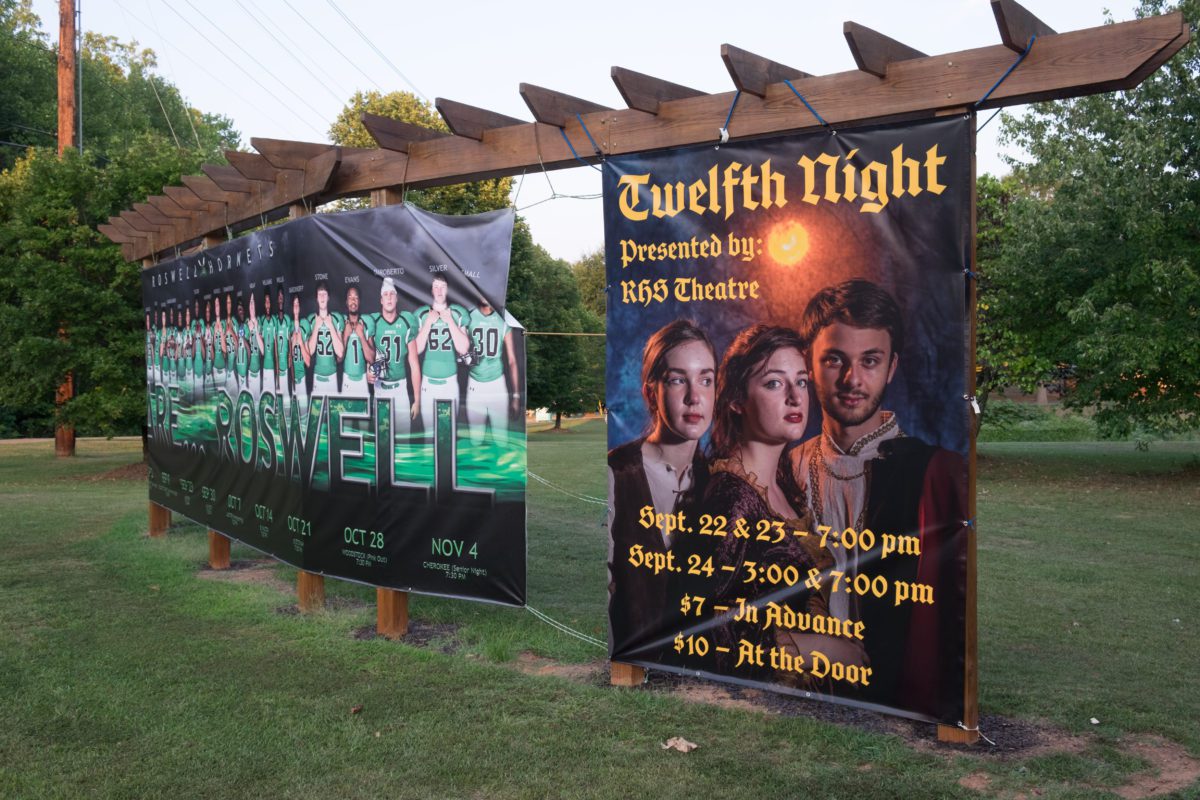
Now to get all the traffic going by the school to know the play is just around the corner, I made a banner 6′ x 9′.

Here you can see me installing the banner with my wife. This will give you a good perspective on the size of the banner.

Here is that banner next to the HUGE football banner.

The feedback we give to first time Multimedia Storytellers

Reading Time: 5 minutes
 
James Dockery, ESPN editor and co-teacher, is in Lisbon with me as we teach the students multimedia storytelling. [Fujifilm X-E2, FUJINON XF 18-55mm, ISO 6400, ƒ/6.4, 1/90]

Each time I teach multimedia storytelling, I find myself sitting with the student and talking about what they could do better.

This summer, I taught in a program the same thing I teach in a workshop, but they needed to have a grade, which required me to write out those tips.

Here is the gist of what I am writing when grading or giving someone feedback on their first multimedia storytelling project.


Since this is the first time you have done multimedia storytelling and have few friends who have been through something like this, you may feel like you are flying blind at times.

When signing up for a course like this, I know most students have often talked to other alums of the classes and decided to take a class based on what those students told them.

These past experiences are to say that, for the most part, the only person helping you with this assignment would have been me. Needing help puts a lot more burden on you to ask more questions and push harder to grasp new concepts.

I saw through the class this grappling with storyline and storytelling. The storyline is the most challenging part of the content to master. If it were that easy to do, there would be blockbusters after another coming out of the studios worldwide.

One of the critical elements of this project is that the success of the project has a lot to do with how well you take ownership and control. Therefore, it requires leadership skills as well as the skills of the technician to capture the content.

You did a great job of adjusting from the first interview to the second time. You showed the concept well with what I call the “Radio Cut.” A “Radio Cut” is where you can close your eyes and listen and get the story as if you were listening to it on the radio.

One area I would encourage you to work on is what I call the peeling of the onion of the story. I thought you did a pretty good job peeling the onion and getting a deeper level than you had in the first round. I believe you will know how to get deeper faster with your subjects in time.

I think it is good to dig more profound because the more you can help the audience understand that this is a problem that is so difficult to overcome and needs a miracle to make it happen, the will not be as engaged.

Zacuto Z-Finder

My advice on the technical side would be to get a viewfinder for your LCD. Many of your shots were slightly out of focus, which is typical if you cannot see the LCD up close.

Fill the 16×9 frame. Make it a cinema piece, and don’t use verticals where you see the black on the sides. Fill the frame.

I would also advise more variety in these shots as both video and stills.

  • 25% Wide Shots – Establishing
  • 25% Medium Shots
  • 50% Close-ups

If you had more time with your subject, you could have shot a lot more and had more b-roll to use while he told us his story through the audio.

Nikon D4, Sigma 120-300mm f/2.8 DG OS HSM, Sigma 2x EX DG APO Autofocus Teleconverter, ISO 1400, ƒ/5.6, 1/2000

Another tip is to fill the screen with a b-roll when someone is talking about things in the past. B-roll is where abstract visuals can help you.

B-roll is where you may have what I call a video portrait of her that can help. For example, the subject is looking out a window, and you slowly move the camera, or it is on a tripod, and they might move just a little.

Fujifilm X-E2, FUJINON XF 55-200mm, ISO 6400, ƒ/4, 1/420

Another thing you could use is what I like to think as visual eye candy shots. Eye candy might be a close-up of water drops during rain hitting leaves. It could be a shot in a room as people walk through the photo. Where you rack focus in and out of focus on elements in your subject’s world. Things like a book, a flower on a table, tools he may use in the job, and something that, when used as a b-roll, is what you might see when daydreaming and looking out a window.

Nikon D5, Sigma 24-105mm f/4 DG OS HSM Art Lens, ISO 10000, ƒ/8, 1/100

For the non-journalistic piece, you can coach the talent/subjects. Their voices sounded the same even when they were talking about killing themselves or running a successful business. Their voices need to have a little more emotions than the same one. Most people need a little coaching and doing several takes until you capture the feeling of what they are saying is necessary. Just as good light can impact the mood of a photo, the tone of the person’s voice can bring mood and emotion to the storyline.

Sequencing needs to keep me on the edge of my seat. Meaning every 10 to 15 seconds, you need to create a little tension. Sometimes this is visual, and sometimes it is in their voices, the words, or something that makes it a page-turner.

Remember this from all that I taught on storytelling. Your clients, for the most part, do not know their stories well enough, or they don’t need you. Also, they don’t know how to take your content and put it together into something for their audience. They need you to take control, capture their stories, and put them into packages for their audience. They also need help with promoting their stories. So individual social media posts to drive people to the “story” are also required. Still, an image with a few words and pointing people to the project on Vimeo or YouTube can not just help the client promote their work but also give them ideas on how to promote their work.

Remember, you are not just telling their stories; you are educating them on how to say to them without you. They will take tips from the process and now be better speakers when they speak due to you helping them see the nuggets of their story. You will help them become more transparent so that, ultimately, their stories move an audience to action.

Can you tell me what you do?

Reading Time: 3 minutes

Photo by Dennis Fahringer


While we do lectures, we are careful to show examples. [Nikon D5, Sigma 24-105mm f/4 DG OS HSM Art Lens, ISO 1100, ƒ/4, 1/100]

If I were to ask you what you do or what does your company do what is your answer? Maybe you start to stumble around trying to find words and even say things like “Well …”

One of the greatest struggles to communicate what you do or what your company does is that words alone often do not do justice to what you do. No matter how well you craft your words it still can fall short. Too often using words alone takes too long and you lose your audience.

Visual content reaches an individual’s brain in a faster and more understandable way than textual information. Or, more accurately, a person’s brain is hardwired to recognize and make sense of visual information more efficiently, which is useful considering that 90 percent of all information that comes to the brain is visual.

We have discovered that showing students the setup and how to do an interview working with a translator improved the results for students. [Nikon D5, Sigma 24-105mm f/4 DG OS HSM Art Lens, ISO 1800, ƒ/8, 1/100]

Storytelling tactics focus on different functions of the brain related to understanding and perception. The brain processes images 60 times faster than text, and 92 percent of consumers want brands to create stories around ads. Because of this, marketers should be delivering linear content with clear narratives and using images to tell their stories.

I work with clients by listening to them and asking lots of questions to help pull out the most compelling storyline that will engage customers to pay attention to what they do. I teach my clients the seven elements they need in their story and then capture that in a visual storyline to build their brand.

A great example of how I did this was with a professor at Georgia Tech. We played basketball together during our lunch breaks. While standing on the sideline waiting for the next game I was just asking what he was working on.

He was creating a bomb detector for about $30. He had presented this a few times but no one was willing to give him a grant. I asked if he would like my help. The solution was simple. By changing his visuals with his story then presented at the next conference and got a $1 million dollar grant.


Size of experimental microneedle array is shown by its placement on the researcher’s finger. There are 400 needles in the array. “Microneedles” much thinner than the diameter of a human hair could be the basis for a new drug delivery technique able to administer small quantities of high-potency medications through the skin without causing pain.

I really do believe that “Seeing is believing” for most of the population. It leads to a way of teaching that “seen evidence” can be easily and correctly interpreted, when in fact, interpretation may be difficult.

Give me a call and let me help capture your story in a visual way so that you too can make what you do understandable to your potential customers.

I also teach this to people in workshops. This summer I taught a workshop in Nicaragua and in Togo, West Africa. In Nicaragua James Dockery, ESPN Video Editor and Jeff Raymond, Director of Visual Communications for ABWE led 9 students through the process of visual storytelling. In Togo, West Africa professor Patrick Davison, UNC School of Media/Journalism worked with Jeff and I in leading 10 students through the same process.

Here are two examples of storytelling done by those students in just one week.

https://player.vimeo.com/video/180096388

https://player.vimeo.com/video/178934277
Give me a call if you want me to help you in telling your story or to help teach your team how to do visual storytelling to build your brand.

Nikon D5 was worth the purchase.

Reading Time: 7 minutes
 
Georgia Bulldog’s Freshman Running Back #35 Brian Herrien Scored his first collegiate touchdown. In contrast, UNC’s Safety #15 Donnie Miles could not stop him during tonight’s Chick-fil-A Kickoff Game on September 3, 2016, at the Georgia Dome. [Nikon D5, Sigma TC-2001 2x, Sigma 120-300mm ƒ/2.8 DG OS HSM | S, ISO 45600, ƒ/5.6, 1/4000]

While I have to know where to point the camera, which does take years of expertise to develop, the Nikon D5 camera is coming through on keeping the camera in focus, with great exposure and excellent dynamic range.

One of the settings I used to help me get this photo is using the 72-point dynamic area of AF.


You want to pick Autofocus Continuous mode for sports.


In the menu, Pencil selections, pick AF Activation under the Autofocus settings.
 
 
Then choosing the AF-ON will mean when you push the shutter release, it will not focus but fire the shutter to take a photo.
 
 
By changing these settings, you will notice the camera will stay in focus and shoot faster frame rate. Great for following a baseball player sliding into a plate and another player trying to tag them, or maybe a football player is running towards you to score. You will find more photos tack sharp in a series.
 
I generally put my focus point dead center and lock it, so I don’t bump it. However, I am trying to get photos of moving subjects, and off-center is too tricky for me. I may crop later for a better composition, but I want the issue to focus first.
 
UNC’s wide receiver #3 Ryan Switzer is tackled by Georgia’s defensive back #2 Maurice Smith & defensive end #51 David Marshall. [Nikon D5, Sigma TC-2001 2x, Sigma 120-300mm ƒ/2.8 DG OS HSM | S, ISO 45600, ƒ/5.6, 1/4000]
The key to getting great photos, regardless of subject, is always preparation. First, it is setting the camera up to execute what you need it to do. Dialing the camera to sports mode on some cameras will come close, but dialing in all the fine-tuning makes a HUGE difference.
 
Georgia Bulldog’s #2 Defensive Back Maurice Smith breaks up the pass to North Carolina Tarheel’s #3 Ryan Switzer in their win over UNC 33 to 24 during the Chick-fil-A Kickoff game at the Georgia Dome on September 3, 2016. [Nikon D5, Sigma TC-2001 2x, Sigma 120-300mm ƒ/2.8 DG OS HSM | S, ISO 36000, ƒ/5.6, 1/4000]
Maintaining focus is very important. You often start following a receiver, as I did here, before the ball arrives. They are not standing still. They also are not running in a straight line. In football, the running tends to be very erratic, and this is where the technology of the Nikon D5 does a better job than every other Nikon that I have ever owned up to this current model.
 
Georgia Bulldog’s #27 Nick Chubb Tailback pushes for more yardage as North Carolina Tarheel’s defense tries to contain him. Georgia defeated UNC 33 to 24 during the Chick-fil-A Kickoff game at the Georgia Dome on September 3, 2016. [Nikon D5, Sigma TC-2001 2x, Sigma 120-300mm ƒ/2.8 DG OS HSM | S, ISO 40000, ƒ/5.6, 1/4000]
Now, this is a tip that has improved my photography more than anything when it comes to photographing sports. Get in a spot where you will see the athlete’s faces. Expressions make a big difference in communicating the effort in a play.
 
 
That is the spot I was in to get all the photos you see in this post other than the one I took in the press box of the halftime bands playing. We had another photographer at the same place on the opposite side of the field. So we had the plays covered.
 
Georgia’s #5 Terry Godwin Wide Reciever is tackled by North Carolina’s #90 Naxair Jones defensive tackle after a reception during the Chick-fil-A Kickoff at The Georgia Dome on September 3, 2016. [Nikon D5, Sigma TC-2001 2x, Sigma 120-300mm ƒ/2.8 DG OS HSM | S, ISO 40000, ƒ/5.6, 1/4000]
In football, if I look into the offense’s faces, then I am where they are trying to go the entire game–The End Zone.
 
Georgia’s tail-back #22 Brendan Douglas fumbles at the North Carolina 12-yard line.  [Nikon D5, Sigma TC-2001 2x, Sigma 120-300mm ƒ/2.8 DG OS HSM | S, ISO 36000, ƒ/5.6, 1/4000]
The other thing is the closer they get to me in the end zone, the more that background goes out of focus. So the most significant plays are often the ones where they are in the Red Zone. The Red Zone is the 20-yard line to the goal. 
 
Georgia Bulldog’s #27 Nick Chubb Tailback is tackled by North Carolina Tarheel’s safety #15 Donnie Miles. Georgia defeated UNC 33 to 24 during the Chick-fil-A Kickoff game at the Georgia Dome on September 3, 2016. [Nikon D5, Sigma TC-2001 2x, Sigma 120-300mm ƒ/2.8 DG OS HSM | S, ISO 36000, ƒ/5.6, 1/4000]
If you notice in all these photos, the players, for the most part, are running right at me. Being in the end zone is like being at the finish line of a track and field event. Now, if you are in the end zone, they run to your right and left, but you are not running up and down the field to get a good angle. So you need the lenses to get the photos.
 
The Sigma 120-300mm ƒ/2.8 DG OS HSM | S lens I have fallen in love with, and it is on sale now for $3,399. 
 
I use the Sigma 1.4x and 2x converters. The 2x makes the lens a 240-600mm ƒ/5.6 lens. The 1.4x makes the lens a 168-420mm ƒ/4 lens.
 
For football, I use the 2x converter almost all the time.
 
UNC’s tail-back #34 Elijah Hood is pursued by Georgia’s defensive back #35 Aaron Davis. Hood had less than 10 carries during the Chick-fil-A Kickoff game at the Georgia Dome. [Nikon D5, Sigma TC-2001 2x, Sigma 120-300mm ƒ/2.8 DG OS HSM | S, ISO 32000, ƒ/5.6, 1/4000]
Now to give those who have older Nikon models some of my insights, here are a few things I love with the Nikon D5.
 
Nikon D5
 
Compared to the Nikon D4 I moved up from, I went from 16 megapixels to 20. The frames per second of 2 more frames have made it where you don’t lose sight of the action. At 12 FPS, it looks like a movie in the viewfinder while shooting.
 
Nikon D4
I gained 3 more stops due to the higher ISO. 
 
Georgia Bulldog’s #27 Nick Chubb Tailback pushes for more yardage as North Carolina Tarheel’s defense attempts to contain him. Georgia defeated UNC 33 to 24 during the Chick-fil-A Kickoff game at the Georgia Dome on September 3, 2016. [Nikon D5, Sigma TC-2001 2x, Sigma 120-300mm ƒ/2.8 DG OS HSM | S, ISO 32000, ƒ/5.6, 1/4000]
Buying a Nikon D5 will not make you a better sports photographer. However, if you understand the technical side of photography, the Nikon D5 will let you better capture what you want to do than earlier model Nikon cameras. 
 

Now, if you are like me, with more than 30 years of experience, you know that you need to keep fresh. You need to practice with your gear like a professional musician does daily. Take the time and shoot kids playing sports in your community regularly and refine those skills, which let you anticipate what will happen rather than react. That is the other massive key to great sports photos. Those who can expect will always be a better sports shooter than someone who responds and shoots. They never get the moment.

One last photo for those interested in the highest ISO I shot at during the game. That was ISO 65535.

Nikon D5, Sigma TC-2001 2x, Sigma 120-300mm ƒ/2.8 DG OS HSM | S, ISO 65535, ƒ/5.6, 1/4000