
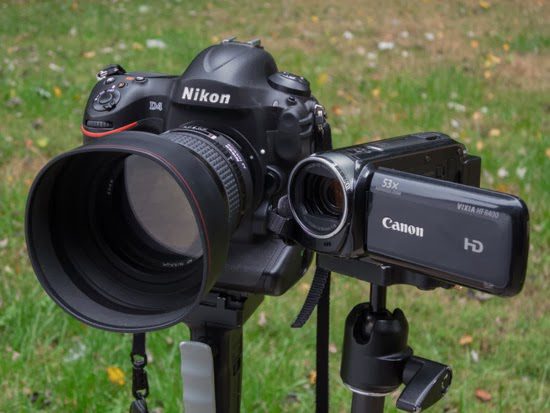
Stills vs. Motion
When photographers photograph people, they can capture decisive moments quickly. They mostly react to what is happening in front of the camera. Those who do it the best are good at anticipating a moment, but still respond to how people behave in front of them. Most photographers can shoot from their hearts because when something moves them, they can capture it.
When a videographer captures something over time, they start rolling and then stop at some point. A videographer cannot just react to a moment and turn the camera on. The videographer must plan the coverage.
The primary difference between shooting stills [photographs] and motion is shooting from their heads. They cannot shoot from the heart. Therefore, they must plan their shot more than the still photographer.


Here is an example of a storyboard from the book Using Your Camcorder by Mandy Matson.
Every book on capturing motion addresses the need to plan your shot list. Everyone recommends storyboarding your shots so you have a good idea of what you plan to get.
Regarding just capturing daily life, it is rare to get the duplicate emotional content that a still photographer will capture because they cannot just react; they must plan their shots.
When filming, videographers not only shoot with a storyboard in mind. They must create emotion through the actors. As we know, one angle can usually improve the emotional moment more than another. The storyboard often has multiple camera angles to jump to, to help make this work. They are filming Dumb and Dumber here in Atlanta. Look at some of the photos shot of the set by John Spink, the AJC photographer, here. You can see the same scene shot by John from two different places on the stage. He could do that because they repeatedly redo the scene for various camera angles or variations from the actors.
In the editing suite, they pick from multiple camera angles and different performances to craft the scene.
As you can see, preplanning is required to shoot a video, and one should not immediately react from the heart.
Sound is the one thing that video has over stills for capturing emotion. Sound is why a good amount of the moving evening news footage is often the interview, where the human voice conveys most of the feeling.
Television news knows the power of the still and uses it all the time for significant news events. For example, Eddie Adam’s photograph from the Vietnam War of the officer shooting the prisoner is always seen on the news when they talk about the war. Of course, they had a film crew who caught the entire shooting, but the still image captured the emotion even more vividly, or they would not have used it in the film.
I believe many of our iconic photographic images of people are where a photographer caught a microexpression. A microexpression is a brief, involuntary facial expression shown on the face of humans according to emotions experienced. They are short, lasting only 1/25 to 1/15 of a second.
Most people do not perceive microexpressions in themselves or others because they cannot freeze the moment to see them. You must slow a video down and look frame by frame to see it running at full speed; the average audience will not see it. The playback speed is why I think video has more difficulty capturing emotions.
The Wizards Project was a research project at the University of California, San Francisco, led by Paul Ekman and Maureen O’Sullivan, that studied people’s ability to detect lies.
Truth Wizards use microexpressions, among many other cues, to determine if someone is truthful. The Wizards Project has identified just over 50 people with this ability after testing nearly 20,000 people. So, the research shows that in real time, most people miss microexpressions.
For me, a photograph’s power is if it captures the “Decisive Moment,” and then the truth-telling makes it a powerful storytelling medium. The picture can capture the storytelling moment that communicates emotion because the audience will have time to see and absorb the moment.
Video or Photograph?
From all my experience, I believe that the best visual storytellers use their heads and hearts.
The still photographer uses their head to plan to be in the right place at the right time. They can anticipate moments due to their knowledge of human behavior on a particular subject.
The videographer knows how to craft a sequence that will pull on your heart as a package—from a videographer’s experience, knowing what has moved their heart in the past.
My suggestion for those telling stories of life happening and not creating stories with actors is to do like so many news outlets do when it comes to communicating news events with a lot of emotion–use stills and the human voice to pull the audience in.