|
Getting your Trinity Audio player ready...
|
This week, the Pentagon said that the firing squad execution of Nidal Hasan, the Fort Hood shooter, will be livestreamed. Defense Secretary Pete Hegseth told a conservative TV outlet the execution would be “public,” and Pentagon officials clarified the next day that it would be livestreamed. The date given is Dec. 3, at Fort Hood.
Executions in the United States have long been closed, tightly controlled events with a handful of official witnesses. A sudden move toward broadcast is a story in itself, and a reporter’s first job is to resist two reflexes: amplifying it because it’s dramatic, and dismissing it because it’s disturbing.
Two historians on a recent Saturday-morning conversation argued the livestream is meant to intimidate. That is an interpretation. It may be right, but a journalist can’t print it as fact. A journalist can establish what changed, who decided, why they say they decided it, and whether the stated reason matches the record.
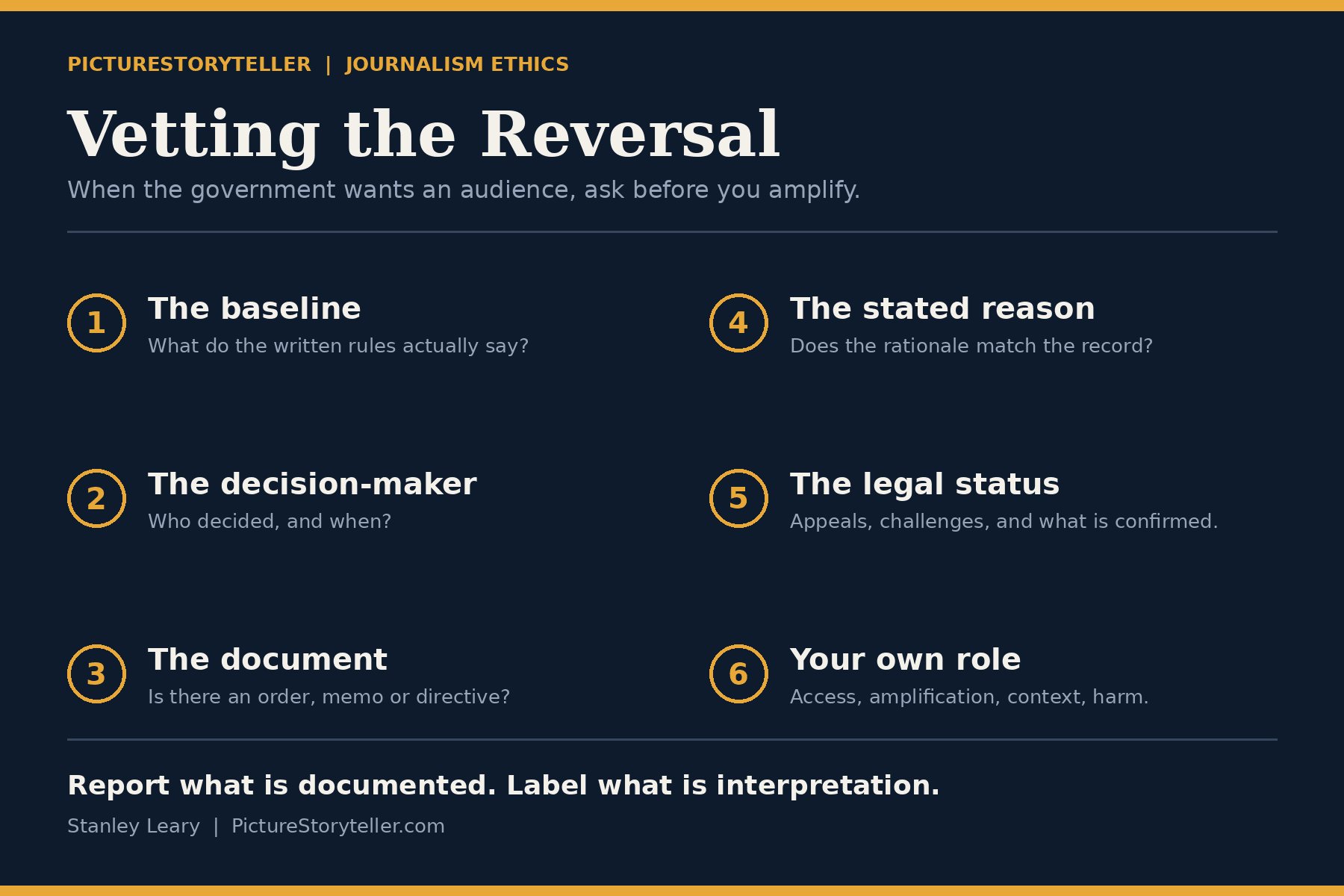
1. Document the baseline before calling it a reversal
“A change in policy” is a factual claim. Before using the phrase, find out:
- What the actual rules say. Look at the military’s governing regulations on executions, including who may witness and whether recording is allowed. Don’t rely on memory or on what “everyone knows.”
- Whether this is a change at all. Is a written policy being revised, or is this a one-case decision? Those are different stories.
- What the historical precedent is. The last U.S. public execution is generally cited as Kentucky in 1936, and its press coverage helped end the practice. Verify the details and the lessons before leaning on them.
The Pentagon’s own account notes the military has not carried out an execution by firing squad since World War II, and its last execution of any kind was a 1961 hanging. That means almost no current staff has carried out one, so ask who is designing the procedure and under what written protocol.
2. Trace the decision to a person and a document
Right now the public record is a television interview and a spokesperson’s clarification. Pentagon spokesperson Sean Parnell said President Trump had approved the execution, and the White House referred questions about the livestream to the Pentagon. That handoff is worth noticing.
- Who made the livestream decision, and when?
- Is there a written order, memo, or directive? Request it, including through FOIA.
- Does the approval of the execution cover the decision to broadcast, or are those separate?
A reporter who can’t get a name and a document should say so in the story.
3. Test the stated rationale
Hegseth’s stated purpose, as the historians quoted him, is to make sure people understand there are consequences for such acts. Treat that as the official explanation and check it:
- Does the justification match the facts of the case, or would it equally apply to past cases that weren’t broadcast?
- Do the people most affected, the victims’ families and survivors, want this? Ask them, and don’t speak for them.
- What do legal experts say about the rules of military executions, the Eighth Amendment, and the dignity of the condemned? Seek out people who disagree.
- Does the timing line up with something else, such as a news cycle or a political event? Timing alone proves nothing, but a reporter can note it and ask.
Seeking motive is legitimate. Asserting it without evidence is speculation. Report what officials say, what the record shows, and what critics and supporters argue, and label each.
4. Check the legal path
The execution is described as set for a specific date. Confirm where the case stands: appeals, clemency requests, court filings, and any legal challenge to the broadcast itself. A date announced on television is not the same as a date that will hold. Several outcomes are possible, and a story that treats the schedule as certain risks becoming part of the spectacle.
5. Decide your own role before the event
This is the question for editors, and for photographers and videographers in particular. If the government produces and distributes the footage, then:
- Access: Will independent press be present, or only an official feed? Who controls the camera, the edit, and the archive?
- Amplification: Will your outlet carry it, link to it, excerpt it, or describe it? Decide on principle now, not under deadline pressure.
- Context: If you use any of it, what accompanies it so that the viewer understands what they are seeing and who chose to show it?
- Harm: What do you owe the victims’ families, the condemned, and the audience, including young viewers?
Staged events are made to be seen, so journalists need standards decided in advance for the images they run, how they caption them, and what they leave out.
6. Separate reporting from commentary, in yourself and your sources
Historians provide valuable pattern-recognition: fear as a tool, spectacle as a message. That belongs in analysis and opinion, clearly labeled. In news reporting, describe what is being done, by whom, and with what stated reason, and let readers weigh the rest. That is not “both sides” balance. It is accuracy: giving weight to claims in proportion to the evidence.
The bottom line
A sudden change in how a government treats its most serious act deserves hard questions. The answer is rigor: the baseline, the decision-maker, the document, the stated reason, the legal status, and your own standards for what you will show. If the goal is an audience, the press decides whether to be one, and how.